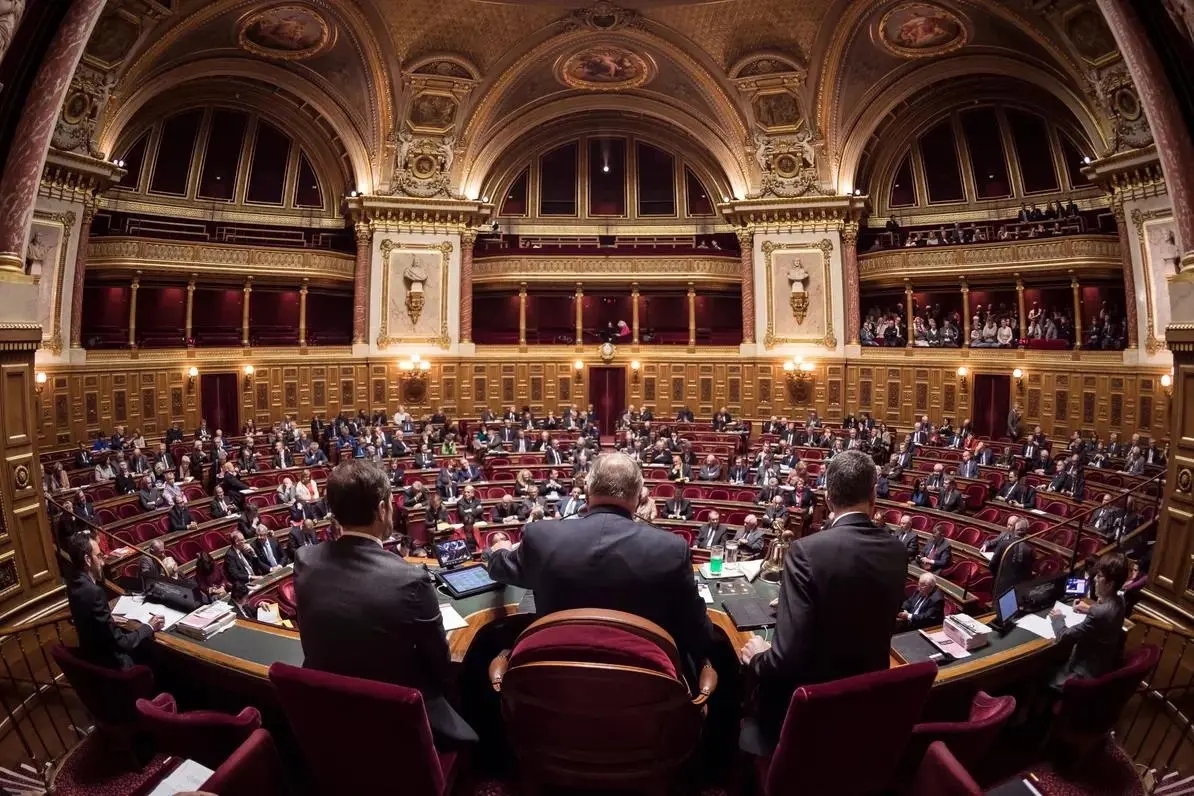
On Sept. 27, France held partial elections to its upper house of parliament on Sunday, with 178 of the Senate’s 348 seats on the ballot. The main takeaway was an increase from three to 14 in the number of senators representing the right-wing populist National Rally and its allies in the Union of the Right for the Republic. Marine Le Pen has already called the result historic, even if a group of this size is nowhere close to big enough to control the legislative body, which remains capable of blocking her populist initiatives. Far more important is the broader trend. The next major date on the French political calendar is April 18, 2027, when the first round of the presidential election will be held. Sunday's results suggest that Le Pen has a real chance of winning it.
Senate elections as part of the presidential campaign
The vote was undoubtedly a success for Marine Le Pen. Her party and its far-right allies had never before had even a small group in the legislature's upper chamber. Yet Le Pen would be wrong to present Sunday's relative success as the guarantee of a second breakthrough: her victory in the 2027 presidential election.
For one thing, Senate elections in France are not direct. Senators are chosen by an electoral college made up of representatives delegated by municipal councils. As a result, a candidate’s party affiliation matters less than their record and reputation in a particular département.
Second, political debate has historically centered on the National Assembly, while senators tend to be less inclined to make high-profile statements. Only a small number of senators, for example, regularly speak out on foreign policy. Finally, the nature of local representation means that the political makeup of the Senate does not mirror the overall balance of political forces in France. In the previous Senate, for example, the traditional Republican right and the centrist coalition held a solid majority, even though their standing at the national level had long been in decline. That balance will remain largely unchanged in the new Senate.
The Senate’s political makeup does not mirror the overall balance of political forces in France
The reasons for this divergence are clear: politics works to a different rhythm at the local level. Voters may agree with the sharp criticisms of the government and established parties leveled by Le Pen or by her opposite number on the left Jean-Luc Mélenchon, but that does not diminish their trust in a good mayor or municipal councilor, even if that person has spent their entire political career in one of those same established parties.
One important conclusion can nevertheless be drawn already. If Marine Le Pen wins the 2027 presidential election, the Senate could become a significant check on her power, particularly when it comes to her plans to amend the Constitution by referendum. The National Rally’s representation in the upper house has grown from negligible to very weak, while the majority remains in the hands of a coalition of moderate conservatives and centrists. The Senate will of course not systematically obstruct a newly elected president (whoever he or she may be), but the populists’ most radical ideas are unlikely to find much support there.
Meanwhile, the presidential campaign is gradually gathering momentum. Even if it has thus far produced no major surprises, there have been some unexpected turns. Few, for example, could have predicted that throughout September all the candidates would be forced to keep discussing gas station prices. Gasoline now costs more than €2 a liter, with diesel even more expensive, at around €2.40. This poses a major and complex problem for the government.
The main issue: the fuel crisis
There are two Frances. One is the France of large- and medium-sized cities, where people can easily get around on foot, by bicycle or tram, and do not rely on cars every day. Given that many drive electric vehicles, it is easy to see why the fuel crisis does not concern them much.
Then there is provincial France, where people commute dozens of kilometers to and from work every day. For them, there is no alternative to the car, and they tend to be people on low or middle incomes who cannot afford anything fancier than an aging diesel Renault.
For them, rising fuel prices have been deeply painful. In September, fishermen were already protesting the fact that every trip to sea had become much more expensive. The anger of provincial France, sudden and fierce, recently found expression in the Yellow Vest movement of 2018-2020 – a nightmare the political establishment does not wish to see repeated.
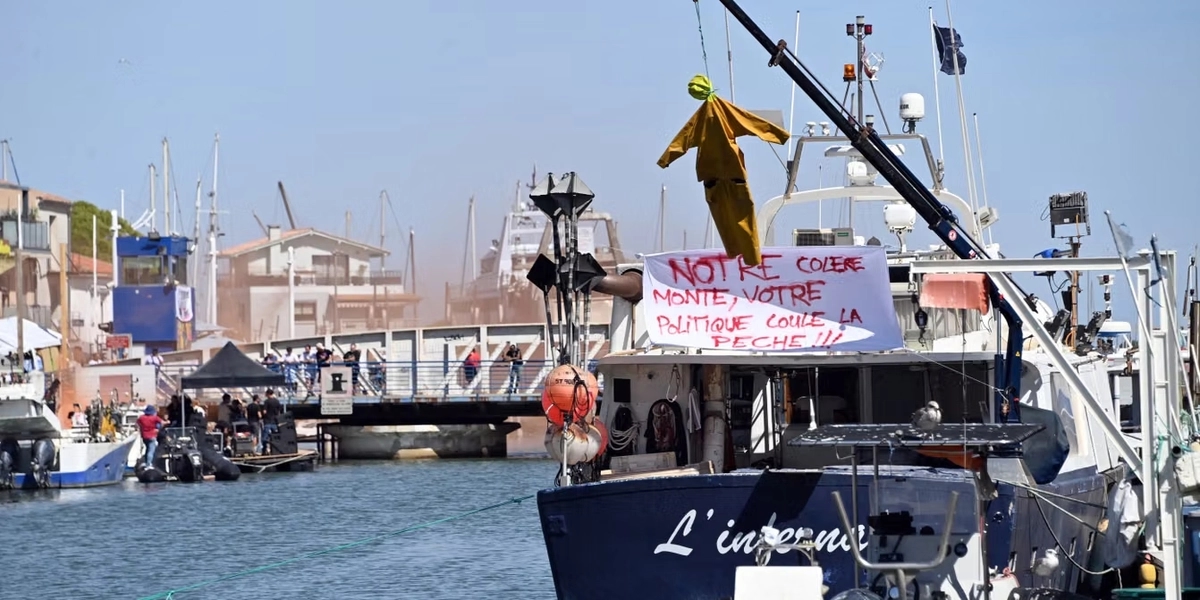
Taxes account for roughly 56% of the price of fuel. Several of France’s neighbors have temporarily cut fuel taxes, at least in part, making it possible to fill up in Germany or Italy at prices that are lower, even if they are not back to pre-crisis levels. However, with a budget deficit of 5.1% and public debt at 116%, the French government cannot afford to do the same, since any loss of tax revenue would only worsen the situation. Meanwhile, France’s debt-servicing costs are now higher than even Greece’s, which was on the brink of bankruptcy just 15 years ago.
The government is offering targeted assistance to people who have to drive long distances or, like fishermen and farmers, need fuel for their boats and farm machinery. But these are only partial measures, weighed down by inevitable bureaucratic complications. With no end in sight to the crisis around Iran, oil prices appear set to remain high, and if they do, social tensions will only grow.
Taxes account for 56% of the price of fuel in France
The presidential candidates may prefer to talk about something else, but under the circumstances there is no avoiding the question: “What would you do about fuel prices?” Le Pen is promising to unveil a plan in October that would slash government spending so deeply that fuel excise duties could easily be reduced.
The left-wing Mélenchon, meanwhile, wants to freeze prices and while raising taxes on the wealthy and on the profits of large companies. Édouard Philippe and other centrists are more cautious, as some of them were in government until recently and understand the scale of the budget problems. They see both extremes – left and right – as forms of unrealistic populism. In any case, the fuel crisis has become one of the main themes of the presidential campaign and could remain so for a long time afterward, especially if it triggers social unrest.
Leading the polls
The frontrunner for the first round of the presidential election is indeed Le Pen, and she remains firmly at the top of the polls, with support above 30% in a field where no other candidate tops 20%. At the same time, her numbers are slightly below their summer peak of 36%, and some pollsters now put her at 31–33%.
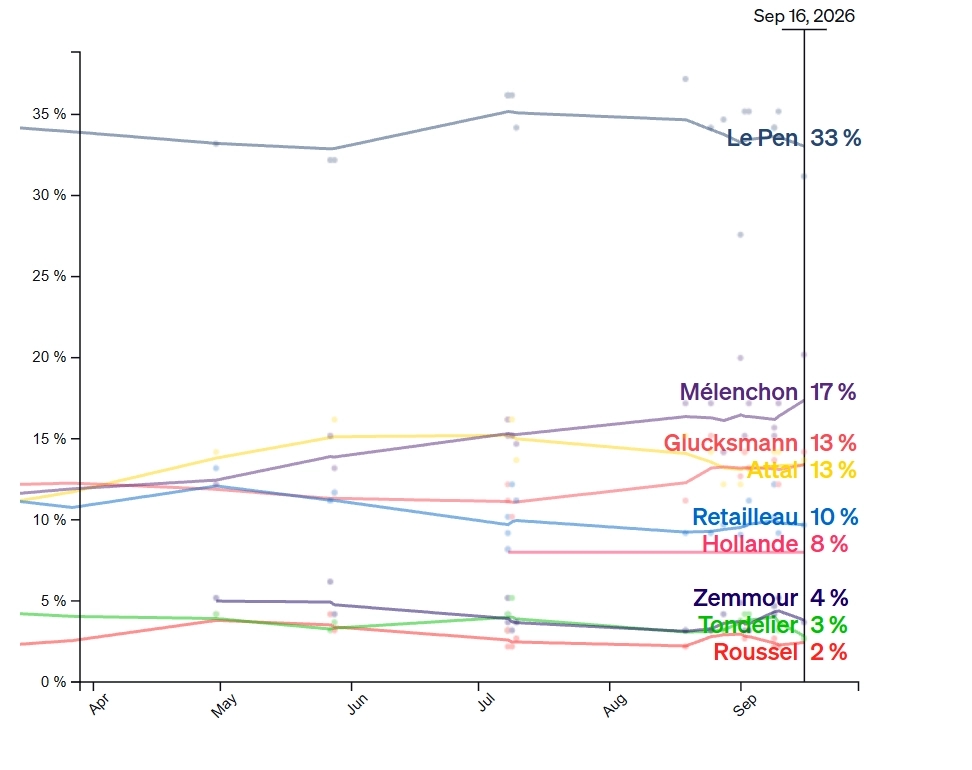
It is worth noting, however, that Le Pen has yet to reveal the details of her economic program, making a substantive assessment of her presidential ambitions impossible.
Le Pen’s support remains above 30%, while none of her rivals has surpassed 20%
What is known for certain? The key slogan of Marine Le Pen’s campaign will be “national priority.” It should not, however, be understood as a translation of Donald Trump’s America First — it is not about settling scores with France’s neighbors or leaving the EU, and is still less about grandiose foreign-policy ambitions.
National priority means tighter immigration rules, withdrawing from international aid programs, and restricting foreigners’ social rights, particularly when it comes to social benefits and housing support. There is nothing surprising about these plans. Marine Le Pen has long advocated lowering the retirement age back to 60 or cutting VAT by saving money on outlays for migrants. She has also promised to sharply reduce aid to Ukraine.
There are two problems with her plans. First, it would be nice to see the figures and scrutinize the calculations of Le Pen’s economic advisers, because there is reason to suspect that the numbers will not add up. France’s huge budget deficit is largely the result of persistent deficits in the pension and social security systems, but instead of reforming them, Le Pen proposes looking for money elsewhere. Some of her ideas may well prove sensible, but the need for fundamental reforms, which she apparently does not intend to pursue, will not disappear.
Second, attempts to put her promised policies into practice could encounter strong institutional resistance. In traditional populist fashion, Le Pen intends to appeal directly to the people by seeking approval in a referendum, including for constitutional amendments. She has little alternative, since it remains unclear whether her party could secure a majority in the National Assembly (to say nothing of the Senate and the Constitutional Council, which would have to approve any referendum) even if she wins the presidential election.
According to the polls, Le Pen remains comfortably in the lead, but the campaign is still ahead. The various contradictions in her program will not trouble her committed supporters, but they may give pause to those in the protest electorate who have the slightest inclination to look beyond the slogans and examine the details.
The battle for the second round
Le Pen still has no serious rival at the top of the race, as her competitors are vying with one another for the right to face the right-wing populist in the second round. A special place in this competition belongs to Jean-Luc Mélenchon, the candidate of the radical-left party La France Insoumise and a perennial contender in presidential elections, where he has typically won around 20% of the vote. Polls currently put him at 19%, potentially enough to carry him into the second round, where he would face Marine Le Pen an a showdown of polar opposites that could end up tipping to the right.
Mélenchon's unfavorable rating is at almost unprecedented levels: more than 60% of French voters say they would never vote for him. A Trotskyist in his youth, Mélenchon has never concealed his hostility toward capitalism in general and the wealthy in particular. His program essentially calls for taking money from the rich by raising every conceivable tax and redistributing the proceeds to the poor in the name of social justice.

Mélenchon’s prospects of reaching the second round would improve if he could unite the entire left behind him, but the Socialists will hold primaries in October to choose a candidate who will have the backing not only of the party but also of moderate left-wing environmentalist movements and trade unions whose members are tired of Mélenchon’s radicalism. Raphaël Glucksmann, a member of the European Parliament currently appears to be the frontrunner among the Socialist candidates. According to polls, he could win around 12% in the first round of the presidential vote. He rejects any alliance with La France Insoumise and could challenge Mélenchon for the support of left-wing voters in April.
Among the centrist and center-right candidates, former prime minister Édouard Philippe currently has the strongest position. Polls put him at around 19% in the first round, on par with Mélenchon. Unlike the Socialists, the centrist camp has no primary planned, and there is no guarantee it will unite behind a single candidate — but if it does, that choice will most likely be made in early 2027, after the current contenders have had a chance to test their public support. Whether Philippe or a different centrist ultimately makes it to the second round, they would prove to be a much more challenging opponent for Le Pen given their potential to unite the electorate against her — as happened in 2017 and 2022, when Le Pen lost to Emmanuel Macron by margins of 32% and 17%, respectively.
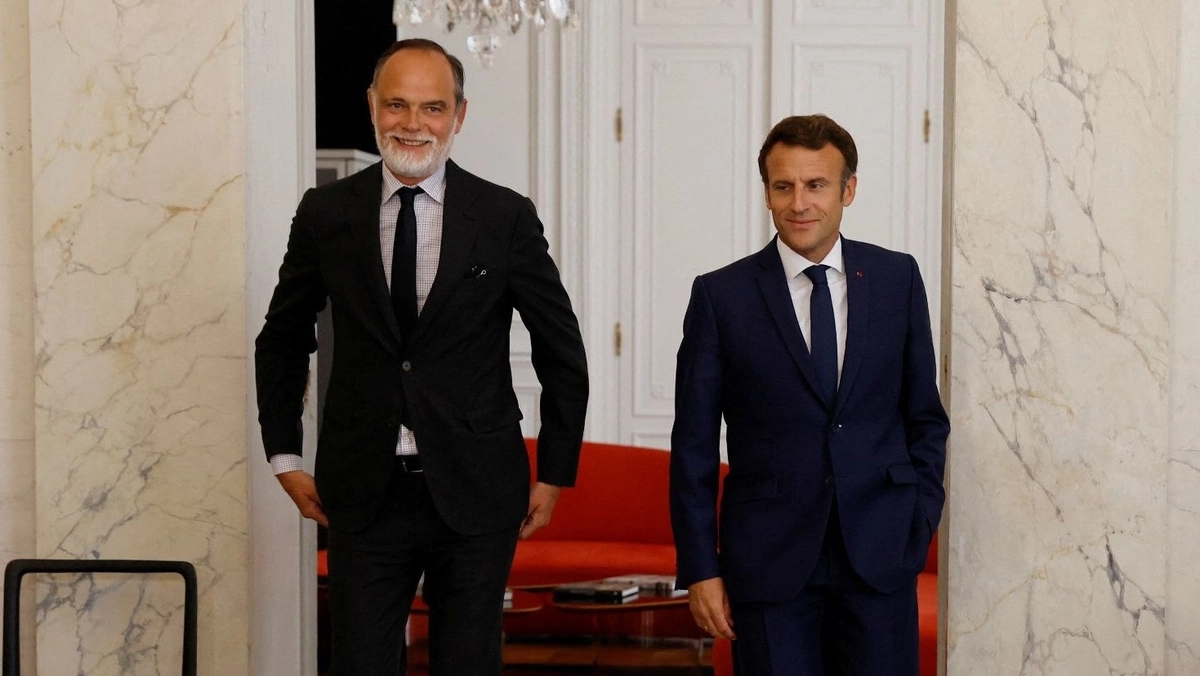
So far, then, the Senate elections have brought no definitive clarity to the 2027 presidential race. Marine Le Pen is riding high, but until her opponent in the second round is known, uncertainty will remain. Much will depend on whether she faces a politician who can unite the left and the center, or a polarizing figure like Mélenchon.
Still, one thing is already clear: even if she wins in 2027, Le Pen will not control the institutional checks on presidential power, particularly the Senate. Her promise to hold a referendum to overcome resistance from the political establishment is therefore almost certain to fail, even if she manages to win the presidency.