On March 20, the Israeli army struck Syrian military positions in the south of the country, framing it as a response to an attack on peaceful Druze in the Suwayda region. Shortly before that, Syria had also been hit by strikes from Iran and the Iran-backed Hezbollah. These episodes once again demonstrate just how complicated Syria’s relations with its neighbors remain just over a year after the fall of the Assad regime in December 2024. Still, the new government is managing (albeit with difficulty) not only to prevent a new civil war, but also to rebuild a complex system of regional and global relationships, all while navigating between Israel, the U.S., Turkey, Russia, Iran, and Lebanon.
“Syrian President Ahmed al-Sharaa wanted to contact the Iranian government to negotiate the settlement of Syria’s debt to Iran, but for some reason no one got back to him.” This was the most popular joke among Syrian internet users during the first days of the U.S.-Israeli operation in Iran. As is often the case, behind this irony lies a genuinely serious problem.
Owing your life to Tehran
Over the years of the civil war that raged from 2011 through 2024, Syria accumulated enormous debts, primarily to Iran. Tehran’s intervention in the early years of the active phase of the conflict effectively saved Bashar al-Assad, even if only temporarily. There is no publicly available figure for Syria’s debt to the ayatollahs’ regime, but expert estimates range from $30 billion to $50 billion, covering not only direct monetary loans but also supplies of oil, weapons, spare parts for military equipment and industrial equipment, and other goods.
Tehran’s motivation for rescuing the friendly Assad regime went beyond alliance considerations. After the Syrian president fled to Moscow in late 2024 and Iranian diplomats were urgently evacuated, journalists discovered in the looted and deserted Iranian embassy in Damascus a detailed business plan for Syria’s postwar reconstruction, one in which Iranian companies were to play a major part.
Inspired, as the document itself states, by the American Marshall Plan for Europe’s post-World War II economic recovery, the Iranian megaproject envisaged active participation of Islamic Republic entities in building a power plant in Latakia, reviving oil fields abandoned due to the war, developing transport infrastructure, and much more. The plan estimated the prospective return on these investments at a staggering $400 billion. In other words, Tehran planned not only to recoup all the funds it had spent saving the friendly dictatorship, but also to earn a substantial profit.
The Iranian “Marshall Plan” estimated the prospective returns on investments into Syria’s rebuilding at a staggering $400 billion
However, after the fall of the Assad regime, Tehran has little hope of breaking even on its investment. In his first speech as the victor in the civil war, Ahmed al-Sharaa made it clear that relations with the Islamic Republic of Iran would be fundamentally reconsidered.
“This victory, my brothers, opens a new chapter in the history of the region — a history full of dangers, which turned Syria into a playground for Iranian ambitions, sowed interreligious enmity, and encouraged corruption,” al-Sharaa said in his speech, delivered like a sermon at the Umayyad Mosque in the capital.
Al-Sharaa has barely made any public statements about Syria’s debts to Iran, but then again, neither have Iranian officials. Only once, just days after Assad fled Syria, Iranian Foreign Ministry spokesperson Esmail Baghaei said that estimates placing Damascus’ debt to Tehran at even $30 billion were greatly exaggerated and had nothing to do with reality. However, the spokesperson did not specify how much money Iran had actually invested in Syria or how much it now wanted returned.
Moreover, Syria has at least one political force — the admittedly marginal Syrian Liberal Party — that demands the president seek $500 billion in compensation from Iran for the casualties and destruction caused by Iran and Iranian-backed proxies over the course of the civil war.
Overall though, there has been virtually no public communication between the two capitals since the change of power in Syria. Tehran tried to establish ties with the new administration in Damascus, but very soon all official contacts became indirect, always involving intermediaries from Turkey, Qatar, or other Middle Eastern states. The Iranian Foreign Ministry describes these contacts in the vaguest and most general terms, refusing to disclose even the subjects of the negotiations.
Russian military presence in exchange for investments
By contrast, the new Syrian government maintains fairly close contact with another key ally of the fallen regime: Russia. Al-Sharaa regularly hosts Russian officials in Damascus and has even flown to Moscow twice for talks with Vladimir Putin. Such close communication with the man who sent regular forces and mercenaries to Syria — forces responsible for committing egregious war crimes and causing thousands of civilian deaths — is striking.
During his visits to Moscow, al-Sharaa called Russian soil “blessed” and praised Russian soldiers, calling them “noble.” Syrian users on X erupted in criticism of their leader, stating, for example, that Russians had killed more Syrian citizens than Iranians have, going so far as to label their interim president as “Putin’s doormat.”
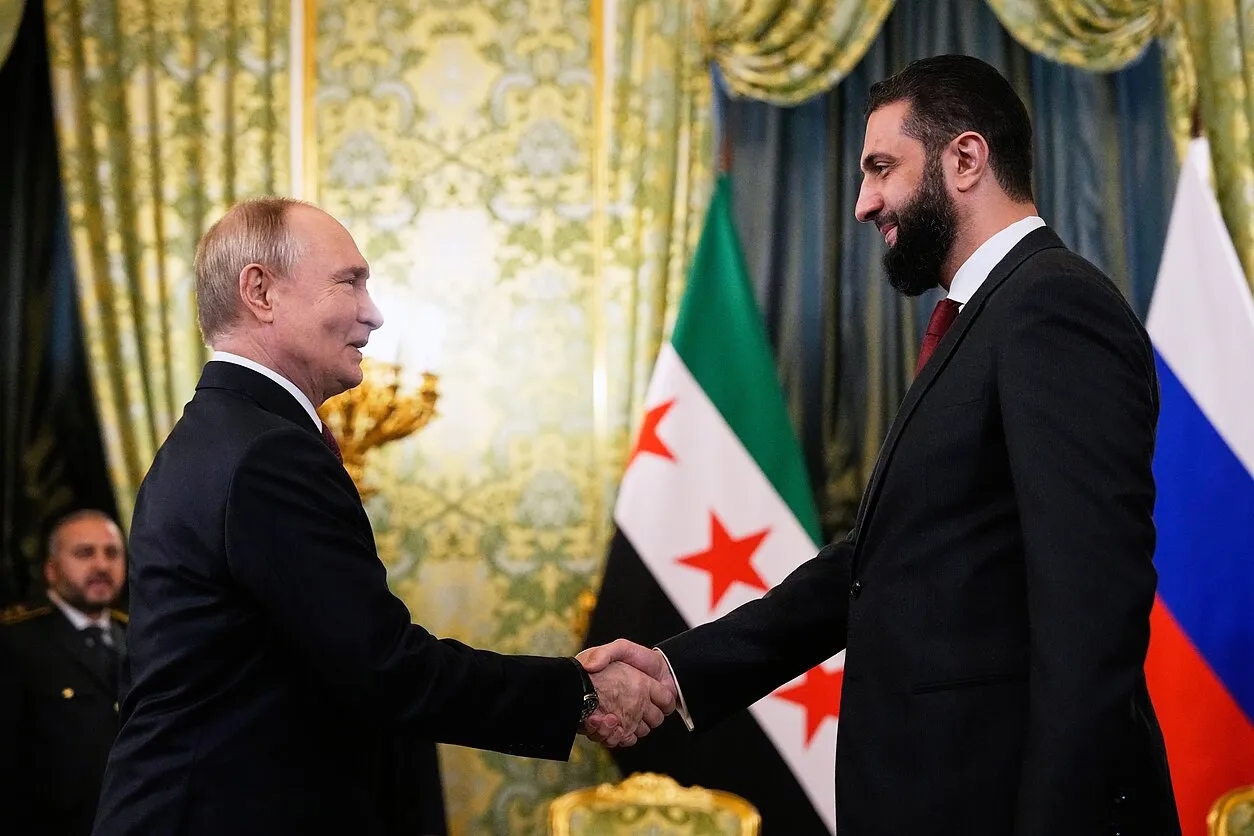
However, the Syrian leader is unlikely to harbor deep affection for Vladimir Putin, who bears direct responsibility for the long nightmare of the civil war. Rather, Syria’s leader appears to be trying to use the Russian dictator’s exorbitant geopolitical ambitions to the benefit of his country.
In theory, it is easier for al-Sharaa to reach agreements with the Russians than with the Iranians. Tehran imposed its ideology and faith on Syrians, building Shia religious centers and mosques in a predominantly Sunni country, and even transferring existing religious sites to the Shia clergy. Tehran also attempted to alter the ethnic and religious composition of Syrian cities by mass resettlement of Shia populations from Iran, Lebanon, and Afghanistan.
Meanwhile, the Russians did not bomb Syria and kill Syrians in order to impose Orthodoxy or bring Slavs to Damascus and Aleppo. Their primary goal was to retain control of the Tartus and Khmeimim military bases — key footholds for the Kremlin’s geopolitical ambitions.
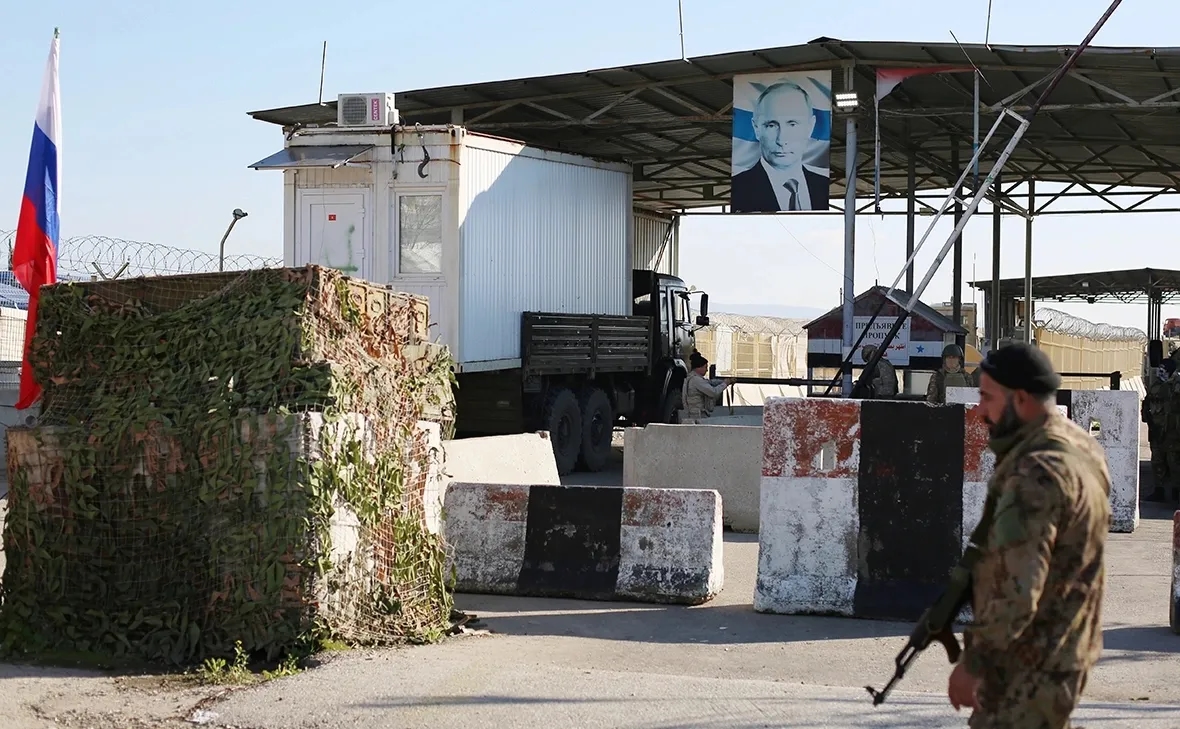
Russia’s Mediterranean bases in Syria serve as logistical hubs for supplying the Russian Armed Forces’ African Corps and other units operating in countries like Sudan, Niger, and Mali. If Tartus and Khmeimim were no longer under Russian control, the transfer of personnel, equipment, and weaponry to Africa would become far more difficult and expensive — if not impossible. The Kremlin, obsessed with the idea of a multipolar world in which Russia is a major power, sees relinquishing its presence in Syria as a painful defeat and a sign of weakness.
Al-Sharaa is well aware of this, which is why he is doing everything he can to leverage Russia’s desire to keep the bases under its control. Primarily, this could involve the cancellation or restructuring of Damascus’s debt to Moscow, estimated at between $1 billion and $2 billion. In addition, Damascus expects Russia to take an active role in the country’s reconstruction after the devastating civil war. The new government seems willing to tolerate a Russian military presence in exchange for debt forgiveness and investment.
Another topic of negotiations between Damascus and Moscow is the fate of former president Assad, who fled to Russia to escape a tribunal — and most likely execution — at home. In talks with Russian officials, al-Sharaa consistently raises the issue of Assad’s extradition. However, it is possible that by insisting on the fugitive’s handover, the new president is looking to secure additional concessions after Russia refuses to comply.
Confrontation with Israel
Of course, there is more to the story than just money. The new Syrian authorities need to counter Israel’s hostile actions, as its army has occupied several border areas, openly supported opponents of al-Sharaa’s administration, and even bombed targets in central Damascus. The Israelis aim to expand the buffer zone between their territory and lands controlled by al-Sharaa, while also weakening the Syrian army by backing hostile groups within Syria.
The new authorities in Damascus are now seriously discussing with Moscow the possibility of deploying Russian military patrols closer to the Israeli border. The calculation is simple: fearing a conflict with the Kremlin, the Israelis would avoid claiming the areas controlled by Russia or supporting armed groups operating there. For now, however, Moscow has made no concrete promises to Damascus. Negotiations continue — just as Israel’s occupation of part of Syrian territory does.
This occupation appears to have come as a highly unpleasant surprise for the new authorities. Early on in his political career, Al-Sharaa (known at the time as the victorious rebel leader Abu Mohammad al-Julani) had expressed a desire to find common ground with Israel and promised that his country would not pose a threat to the Jewish state. In return, he asked the Israelis to abandon the occupation of the Golan Heights and return this Syrian territory, occupied since 1967, to Damascus under guarantees that no troops or weapons would be stationed there.
For Israel, the issue is extremely sensitive. The Golan Heights have long been officially annexed and, under Israeli law, they are considered an integral part of the state. In 2019, during Donald Trump’s first presidential term, the United States officially recognized this annexation, despite UN resolutions and international law both being on the other side of the dispute.
The strange state of an “absence of peace” that prevailed between Syria and Israel during the eras of Bashar al-Assad and his father, Hafez, allowed both sides to ignore the issue of territorial claims. The question of the Golan Heights appeared irrelevant in a setting of mutual hatred, lack of a peace agreement, frozen diplomatic contacts, and tensions constantly teetering on the edge of armed conflict. Now Damascus’s willingness to actually make peace and recognize the Jewish state in exchange for Israel’s compliance with international law disrupts the familiar pattern of their bilateral relations.
Israel might not be opposed to the idea of peace with Syria — but not at the cost of returning annexed territory that has long been fully integrated into the national economy. When Israeli cabinet ministers claim they don’t trust the former Al-Qaeda fighter al-Sharaa — and even call for his elimination, saying that “there are no former jihadists” — it is quite possible they fear not so much his extremist past as they do the territorial complications that a peace process would entail.
Israeli cabinet ministers don’t trust al-Sharaa and even call for his elimination, saying that “there are no former jihadists”
To maintain stability, Israel has relied on a strategy of preemptive strikes against any military targets in Syria that could potentially threaten its security. Without abandoning this tactic (as noted above, Israel has already bombed Damascus under the new authorities), the Israelis are also relying on other methods to deter any potential threat from Syria. For example, they supply the Druze separatists in Syria with food and weapons, pay salaries to Druze fighters, assist them with logistics, and provide medical treatment in Israeli hospitals, insisting that this is a way to protect a friendly community from genocide by the new authorities.
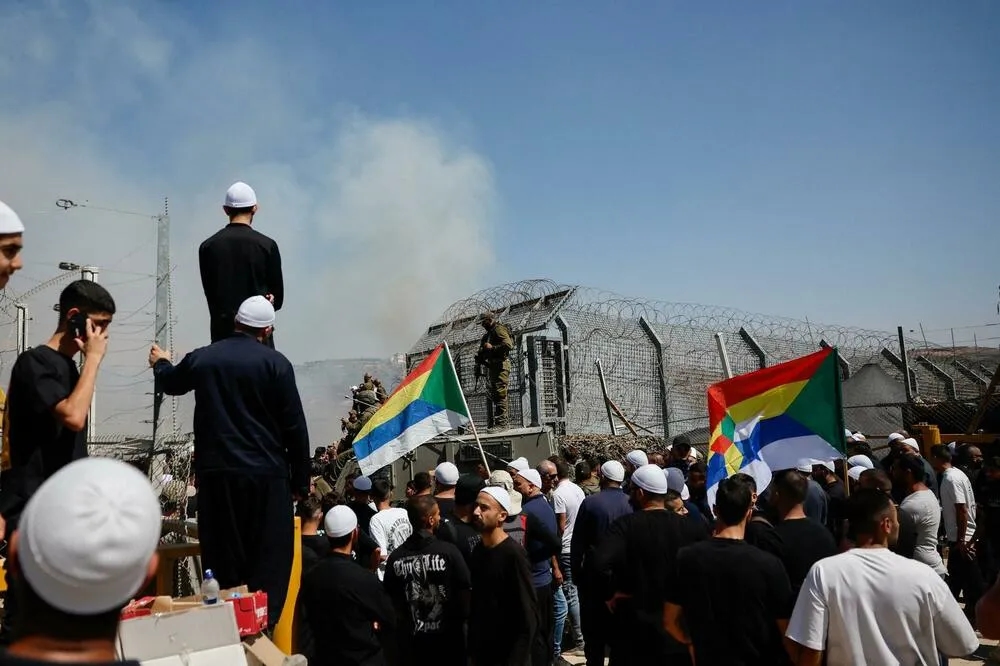
Indeed, many hundreds of Druze fell victim to pogroms in the spring and summer of 2025 at the hands of militants ideologically aligned with the new administration, but the Syrian government condemned the actions of the attackers and launched an investigation into the tragedy. However, the very occurrence of these pogroms gave Israel a pretext to expand its occupation zone in Syria under the guise of saving Druze lives.
Many Druze welcomed Israel’s actions, displaying the Jewish state’s flags on the streets and even beginning to use Hebrew names instead of Arabic ones for the regions where they lived. Several hundred Israeli Druze crossed the border to join the units of their Syrian compatriots.
Angered by the massacre in Syria, some Lebanese Druze also tried to enter the country. The Lebanese army stopped them, and local Druze leaders, while condemning the violence against their co-religionists, also criticized the separatists in Syria. Walid Jumblatt, leader of one of Lebanon’s most influential Druze clans, stated that Israel is not protecting the Druze but merely using the massacre as a pretext for occupation and interference in Syria’s internal affairs. Jumblatt also advocated for maintaining a unified Syria in which the law protects everyone — a position that broadly aligns with the official Lebanese stance on events.
Relations with Lebanon
Lebanon generally welcomed the change of regime in Syria. With a population of 4 million that was still exhausted from its own civil war, Lebanon had to take in around 1.5 million Syrian refugees after the outbreak of the Syrian civil war. The end of the war allowed many of them to return home, noticeably reducing the strain on Lebanon’s social services and economy.
Moreover, the Assads never had much regard for the sovereignty of their small neighbor. In 1976, at the height of Lebanon’s civil war, Syrian troops occupied a significant portion of the neighboring country, remaining there until 2005. Under pressure from Lebanese protests and Western dissatisfaction with the Syrian military presence in a sovereign state, Bashar Assad was finally forced to withdraw his troops. Still, he continued to treat Lebanon as a “fake” state whose territory, in his view, rightfully belonged to Syria.
Until recently, the idea of annexing Lebanon to Syria had some support even among a fringe of the Lebanese population. The Syrian Social Nationalist Party, which advocates for a “Greater Syria,” operates legally in the country, but since 2022, none of its representatives have been elected to parliament. After Assad’s fall, the party became completely marginal.
Another pro-Assad Lebanese political force, Hezbollah, played a key role in Syria’s civil war on the side of Assad’s army. However, after the regime’s collapse, it found itself in a difficult position. Created and financed by Iran, Hezbollah was left without its key land supply route following the change of power in Damascus.
Predictably, the new Syrian authorities blocked all supply routes from Iran into Lebanon that they could identify, including those used for moving weapons, money, and instructors. As a result, Hezbollah has lost a significant portion of the influence it held during the Assad era.
For al-Sharaa and his government, Hezbollah is an obvious enemy, while for the Lebanese authorities, it is a serious destabilizing factor — the “hand of Iran” in Beirut, alternately dragging Lebanon into another war with Israel or provoking domestic political crises by refusing to comply with cabinet orders to disarm.
Under the new Syrian authorities, who show actual respect for Lebanese sovereignty and focus on eliminating Hezbollah, Damascus’s relations with Beirut have a real chance of warming. However, a true breakthrough has yet to occur — in part due to the history between the heads of state. Lebanon’s president Joseph Aoun was the army general who commanded Lebanese army units on the Syrian border in 2017, defeating forces of ISIS and the al-Nusra Front — commanded at the time by none other than al-Sharaa.
Under the new Syrian authorities, relations between Damascus and Beirut have a chance of warming
On another note, Lebanon, with its ethno-religious diversity and absence of a single dominant confessional or national group, has certain misgivings about the Syrian authorities’ preference for privileging the country’s Suni Arab majority.
Overall, just over a year after the change of power in Damascus, it can be said that none of the more extreme forecasts have come true: neither the grim predictions of skeptics who insisted that Syria would turn into one vast jihadi camp, nor the rosy dreams of the al-Sharaa supporters who claimed Syria would quickly resolve all internal and external crises and win over civil society. The leadership in Damascus faces serious challenges of postwar rebuilding, the need to forge a new national identity, and threats from separatists in border regions. Yet even these challenges pale in comparison to the horrors of the civil war the country has already endured.