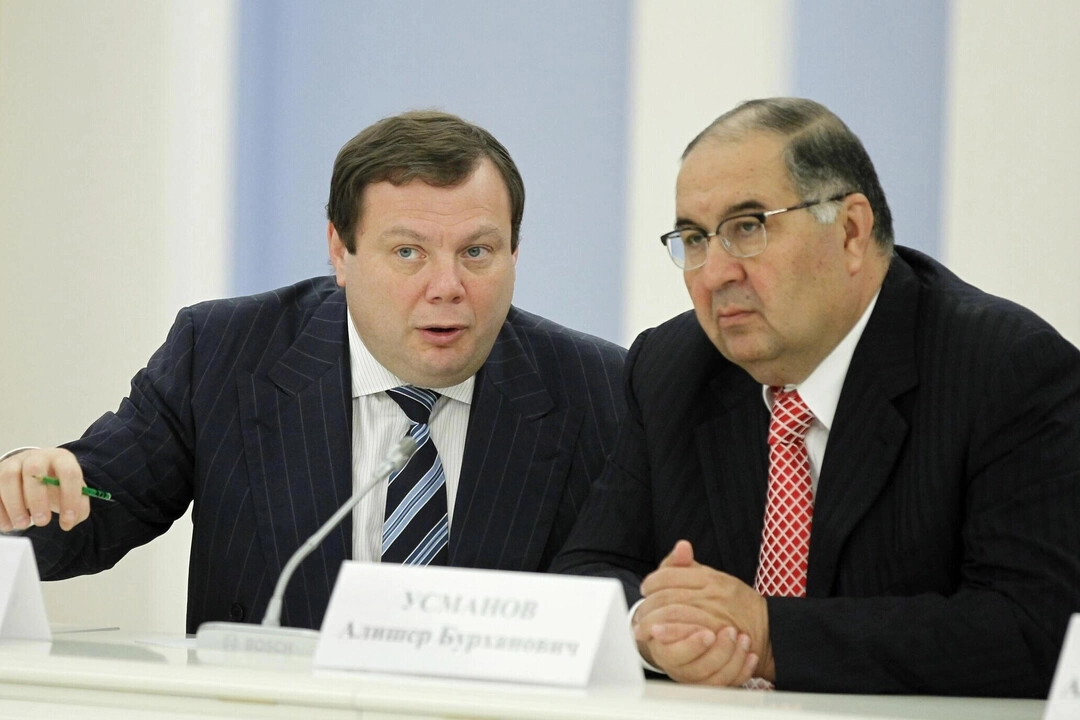

Following the European Union's lead, Switzerland has lifted sanctions on Alisher Usmanov and Mikhail Fridman, even as their lists of nefarious Russian individuals and entities continues to grow. The announcement of new rounds of restrictions, however, should not be taken as a success in itself. After all, sanctions have not reduced the fortunes of Russian billionaires, triggered a split among the elite, or turned big business interests against the Kremlin, economist Vladislav Inozemtsev argues. But it is still not too late to implement the sorts of measures that might actually produce the desired effect.
The recent decision by the EU Council to lift sanctions on Russian billionaires Alisher Usmanov and Mikhail Fridman, followed by a similar move from Swiss authorities, was one of the most controversial steps in the history of the European Union’s sanctions policy toward Russia. Many observers rushed to declare that the entire framework would begin to crumble. Fortunately, such catastrophizing seems premature to me —especially since, as a safeguard, sanctions against the other Russians on the list were extended for three years, while the 22nd package added more than 800 people, bringing the total to at least 4,000. Some sources put the number of Russians subject to various restrictions at more than 13,000 (although the Swiss added “only” 115 new names in its latest round).
My position is well known: I do not consider this instrument effective, or even legitimate. In my view, it conflicts in too many ways with fundamental principles of law. I will point to just three of its most obvious flaws, though there are many more.
First, unlike a sound law, personal sanctions do not apply to an open-ended class of people who have committed a particular act. If Western governments intend to punish Russia’s political leadership for invading Ukraine, it would be logical, for example, to sanction all cabinet ministers or governors. Yet sanctions have never covered every senior member of the government, and more than 50 of the country’s 89 regional leaders remain unaffected (including six in Russian-occupied regions of Ukraine).
If the aim is to target the financing of an aggressive regime, then “influential Russian businesspeople” should include, for example, all 155 dollar billionaires holding Russian passports. In reality, however, the sanctions lists have included between 55 and 65 of them at different times.
If the goal is to designate the Russian army or security services as criminal organizations, then the sanctions have failed here as well, as only a couple hundred out of Russia's 1,400 to 1,800 generals have been designated. This alone suggests that, unlike sectoral sanctions, personal sanctions are an exercise in arbitrary selection and political maneuvering.
Second, the purpose of such sanctions remains unclear. Laws are generally meant to deter people from criminal acts by threatening punishment. If sanctions policy followed the same logic, Western governments would have to specify which acts would trigger restrictions. Had a warning circulated on the morning of February 24, 2022, that any businessperson who met with Vladimir Putin would automatically be put on the list, far fewer people would have attended the president’s meeting with the leadership of the Russian Union of Industrialists and Entrepreneurs that afternoon.
In any case, between February 28 and April 8, 2022, every participant in that meeting was sanctioned, the stated reason being that the person “attended a meeting of oligarchs at the Kremlin with President Vladimir Putin on February 24, 2022.” In other words, personal sanctions have been imposed for actions that were not considered criminal when they took place. By applying the punishments retroactively, they lose their deterrent effect.
Personal sanctions are imposed for actions that were not considered criminal when they took place
Third, sanctions seriously undermine the foundations of Western rule of law by imposing various restrictions (including on property and citizenship rights) without due process. I have often said that EU and U.S. authorities have every right to bar any category of person from any country from receiving visas. But revoking passports or residence permits that have already been issued is quite another matter.
To be clear, it is entirely fair to require businesspeople to sell their assets and move “dirty” money out of “clean” jurisdictions. Freezing those assets, however, is questionable, as it shifts the state’s blame onto its subjects.
Finally, sanctions policy devalues the role of courts. Decisions to impose sanctions are often based on secret information that cannot be disclosed, and when a challenge does succeed in court, sanctions are sometimes reimposed in a new decision on the same grounds. I would go so far as to say that sanctions against private individuals directly contradict the classical concepts of rule-of-law, Western countries have yet to recognize both this reality and its consequences.
Still, given that sanctions are a purely political instrument, the more useful question is what political goals they are meant to achieve and how effectively they reach their intended aims.
Let me be blunt: personal sanctions, like sanctions more broadly, are in many ways an apology by Western politicians for providing Ukraine with too little military aid. They are meant to create the appearance of an active effort to defend Ukraine’s interests in the absence of sufficient actual action. Consider the sweeping sanctions on Russia’s oil and gas industry: in 2026, they reduced the sector’s export revenue by 10 percent, or $23–24 billion, compared with 2021. Yet in the EU alone, at least €800 billion had to be set aside in 2022 to offset the resulting losses.
Sanctions embody Western politicians’ apology for providing Ukraine with too little military aid
Personal sanctions are even harder to explain in this context. They have not reduced the fortunes of Russian billionaires, which rose from $606.2 billion in 2021 to $696.5 billion in 2026. They have not prompted capital to flee Russia (on the contrary, many major businesspeople rushed to bring money back). Nor have they split the elite. Apart from a few Russian tech entrepreneurs, no one left the country, gave up their citizenship, or condemned the war against Ukraine.
The reason, in my view, is clear, and it ultimately comes down once again to the lawless nature of sanctions. Ordinary law allows for a reduced or canceled sentence if someone abandons a crime before completing it, and for a criminal record to be expunged after a sentence has been served or damages have been repaid. Sanctions practice offers nothing comparable. That is precisely why personal sanctions have alienated the most pro-Western social group in Russia, and it has done so with no tangible benefit to the West: no signs of domestic discontent with Putin’s regime are visible even as the disastrous invasion of Ukraine approaches its fifth anniversary.
Personal sanctions alienated the most pro-Western social group in Russia from “Western values”
Can personal sanctions limit the Kremlin’s resources, persuade big business to distance itself from the Kremlin, or secure future compensation for Ukraine? In my view, the likelihood of achieving any of these aims is close to zero.
The West’s practice of immobilizing Russian businesspeople’s assets prompted a sweeping response from the Kremlin. First, it began to pressure Western companies that had condemned the war and tried to leave the Russian market, effectively confiscating tens of billions of dollars’ worth of their property. Then, just as Western governments had done with Russian assets, the Kremlin began placing Western companies under “temporary administration.” A total of 29 companies, valued at no less than 2 trillion rubles ($24.3 billion), have already faced this measure.
It is hard for me to see how these outcomes can be described as “limiting the Kremlin’s resources.” If anything, they have increased the wealth of Vladimir Putin’s inner circle, brought additional revenue into the state budget, and effectively expanded the space for lawlessness by giving it a pretext: it can now be presented not as violations of the law but as a “mirror response” to the actions of Western governments.
Likewise, sanctions have not led businesspeople to distance themselves from the Kremlin. In 2023, Vladimir Putin asked some big businesses to hand over 10 percent of their “extraordinary” profits to the state, a "request" that was unquestionably more attractive than having those same assets completely frozen in Western jurisdictions.
It is also important to remember that, despite major efforts to move money abroad and legitimize it, virtually none of Russia’s billionaires has shifted the center of gravity of their business empires outside the country (tech companies excepted). The only way to achieve the desired “distancing,” then, might have been to fully legalize assets moved abroad and encourage capital to leave — but such a policy runs directly counter to the ideology behind sanctions, and it only could have worked if it had been implemented in the first months of the war. By now, big business has restructured around the new reality and Russian businesspeople have lost trust in the West and its institutions.
Finally, neither support for Ukraine nor compensation for it can serve as a goal capable of mobilizing Russia’s business community. On the one hand, Kyiv has initiated and lobbied for many sanctions decisions against Russian businesspeople — decisions that have sometimes led to the outright theft of their assets in Ukraine. As a result, in the eyes of Russian business, helping Ukraine, which might have seemed reasonable in the early stages of the war, now looks wholly irrational.
On the other hand, with the exception of a few individuals who either serve as “Putin’s wallets” or combine corporate positions with government roles, Russia’s business community bears no responsibility for the war and has no reason to pay compensation to Ukraine. Even after Nazi Germany’s defeat, only a small number of businesspeople were convicted by occupation courts, mostly for producing military goods and means of killing people in concentration camps, or for using the labor of civilians from occupied countries and territories who had been forcibly deported to the Reich.
What can be done about personal sanctions at this point in Putin’s war against Ukraine? In the abstract, I see two possible approaches.
The first is the most obvious and conventional, though it is also controversial. Western governments could, for example, announce that they are prepared to lift sanctions on people who condemn the war, declare that they are ending their cooperation with Vladimir Putin’s regime, and are willing to donate some of their wealth to support Ukraine. This sounds appealing, but I see no way to put it into practice.
On the one hand, all of this can be done only from outside Russia, most likely in countries Russia deems “unfriendly” and are thus difficult for sanctioned individuals to enter. They would also need either to hold substantial funds in the jurisdictions that imposed the sanctions and be confident that those funds would be unfrozen (which is far from certain), or else move significant assets to third countries (which would arouse the Kremlin’s suspicions, an extremely dangerous course for anyone resident in Russia).
On the other hand, such an offer is legally questionable. If these people break with the regime, they will immediately be added to Moscow's lists of extremists, denied consular services, and stripped of their civil rights. That would raise the question of how they could secure legal status in their hypothetical new countries of residence. Moreover, thousands of Russians have already condemned the war, fled Russia, and even provided material support to Ukraine, yet they have not been warmly welcomed in Western countries. It is difficult to imagine those currently under sanctions being greeted any better (and if they were, they would be given priority over Russians who have actually opposed the war all along).
The second course of action is so adventurous that I would not expect Western politicians to attempt it. It starts from the assumption that the war can be stopped only by a change of regime in Moscow, and that the goal should be to split the elite radically, triggering a “war of all against all” at the highest levels of power. This conflict is already simmering beneath the surface. Russia is stepping up persecution of businesspeople suspected of offshore dealings, disloyalty, or moving capital abroad. An “anti-corruption” campaign is also expanding, ensnaring many officials, lawmakers, and judges.
Against this backdrop, Western governments could begin lifting sanctions without announcing anything in advance, explaining that the individuals had been mistakenly placed on the lists as they were not actively supporting the war in Ukraine. They could start with officials and businesspeople whose activities may make the Kremlin uneasy or arouse its suspicions. Such a move would be highly likely to provoke preemptive repression against those against whom restrictions have been eased, prompting some members of the elite to flee.
Given how many Russians are on sanctions lists, Western governments have enormous scope to maneuver. Used skillfully, it could break up many of the financial and organizational ties within Russia’s upper ranks and push the Kremlin into a campaign of arbitrary terror against those who have been and remain loyal to it. This is unlikely to trigger a palace coup or an internal crisis, but it would almost certainly end the unity of the Russian elite that has held since the beginning of the war, founded on the sense that everyone is “in the same boat.”
The West's personal sanctions policy now looks like a complete failure. Its main mistake in dealing with Russian citizens was applying the same measures against everyone. In my view, it would have made far more sense to divide all those the West considers “objectionable” into at least three categories. The first would include those suspected of war crimes: the commanders and personnel of military units, along with those who enabled such crimes (including the country’s top leadership and lawmakers and the leading propagandists who defended those decisions). This group would face the harshest sanctions, which could not be lifted under any circumstances. They would ultimately have to stand trial.
The second category would include people whose economic activity or official position contributes to the regime’s functioning and supports its war effort without rising to the level of war crimes. Sanctions on these individuals could be lifted if they ended that support by resigning their offices or leaving their businesses.
The third category would include people connected to Putin’s system only indirectly — for example, major taxpayers. They should be offered a kind of “green corridor” to escape Putin’s “paradise,” subject to conditions that would prevent them from returning.
Had this kind of categorization been implemented in the first weeks of the war, it might, to some extent, have split Russia’s upper class. Even if there are serious doubts that it could be effectively applied today, the attempt would still have a better chance at success than a continuation of the current policy does.