
Belarus is again maneuvering between the West and Russia, even though its autonomy from the Kremlin has sharply declined since 2020. Minsk has already benefited from freeing some of its political prisoners in exchange for concessions from the United States. Lukashenko is trying to present himself as a potential mediator for talks with Moscow. In reality, however, his contacts with the West are taking place under Kremlin supervision, writes Kamil Kłysiński, a senior fellow at Poland’s Center for Eastern Studies (OSW). The Kremlin, he says, plans to benefit from any easing of sanctions on Belarus.
Having exercised unchallenged power in Belarus since 1994, Alexander Lukashenko has earned himself not only the title of “Europe’s last dictator,” but also a well-deserved reputation as a shrewd international player. Superficially educated, simple and at times even arrogant in his behaviour, the Belarusian leader possessed a rare talent for sensing opportunities and exploiting them to gain specific political or economic benefits, or simply to broaden his room for manoeuvre on the international stage. One must, however, consider whether this once-deserved praise is still valid.
The art of maneuver
By the mid-1990s, it was already clear that the top priority of Lukashenko’s foreign policy would be (re)integration with Russia, the former center of the USSR. The young president of a small country situated in the heart of Europe hoped to outmanoeuvre the ailing Boris Yeltsin in order to become his successor, this time as president of a Union State comprising Belarus and the Russian Federation. Here, however, Lukashenko miscalculated badly. Vladimir Putin, who would not even entertain the possibility of a partnership with a smaller, weaker ally, took his seat in the Kremlin and sought the complete subjugation of Belarus.
Moscow’s assertive, even imperial, policy under Putin has forced Lukashenko, himself an autocrat with a deeply Soviet mindset, to become a sort of defender of Belarusian sovereignty in order to hold on to power.
Moscow’s assertive policy under Putin has forced Lukashenko to become a sort of defender of Belarusian sovereignty in order to hold on to power
Minsk sabotaged progress in the integration process within the Union State while simultaneously seeking alternative directions not only in the political sphere but perhaps above all in the areas of finance and economics in order to reduce its dependence on Russian oil, gas, and trade. Between 2000 and 2020, Minsk cooperated with the European Union and non-European states alike, creating the enigmatic concept of a “great arc in Belarusian foreign policy.”
Although Russia remained the number one partner (particularly in the military and political spheres), Belarusian diplomacy invested considerable effort in diversification, with the most ambitious objective relating to trade. The aim was to achieve a “balance,” with 30 per cent each allocated to Russia, the EU, and non-European countries. This strategy was not ideal, particularly given the differing approaches to human rights and democracy among the various partners. As a result, the Belarus-EU dialogue would break down every few years, followed by long periods of stagnation and isolation for the regime. Cooperation with partners in Africa, Asia, and South America, on the other hand, was hampered by the high cost of logistics as well as mental and cultural differences. After all, for a small country in Eastern Europe, conquering distant markets and building real political alliances half a world away is no easy task.
The watershed year of 2020
The tragic course of the 2020 presidential election in Belarus — namely Lukashenko’s usurpation of power and the subsequent suppression of the resulting protest movement — led to a radical deterioration in the country’s political and social situation, felt most acutely by the section of society that was most critical of the regime and which was therefore subjected to the harshest repression. It also resulted in the collapse of dialogue with the West. Minsk effectively lost the ability to conduct a meaningful foreign policy towards the EU and the U.S. as a period of unprecedented sanctions and isolation of the regime began. The Belarusian authorities were unable to compensate for the loss of EU markets through increased activity on other continents as reality failed to keep pace with the ambitious declarations emanating from Minsk.
As a result, Belarus’s already significant dependence on Moscow increased substantially. Russia now accounts for around 90 per cent of Belarus’s foreign trade and 100 per cent of its oil and gas supplies. It is also the source of almost all remaining loans to Belarus and provides the majority of foreign investment.
The key factor in the Kremlin’s dominance, however, is the joint Russian-Belarusian aggression against Ukraine. The support Lukashenko gave to Moscow in February 2022 led not only to the loss of the highly lucrative Ukrainian market but also, it seems, irrevocably bound him to Putin. The Belarusian dictator, too, faces charges at the International Criminal Court in The Hague, and the country he rules has faced successive packages of sanctions similar to those imposed on Putin’s Russia. Thus, Lukashenko, obsessed with retaining power at any cost, in effect traded a significant portion of his external autonomy in exchange for a guarantee of the Kremlin’s support for the continuation of his absolute rule.
Is Belarus’s foreign policy truly Belarusian?
Russia’s dominance in trade, energy, politics, security, and military cooperation has meant that, in recent years, Belarus has become a de facto satellite of the Kremlin. The degree of dependence is now so high that any strategic actions by Minsk relating to regional security or international policy are either consulted with “Big Brother” or are in fact part of a joint plan, the parameters of which were established on the Russian side rather than the Belarusian.
Any strategic actions by Minsk relating to regional security or international policy are either consulted with “Big Brother” in Moscow or are part of a joint plan
An example of this is the migration crisis on the border between Belarus and Poland, Lithuania, and Latvia that follows patterns previously employed on the Russian border with Finland and Norway. Russian modes of behaviour are also evident in the aggressive narrative of the Minsk regime’s media, in its anti-Western (and particularly anti-Polish) historical policy, as well as in statements by the Belarusian Ministry of Foreign Affairs on current global events. To summarise the issue more succinctly, it can be said that the Belarusian authorities are currently operating in a state of war, having joined the conflict at Moscow’s request (or under its pressure). The struggle is being waged on two fronts: a hybrid battle against the West and a kinetic one against Ukraine, although in the latter case the Belarusian armed forces have not yet been deployed in combat (a fact that by no means implies Belarus’s neutrality).
Having ceded a significant portion of its sovereignty to Russia, Belarus has lost its credibility as an independent actor and player on the international stage. The role of Russian proxy ensures Lukashenko continues to receive political backing from the Kremlin, as well as various subsidies essential to his economy’s survival. Hence the Belarusian leader does not even conceal his coordination with Russia and instead often admits that he has agreed on something with Putin — such as the route and objectives of his tour of African countries in December 2023, which was supposedly intended to be a manifesto of Belarusian foreign policy independence.
Minsk as the “good cop”
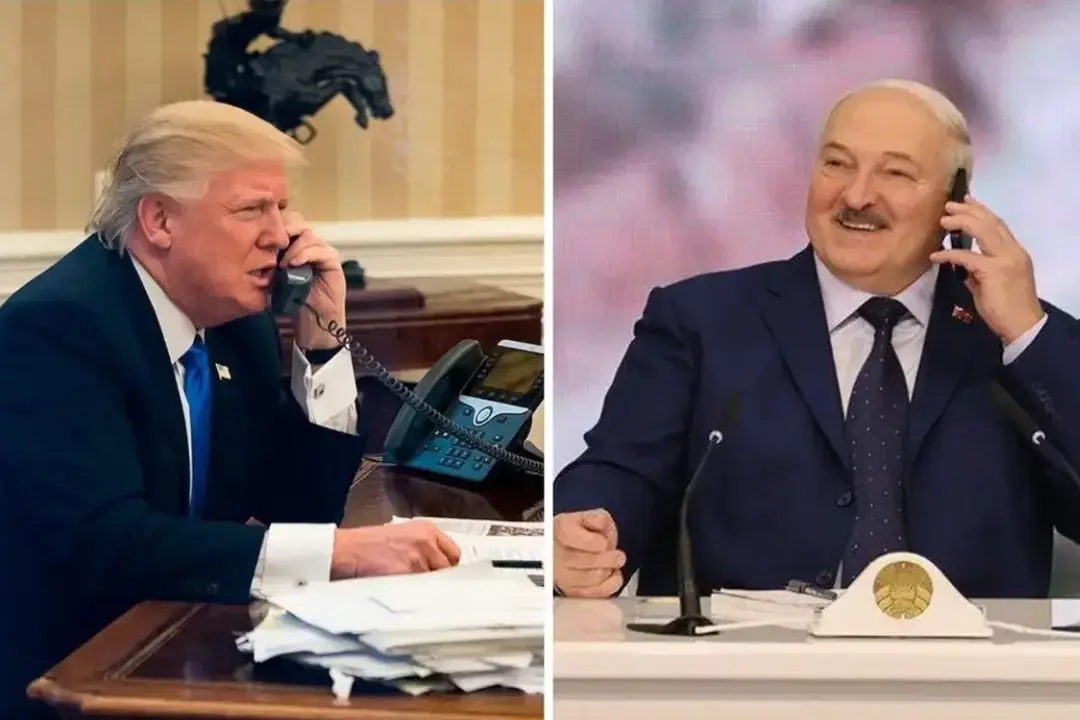
An interesting aspect of the joint Russian-Belarusian foreign policy is the thaw in relations between Minsk and Washington that has been observed since the beginning of 2025, when Donald Trump’s return to the White House signalled Washington’s move away from a principled values-based policy towards a transactional approach. From that point on, every issue in American international relations became subject to negotiation and a cost-benefit analysis.
The context of the U.S.-Russian talks, which proceeded with varying intensity, opened up the possibility of parallel negotiations with Minsk — all the more so given that Trump took a personal interest in Belarus, seeing the potential for a quick success by persuading the regime to release at least some of its political prisoners. Still, despite the fact that several rounds of talks between June 2025 and March 2026 led to the release of over 500 prisoners, Lukashenko nevertheless refused to attend the February meeting of the Peace Council established under Trump’s patronage to resolve the situation in the Gaza Strip.
The Belarusian dictator’s caution was likely the result of consultations with Putin, who also declined the invitation. Thus, despite the appearance of autonomy, Lukashenko operates solely within the parameters set by his Russian protector. Washington’s dialogue with Minsk is, in principle, only possible in areas where it does not threaten Russia’s influence in Belarus; in some cases, the cooperation even benefits Moscow, as evidenced in the lifting of the embargo on spare parts for Boeing aircraft for the fleet of the Belarusian airline Belavia, which opens up potential opportunities for re-export to Russia, where such restrictions remain in place. It can therefore be assumed that, should the Russian-American dialogue break down, the regime will almost automatically follow suit, and the U.S. will once again become a target of Belarusian propaganda.
Looking at Minsk’s rhetoric towards the West, one can discern a recurring theme regarding the “peaceful” nature of a country that “will never attack any of its neighbours” and whose aim has always been “harmony and cooperation.” The pacifist tone evident in this narrative, with its focus on good neighbourliness, can only be interpreted as disinformation given Lukashenko’s close alliance with imperial, aggressive Russia. It therefore appears that, as part of the division of tasks between allies, Minsk has been assigned the role of the milder, more conciliatory state — one that, if necessary, can act as a mediator in peace talks.
Minsk has been assigned the role of the milder, more conciliatory state — one that, if necessary, can act as a mediator in peace talks
Belarusian diplomacy is building on its image of success from 2014–2015, when the Belarusian capital was indeed the venue for talks between European leaders and Putin, culminating in the signing of the Minsk I and Minsk II agreements. The aim of the current maneuver, however, is primarily to create divisions among EU member states: between those ready to accept Minsk’s “friendly” offer and those that can be held responsible for the poor state of relations. In the Belarusian authorities’ calculation, the erosion of European unity in its policy towards the regime could pave the way for the easing of EU sanctions, which are far more painful than U.S. restrictions.
A useful subcontractor
The Ukrainian authorities were quick to recognise the risk of a gradual dismantling of Western sanctions regimes, hence the radical shift in Kyiv’s policy towards Minsk observed since January. In order to discourage its Western partners from improving relations with the regime, the Ukrainian side has in recent months been hyping the alleged threat of military aggression from Belarus — a claim that has no basis in reality but which nevertheless forces Lukashenko to make increasingly frequent assurances of his readiness for war. At the same time, the dictator declares on every possible occasion that he does not actually want war.
Both sides, in Minsk and in Kyiv, know that the scenario of a unilateral Belarusian aggression is unrealistic and that a threat will arise only if Russian units are concentrated in Belarus, as was the case at the turn of 2021 and in 2022. After all, the Belarusian army could field only 15,000-20,000 of its best-trained soldiers for a potential offensive.
The Belarusian army could field only 15,000-20,000 of its best-trained soldiers for a potential offensive in Ukraine
Another significant factor is the pacifist sentiment within Belarusian society — as well as within the army itself, among both soldiers and officers. Aware of this, Putin is unlikely to put pressure on his ally, so as not to inadvertently destabilise the internal situation in Belarus, nor to discredit a loyal satrap who has provided and continues to provide extensive support (logistical, political, propaganda, etc.) for the Russian dictator’s aggression against Ukraine.
Nevertheless, the trading of accusations continues. This state of affairs is advantageous for the Kremlin as it allows it to maintain a state of uncertainty regarding the risk of an additional northern front opening up in the war with Ukraine, which would pose a serious challenge to the Ukrainian authorities and high command. In light of the arguments set out above, any speculation about the involvement of Belarusian troops in an attack on one or more NATO countries is even further removed from reality. Russia does not appear ready for this either, at least until it has secured a decisive victory in Ukraine.
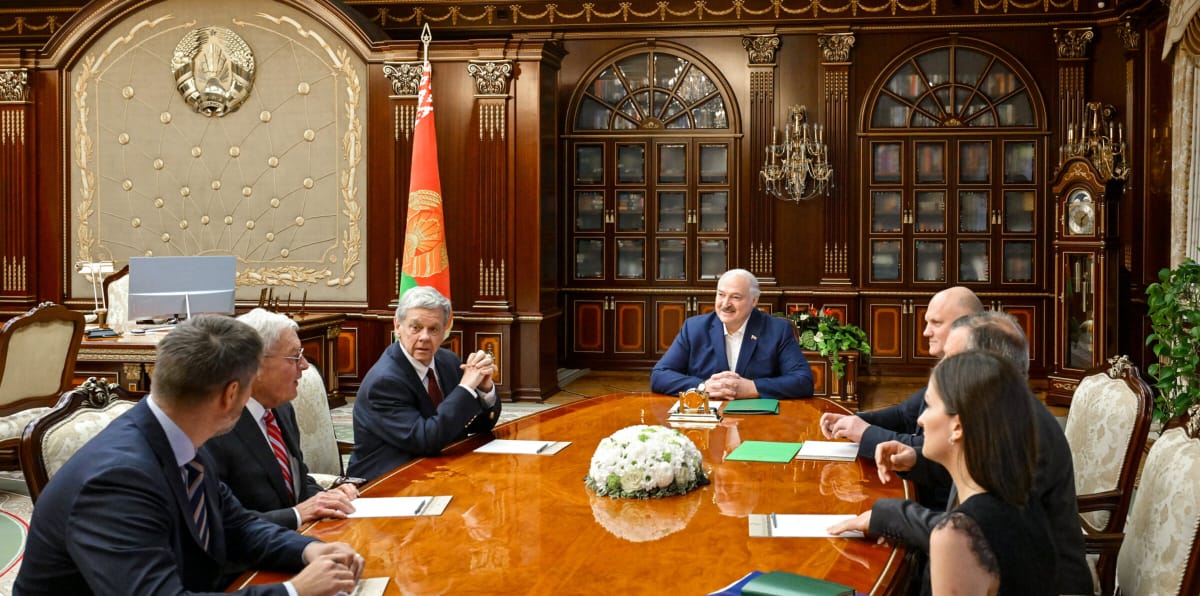
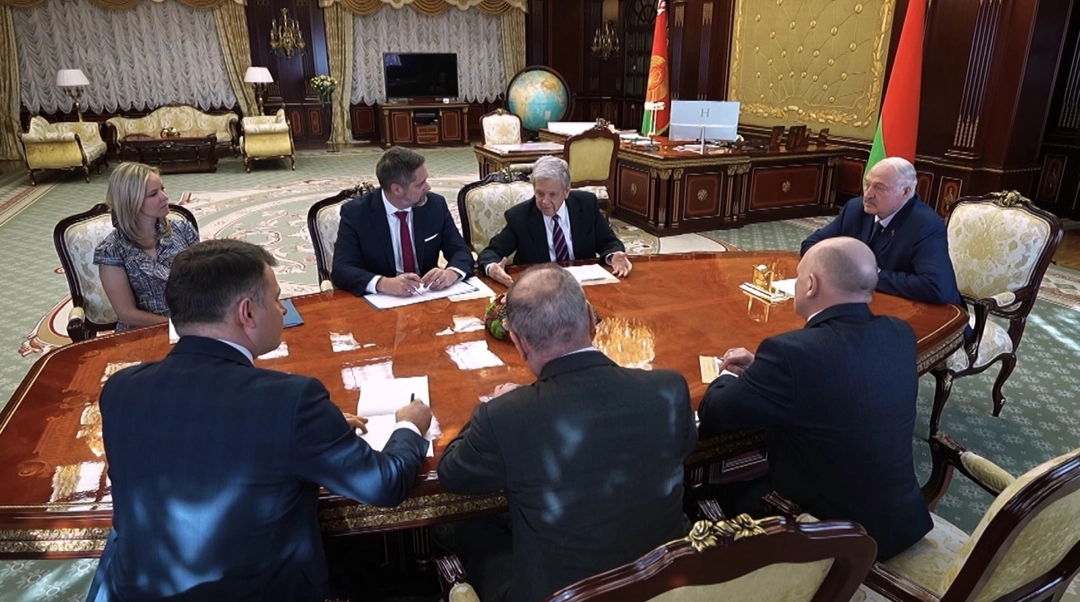
Paris is currently taking an active approach. Despite the scaling back of French diplomatic activities in Minsk and the lack of any tangible gestures of goodwill from the regime, French diplomats have been heavily engaged in talks with the Belarusian side in recent weeks. According to confirmed media reports, on May 24 Emmanuel Macron telephoned Lukashenko, allegedly attempting to persuade him to “distance” himself from the conflict in Ukraine. Then, in early June, special envoys from Paris travelled to the Belarusian capital, including the head of the French intelligence agency DGSE, Nicolas Lerner. However, media speculation persistently returns to the hypothesis that such interlocutors are merely endeavoring to reach Putin via his closest ally.
Lukashenko’s game, full of contradictions and inconsistencies, only becomes more comprehensible when his actions are seen as part of a hybrid operation planned and carried out jointly with Russia. Crucially, the Kremlin’s strategy — hostile to the West and imperial in nature — is of decisive importance in these actions, while Belarus plays the role of a more or less useful subcontractor.