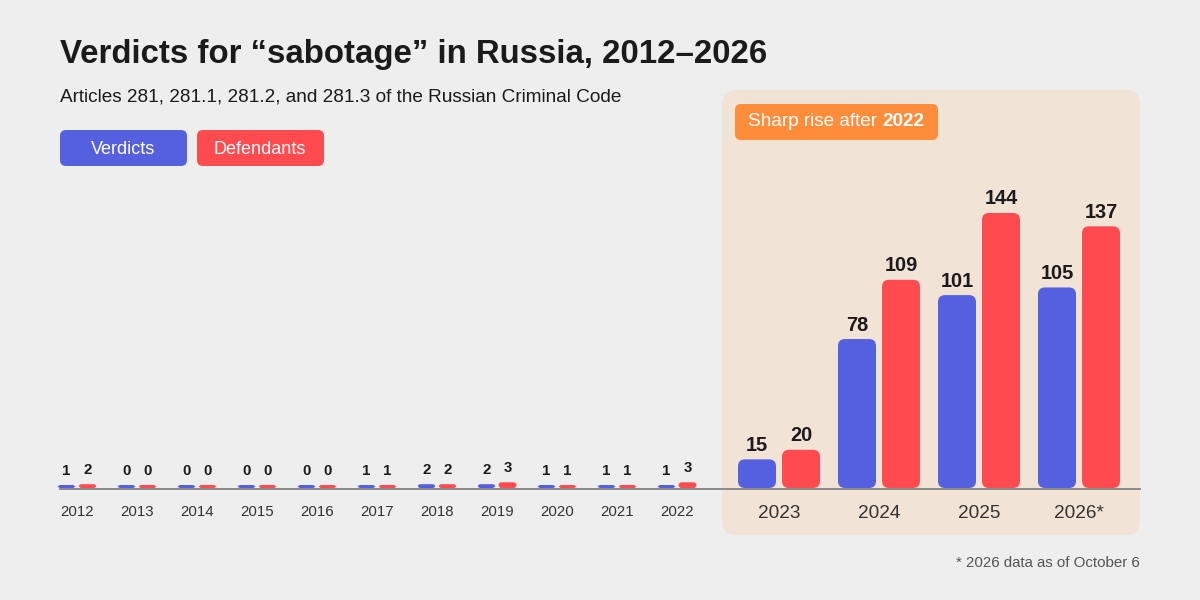
Since the start of the full-scale invasion of Ukraine, Russian courts have begun hearing significantly more cases involving acts of sabotage. Between 2012 and 2021, only eight verdicts were handed down in such cases. Since February 2022, the number is 300, according to a joint study by the Pervy Otdel (lit. “Department One”) human rights project and the independent research association Parubets Analytics.
Previously, the record years were 2018 and 2019, when the courts handed down two guilty verdicts each. In 2023, a sharp rise saw 20 people convicted under sabotage articles, but the new normal only became visible in 2024, when the number rose to 78. It has continued to climb, coming in at 101 in 2025 and at 105 over the first nine months of 2026.
In almost 40% of cases, sabotage charges were “combined” with other especially grave accusations — for example, articles on “treason,” espionage, or terrorism. The identities of most of the convicts are classified.
At present, at least 90 more cases against at least 142 defendants are pending in the courts. Eighty-two of these cases reached the courts this year. To date, there is only one known instance in which such a case was dropped.
Data is available on 423 individuals convicted of sabotage. For 304 of them, the actual prison term is known. The majority (222 people) received 10 years or more.
Human rights activists note that the growth in the number of sabotage cases coincided with the toughening of Article 281 of the Russian Criminal Code. In 2023, the maximum term of imprisonment under the main part of the article was increased from 15 years to 20. The article was amended once more last year to lower the age of criminal liability from 16 to 14. Given the number of cases pending in the courts, the number of convictions is expected to continue to rise.