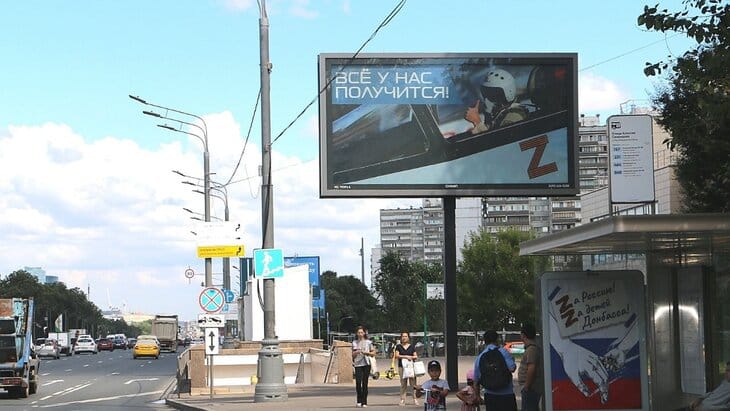
Almost half of the 12.5 million social media accounts and profiles monitored daily by Russia’s Federal Agency for Youth Affairs (Rosmolodezh) are critical of Russia’s war in Ukraine, according to the agency’s deputy head Denis Ashirov. Ashirov presented the data on Oct. 26 at a meeting of the expert council of the State Duma committee on family protection, saying that the agency is tracking 6 million profiles criticizing the “special military operation” and the Russian army. Rosmolodezh classifies such publications as “destructive and unlawful information.”
In addition, the agency links another 1.1 million monitored profiles to political violence and criticism of the authorities, 1.5 million to drugs and drug-related content, and 906,000 to the promotion and rehabilitation of Nazism. It is unclear from Ashirov’s remarks what criteria the agency uses to determine the presence of criticism of the war and the authorities, whether the listed categories overlap, and what share of the accounts belongs to minors. It is also not specified how many unique users stand behind these profiles.
The figures were cited in the context of protecting children from dangerous online content. State Duma family protection committee chair Nina Ostanina noted that existing mechanisms for blocking content do not make it possible to fully restrict the spread of banned materials, and teenagers continue to use digital tools to bypass restrictions. At the same time, the lawmaker acknowledged that bans alone cannot solve the problem — as Ostanina herself explained, restrictions can pique heightened interest in banned content among underage users.
At the same meeting, a representative of the Ministry of Internal Affairs said that in the first nine months of 2026, Russian law enforcement authorities identified 62,300 people suspected of committing crimes on the internet; 4,220 of them (6.8%) were minors. Another 692 minors were held liable for fraud.
How Rosmolodezh monitors social media users
Rosmolodezh has a Center for the Study and Network Monitoring of the Youth Environment (CISM), created on Vladimir Putin’s instruction. The organization searches the internet for information that the Russian authorities consider dangerous to minors.
As The Insider previously reported, the center takes part in identifying “socially dangerous” schoolchildren and students. According to Rosmolodezh head Grigory Gurov, thanks to the center’s work, Russia opened approximately 500 criminal and several hundred administrative cases in 2024. In addition, thousands of people were subjected to “preventive measures” aimed at countering the spread of banned information.
In August 2026, DOXA reported on the center’s work. Journalists studied the court system and found 48 rulings from 2025 and the first half of 2026 in which information supplied by the center served as the basis for prosecution. Among them is the case of Magnitogorsk resident Sergei Sokolov, who was fined 30,000 rubles ($373) after the center reported him to the prosecutor’s office over his VKontakte comments criticizing the Russian army. In Novosibirsk Region in 2025, the most common category of “destructive” content identified by Rosmolodezh was criticism of the war in Ukraine. Anarchist ideas and drug propaganda came in second and third.
The center has also been mentioned in investigations by international law enforcement agencies. In December 2025, the U.S. Department of Justice announced that, according to the charging documents, several CISM employees were members of the pro-Russian hacker group NoName057(16), which carried out DDoS attacks on government institutions, banks, and infrastructure facilities in various countries. According to the U.S. investigation, center employees also took part in creating the network infrastructure for those attacks. Vot Tak previously linked the center’s leadership to the development of the DDoSia program used by the group to attack the websites of European states.
Earlier, media reports also covered Russia’s development of a system called Generation Index. Its closed part is designed to track the ideological attitudes of young people, including their views on the West, LGBT people, and the war in Ukraine. In particular, the system is designed to assess the share of young people who believe in Russia’s war effort, and low figures are supposed to serve as grounds for the authorities to take “urgent measures.”