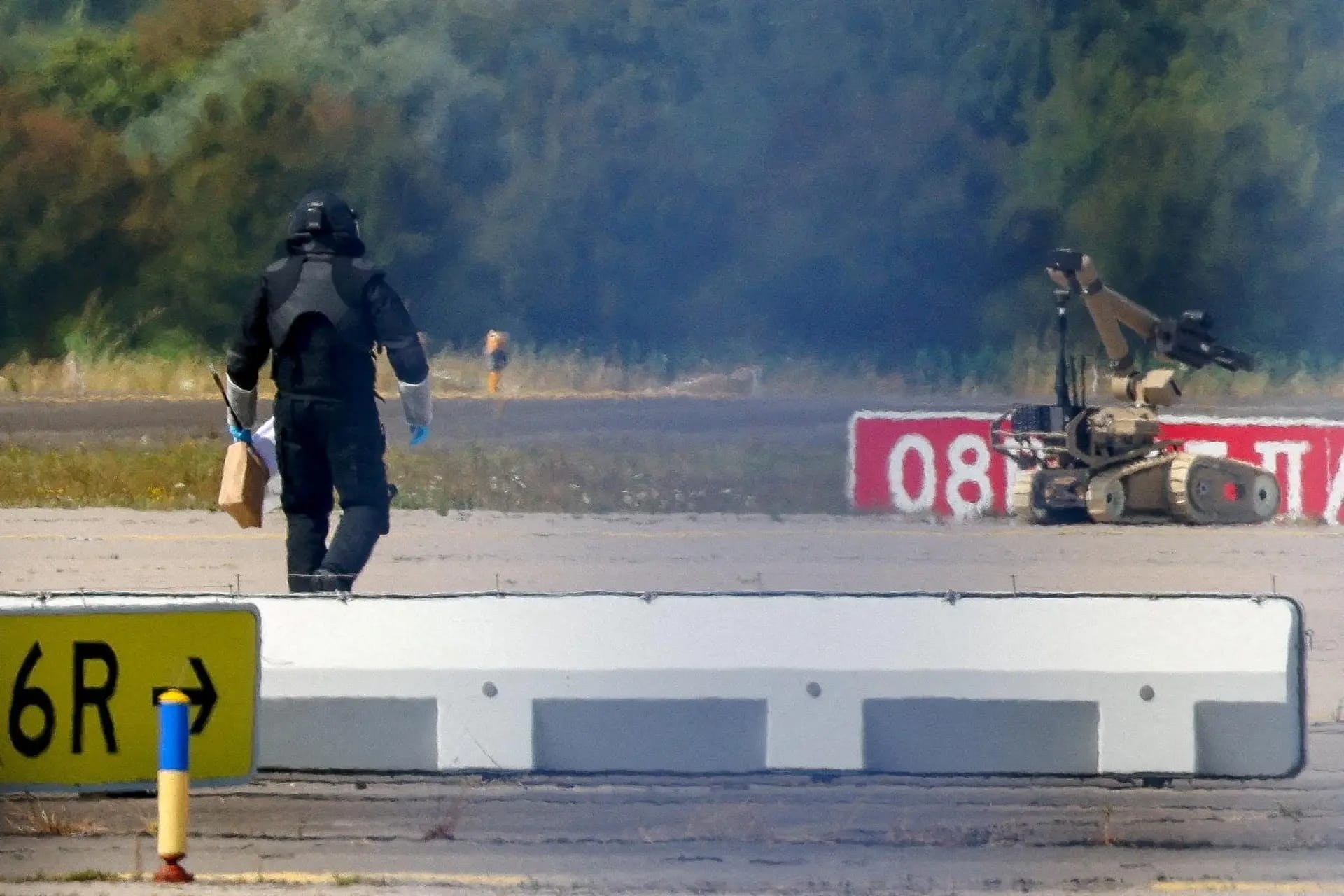
A suspicious substance that investigators believe is likely explosive material was found just a few meters from the wreckage of a drone that was discovered near the Bundeswehr’s Wunstorf air base in Lower Saxony late last week. As Süddeutsche Zeitung, NDR, and WDR report, Germany’s Federal Prosecutor General’s Office and the Federal Criminal Police Office are examining a possible link between the find and the early August attempted act of sabotage at Leipzig/Halle Airport, which the German government has blamed on Russia.
In the latest incident, a farmer discovered a drone broken into several pieces near the Wunstorf military airfield. A few days later, police discovered a suspicious substance just a few meters away. According to German journalists, investigators are operating on the assumption that they are dealing with explosive material; however, forensic analysis of the substance has not yet been completed.
The drone found at Wunstorf is similar in design to those used in the attempted attack on Leipzig/Halle Airport. At least one of its components was made on a 3D printer. Investigators also suspect that the drone may have been lying near the base for an extended period of time — potentially as long as two years.
Wunstorf is a key base for Germany’s military transport aviation, hosting the 62nd Air Transport Wing and all 53 of the German Air Force’s Airbus A400M aircraft, according to Bundeswehr data. Germany received its 53rd and final A400M in April 2026. The Bundeswehr itself describes the A400M as the backbone of Germany’s military transport aviation.
It remains to be determined whether the two drone incidents are connected. Overnight into Aug. 5, a drone carrying explosives and a detonator was discovered in Leipzig. Investigators believe the target may have been Ukrainian cargo planes. In early September, the German government officially blamed Russia for the attempted attack, citing the results of a police investigation and intelligence data. Moscow denied any involvement.
Investigators have identified two suspects in the Leipzig case. One of them, Oleg L., a Latvian citizen with a Russian passport, had maintained contact with Russian military intelligence for years, including with Colonel Denis Smolyaninov of the Main Intelligence Directorate (GRU), according to reporting by Süddeutsche Zeitung, NDR, and WDR.
A spokesperson for the Federal Prosecutor General’s Office declined to comment on details of the investigation into the more recent Wunstorf incident. Nevertheless, the drone discovered there was discussed on Tuesday at the weekly meeting of the heads of Germany’s security services at the Federal Chancellery.