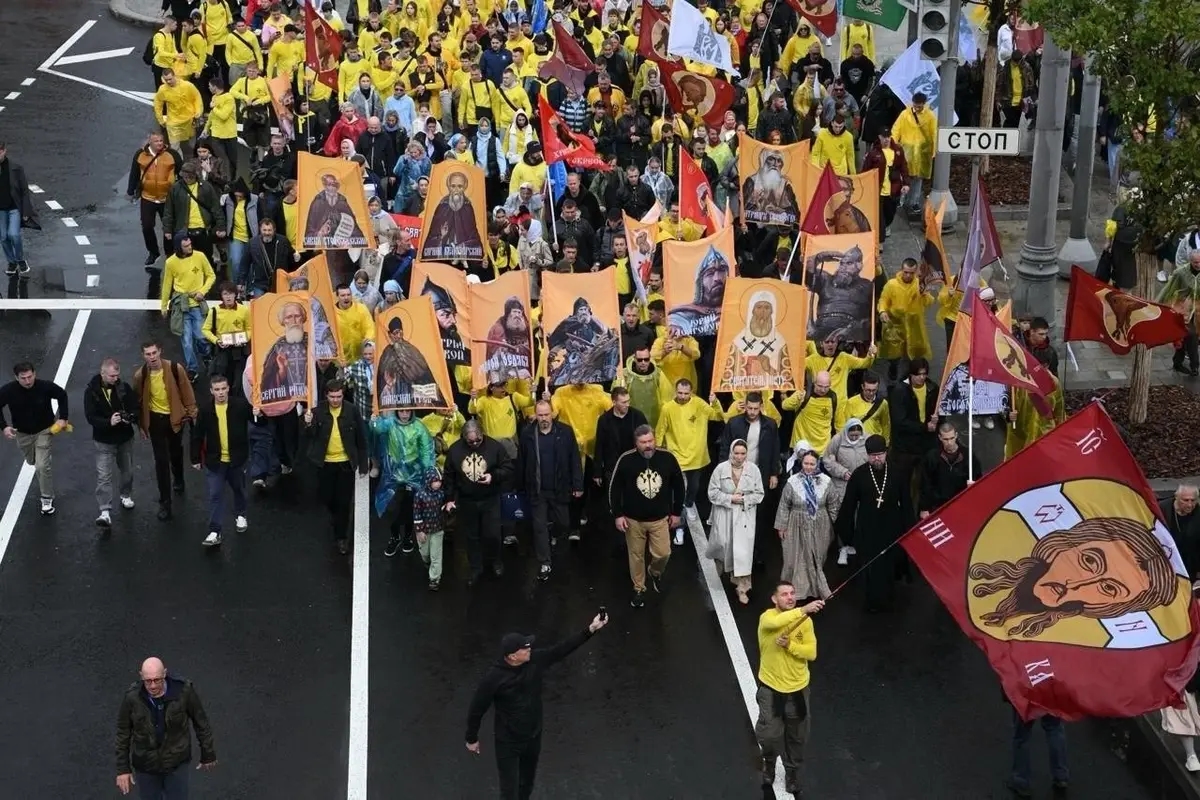
So far this month, religious processions promoted by far-right and nationalist groups have been held in Moscow, Irkutsk, Elista, and St. Petersburg, drawing more than 200,000 participants overall, according to official figures. Tsargrad, the media outlet owned by billionaire and invasion of Ukraine sponsor Konstantin Malofeev, explicitly described the Moscow procession as a “nationwide Russian March,” a reference to the annual nationalist demonstrations commonly held on Nov. 4. Malofeev’s groups and the Russian Community organized their own columns in advance of the recent religious processions and urged supporters to join them. The events were held with government support, including financial backing, while the Russian Orthodox Church openly linked them to support for Putin and the war. At the Moscow procession, Patriarch Kirill called on participants to pray “for our Orthodox president and for our armed forces.”
Moscow: “Not just a religious procession, but a real Russian March”
On Sept. 6, a religious procession held in Moscow drew upwards of 100,000 people, according to the Interior Ministry. The procession, which travelled from the Cathedral of Christ the Savior to the Novodevichy Convent, was led by Patriarch Kirill (Vladimir Gundyaev). Notable attendees also included federal officials and far-right activists from several organizations.
Public preparations for the procession began a month before the event. An official Telegram channel was launched in late July, with its first posts appearing on Aug. 3. These stressed that the procession had Kirill’s blessing and the approval of Moscow authorities. Organizers also set up a dedicated website and a free mobile app while promising to provide transportation from some churches.
Far-right and nationalist organizations joined the campaign around the same time. The Malofeev-linked Two-Headed Eagle reposted the announcement on Aug. 3, while the far-right nationalist Russian Community published its own announcement the following day. By the end of the month, the Russian Community was urging supporters not only to attend but to bring friends, relatives, colleagues, and neighbors, as well as to distribute promotional posters in group chats, coordinate with parish priests, and organize separate groups.
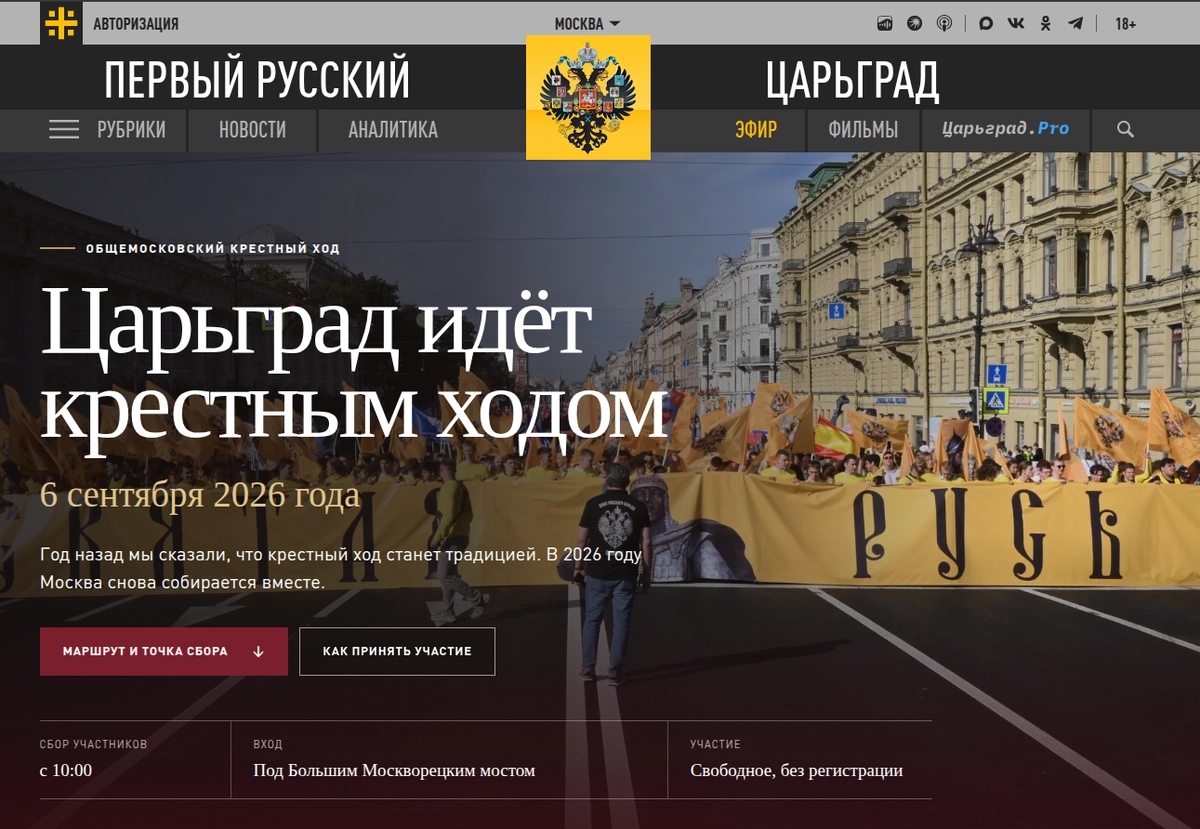
The procession was promoted particularly heavily by Tsargrad, Malofeev's Orthodox nationalist television channel, which devoted a separate page on its website to the event. In the two days before the procession, the outlet repeatedly described it as a “Russian March.” One post called it “the real nationwide Russian March,” while in another, blogger Petya Pervy described it as “a genuine peaceful Russian march, with no political slogans or divisions.” On the eve of the event, Tsargrad again wrote that Moscow would see “not just a religious procession, but a real Russian March” — one featuring prayers for Russian soldiers and Russian “Victory.” Actress Yana Poplavskaya used the same formulation in a Tsargrad video.
During the procession, Patriarch Kirill directly linked the event to support for the authorities and of the Russian military. In two official speeches, he said that people should pray “for our Orthodox president and for our armed forces,” describing Russia as a country once again becoming “invincible.” The procession was accompanied by the Smolensk Icon of the Mother of God and an ark containing a fragment of the relics of 14th century prince Dmitry Donskoy.
We must work for the good of our Fatherland, for the good of our Church, and not slacken in our prayers for our President, for the authorities, for our armed forces and for our people.
Patriarch Kirill
The procession also drew sitting government officials and politicians. The Moscow Diocese listed Industry and Trade Minister Anton Alikhanov, State Duma Deputy Speaker Anna Kuznetsova, LDPR leader Leonid Slutsky, Moscow Department of National Policy head Vitaly Suchkov, and Accounts Chamber auditor Irina Kagramanyan as being among the participants. Representatives of the World Russian People’s Council, various Cossack organizations, and public groups affiliated with the Russian Orthodox Church also took part.
Far-right and nationalist elements were also visibly represented, although the Sova Center estimated their combined presence at only around 2,000 people, or 2% of the total attendance estimated by the Interior Ministry. The Russian Community claimed it had formed “the largest and most striking” column and helped “maintain order,” though these claims could not be independently verified. The group nevertheless made its presence conspicuous, marching behind banners dedicated to Alexander Nevsky.
The procession was also attended by the Two-Headed Eagle and the far-right student group Brotherhood of Academicians — as well as by Konstantin Malofeev himself, under whose auspices both organizations were created. He attended with his wife, Maria Lvova-Belova, Russia’s presidential commissioner for children’s rights, who is wanted by the International Criminal Court (ICC) over allegations of abducting Ukrainian children.
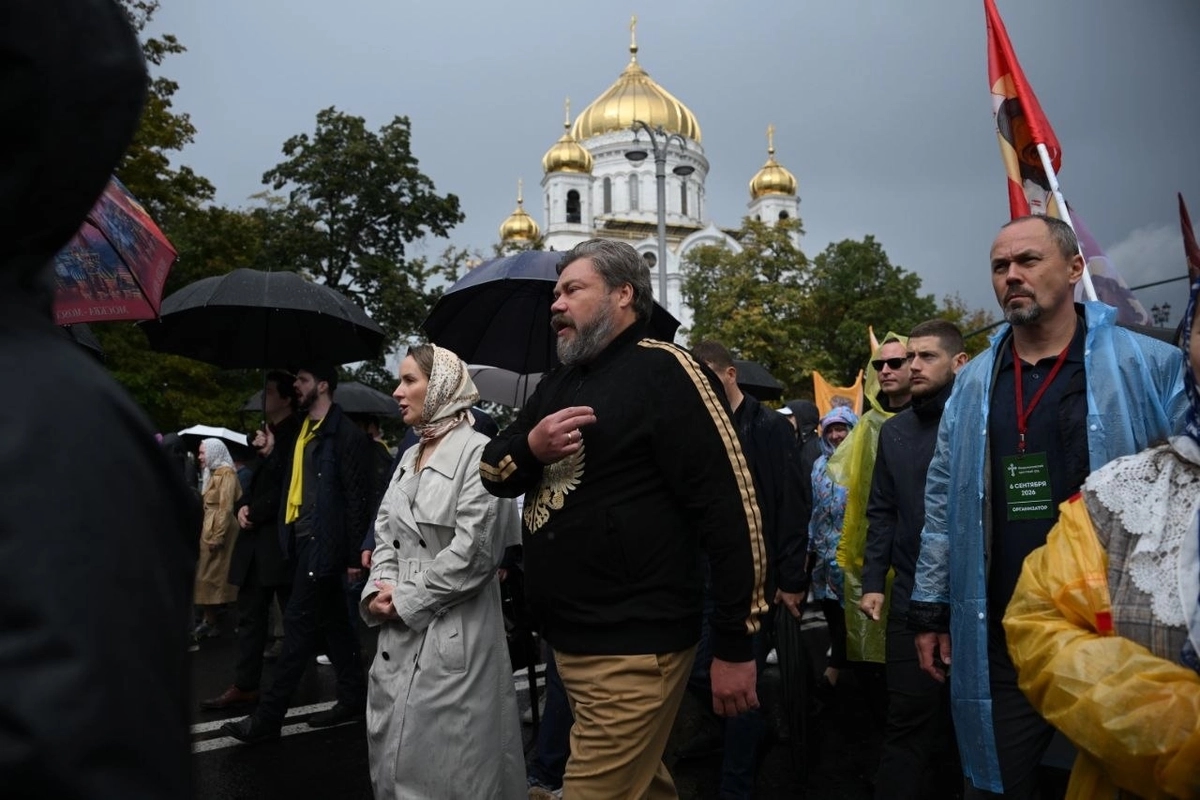
Malofeev is a billionaire who has repeatedly been accused of corporate raiding and fraud. In 2014, The Insider established his role in financing the armed seizure of parts of the Donbas. Igor Girkin, a separatist commander who had previously headed the security department at a Malofeev-owned company, reported directly to Malofeev after his fighters' capture of Sloviansk. In 2025, Malofeev’s name also surfaced in connection with the disappearance of around $450 million from the WEX cryptocurrency exchange. Its former technical director, Alexey Bilyuchenko, claimed that at Malofeev’s request he handed FSB representatives the keys to the exchange’s cryptocurrency wallets. Malofeev has denied any involvement with the missing funds.
After the Sept. 6 march in Moscow, the Brotherhood of Academicians wrote that participants were united by “one idea, one faith, one identity” — wording reminiscent of Nazi Germany’s slogan “One people, one Reich, one leader” (“Ein Volk, ein Reich, ein Führer”). The group also described the slogan “We are Russian — God is with us” as part of a “new reality”:
“If anyone has questions about this phrase, they will have to accept this mainstream, this new reality, in which Russians are strong and united in their faith.”
Other nationalist movements also organized their own groups and columns. The Northern Man reported that its Moscow and Moscow Region branches had marched "in a single formation" as “one powerful column.” The nationalist movement "Society. Future," founded by Roman Yuneman, also participated, and prominent nationalist writer and commentator Yegor Kholmogorov was among those in attendance.
After the procession, Malofeev wrote that Moscow had shown a “living Russia, walking shoulder to shoulder” — one that, “despite the fifth year of the war,” remained united. He described the procession as a prayer “for our soldiers” and “for a Russian Victory.” The Russian Community likewise ended its report by declaring that “Holy Rus is alive and being reborn” and that “Victory will be ours.”
Irkutsk: Less pro-war rhetoric and fewer far-right groups
Also on Sept. 6, a religious procession going under the name “The Radiance of Russia” was held in Irkutsk to open the nationwide Days of Russian Spirituality and Culture. According to the Irkutsk regional government and the Russian Orthodox Church, more than 15,000 people took part in the procession, which carried the relics of Saints Spyridon of Trimythous and Innocent of Irkutsk. The relics were brought to the city by the Irkutsk Diocese, while the festival itself was organized jointly with the regional authorities.
The procession was attended by Irkutsk Region Governor Igor Kobzev and regional Legislative Assembly Chairman Alexander Vedernikov, as well as representatives of the Cossacks, security agencies, and military educational institutions. OMON riot police inspected the venues in advance, while access controls were introduced on the day of the procession. The Interior Ministry and the National Guard provided security, while traffic was restricted in central Irkutsk and public transport routes were altered.
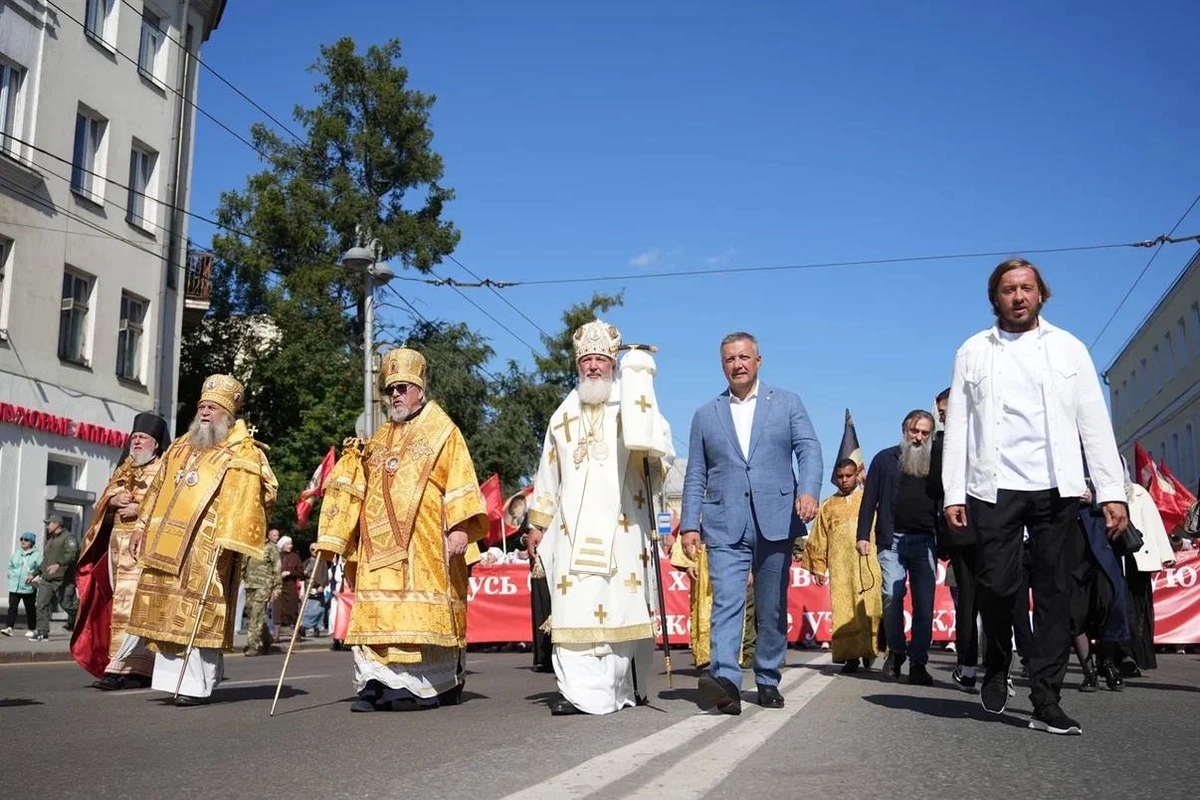
The festival also received organizational support from the state: a procurement worth 552,500 rubles ($6,530) was announced to provide technical equipment for one of the “Radiance of Russia” events. Unlike the Moscow procession, however, official statements by Irkutsk authorities and the Russian Orthodox Church did not feature rhetoric about supporting the war or praying for the president and the military. Governor Kobzev focused instead on Orthodoxy, Russian culture, “traditional Russian values,” and spiritual unity.
The Irkutsk branch of the Russian Community also invited its supporters to join the procession. Afterward, it reported that its “squad” had helped “maintain public order.” The group did not disclose the size of its contingent, and a video published by the far-right organization shows only a handful of Russian Community flags.
Elista: With Malofeev “in the name of victory”
On Sept. 10, a religious procession was held in Elista, the capital of Kalmykia, as part of celebrations marking the 80th anniversary of the Appearance of Christ the Savior, a purported 1946 miracle in which Christ himself is said to have visited the city. According to the official anniversary website, more than 2,000 people took part in the procession from the Kazan Cathedral to the Church of the Exaltation of the Cross.
The anniversary was organized by the Kalmyk authorities in cooperation with the Elista Diocese. The organizing committee was headed by Kalmykia head Batu Khasikov, who joined the procession alongside Astrakhan Region Governor Igor Babushkin, Metropolitan Matthew of Pskov and Porkhov, and other government and church officials. Khasikov also reported that Construction Minister Irek Fayzullin and Ataman Sergei Bodryakov of the Great Don Cossack Host took part.
Military and state-patriotic rhetoric featured in the anniversary program even before the procession. On Sept. 9, Elista hosted events organized by the Kalmyk Cossack District of the Great Don Cossack Host, which were attended by government officials, Cossacks, and members of the security forces. Archbishop Justinian held a prayer service “for the defenders and builders of the Fatherland,” including servicemen “fulfilling their duty” and Cossacks “guarding the borders.” The Kalmyk Cossack District was then presented with a consecrated military banner.
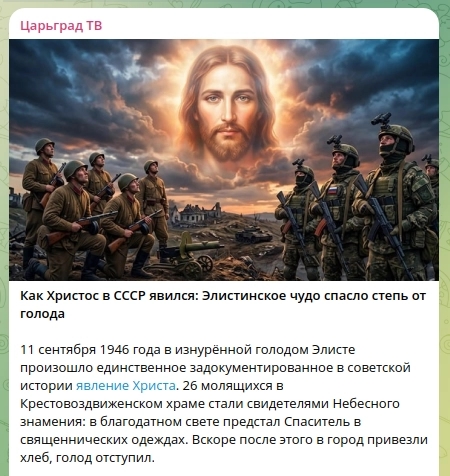
The 80th anniversary of the “Appearance of Christ the Savior in Elista” was promoted particularly heavily by Malofeev’s Tsargrad. Beginning Sept. 7, the outlet put out a series of reports on the “Elista miracle,” portraying Russia as an “Empire” that is “invincible” — a “Katechon holding the world back from evil.” The reports were accompanied by AI-generated images. One illustration depicts Soviet soldiers and modern Russian servicemen bearing Russian symbols before an image of Christ.
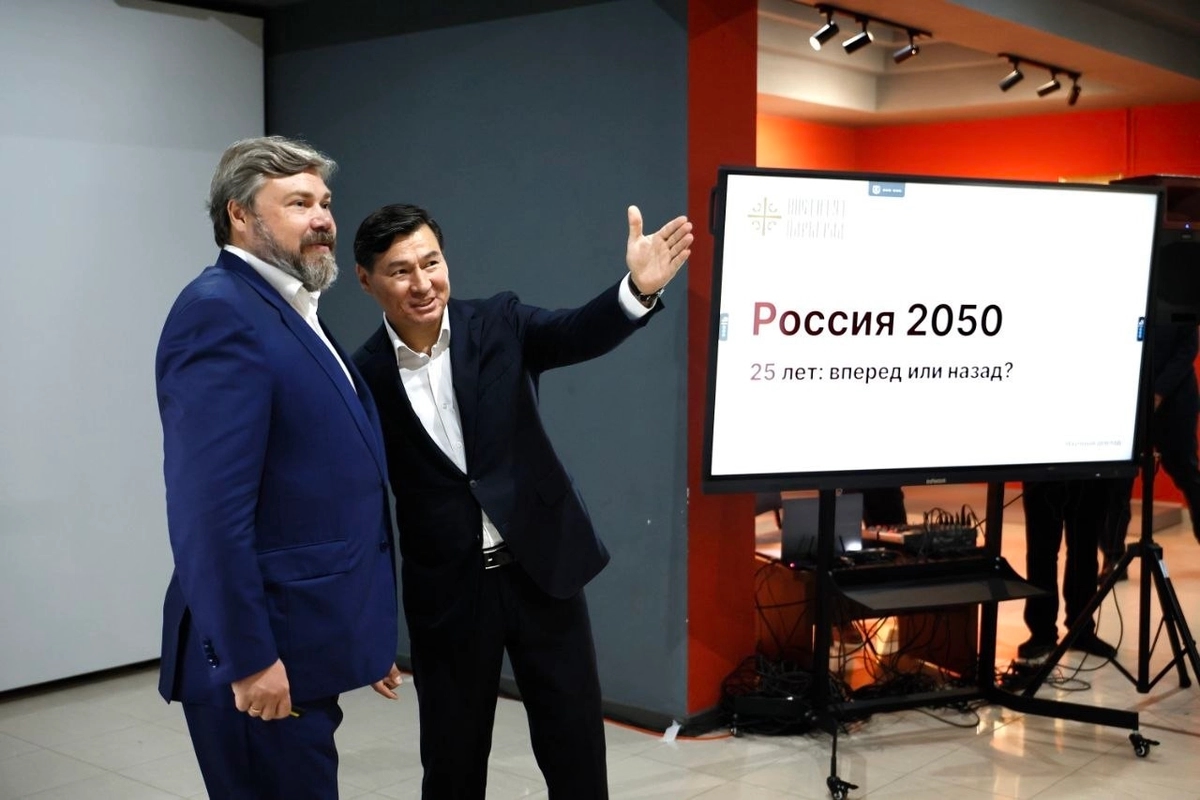
Malofeev himself arrived in Kalmykia the day before the procession and appeared alongside Khasikov at the launch of the regional “2050 Club.” The two also jointly presented “Tsargrad Crosses” to participants in the war in Ukraine. Malofeev called Kalmykia a “southern outpost of the Russian World,” adding that its residents were “bravely fighting the enemy in the special military operation zone.” He ended his post: “For four centuries, Kalmyks have been victorious alongside Russians and dozens of other peoples. They will be victorious this time, too.”
The following day, Malofeev directly linked the procession to Russia's ongoing invasion of Ukraine, writing that “in the fifth year of the war,” the relics of Dmitry Donskoy had “appeared” in Russia, while even in Buddhist Kalmykia, regional governor Khasikov carried an Orthodox relic through Elista.
During the celebrations, Khasikov described Russia as a “sacred power” whose destiny was to “protect the world from evil.” In a speech following the procession, he directly linked the anniversary to “Victory”:
“Our country is a sacred power, and Russia’s destiny is to protect the world from evil... The time has come to say this. To say it with love, in the name of good, in the name of Victory.”
St. Petersburg: Nationalists in their most organized form
On Sept. 12, St. Petersburg held its annual Alexander Nevsky religious procession from Kazan Cathedral to the Alexander Nevsky Lavra. According to the Interior Ministry, more than 90,000 people took part. The procession moved along Nevsky Prospect with the Kazan Icon of the Mother of God and an ark containing a fragment of the relics of Dmitry Donskoy, which were brought from Moscow. At the same time, a smaller procession carrying the relics of Alexander Nevsky set out from the lavra, while a separate water procession took place on the Neva.
The event was held with the blessing of Metropolitan Barsanuphius of St. Petersburg and Ladoga — and with the direct involvement of the city authorities. A preparatory press conference was attended by Fyodor Boltin, head of the city’s culture committee, along with a representative of the Committee on Law, officials from the transport and media committees, and representatives of the St. Petersburg Diocese. For the procession, the authorities closed a large section of Nevsky Prospect and adjacent streets to traffic.
The celebrations were financed using the St. Petersburg city budget. On June 29, the city’s culture committee announced a tender for an event marking the Feast of the Translation of the Relics of Alexander Nevsky and the Treaty of Nystad, with an initial budget of 14.4 million rubles ($170,000). The amount covered the entire program of festivities, not the procession alone.
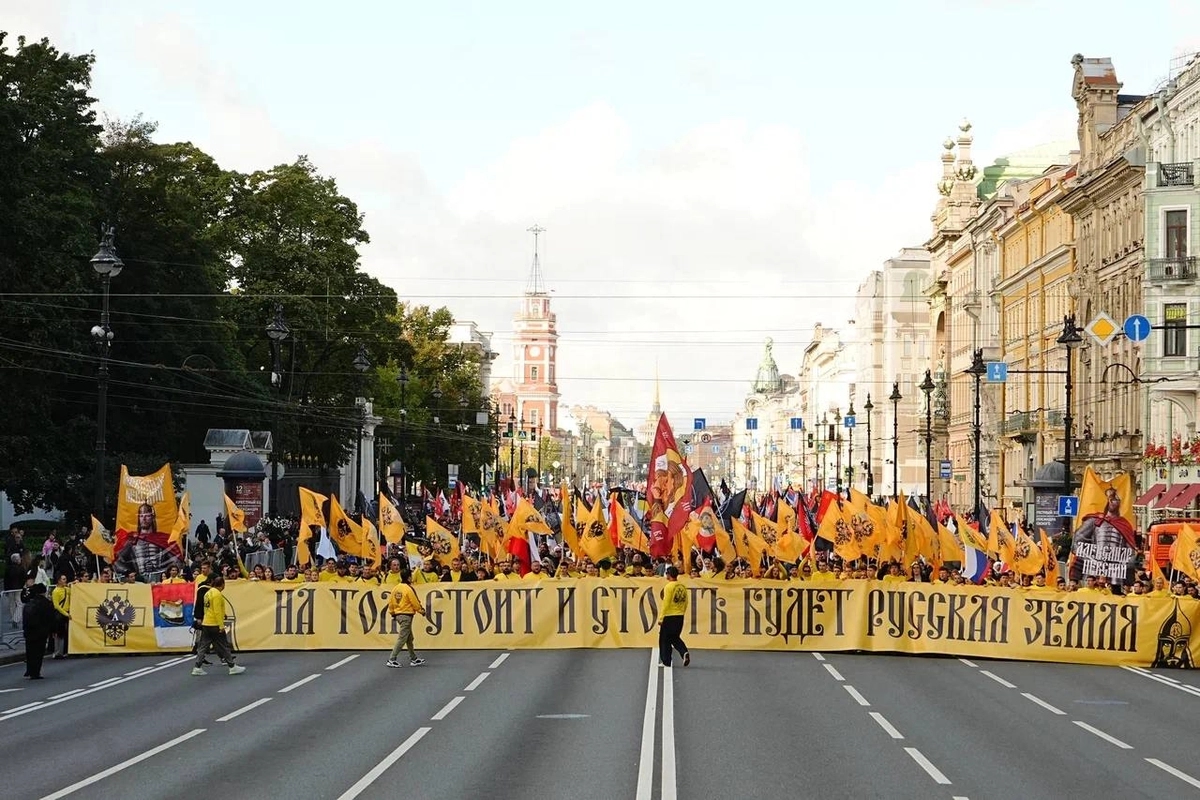
Nationalist groups had a particularly prominent presence in the procession. The Russian Community marched in a separate column under its own flags, while some participants carried the imperial black-yellow-white flag. Russian Community activists chanted “We are Russian — God is with us,” among other slogans. The organization described its participation as a being part of a “celebration of unity.” Its St. Petersburg spiritual adviser, Priest Alexander Bashkin, said afterward that “when we are united, we are invincible” and that “no enemy can overcome our unifying Russian strength.”
Malofeev’s organizations were even more organized. The Two-Headed Eagle claimed that its column had teamed up with the Brotherhood of Academicians and “led the public organizations.” According to the group, around 300 young people marched under a banner reading “The Russian Land has stood and will stand on this,” and the slogan “We are Russian! God is with us!” The Academicians described their contingent as the “Orthodox vanguard” and called the procession a “march of youth” allowing them to “openly proclaim our ideas.”
During the procession, the Two-Headed Eagle recorded a separate address to the Serbian far-right groups Srpska Akcija (“Serbian Action”) and Narodna Patrola (“People’s Patrol”), whose participants carried a Serbian flag. The group expressed support for Serbian nationalists who had recently attended the funeral of Ratko Mladić, the former commander of the Army of Republika Srpska. Srpska Akcija responded by calling the Two-Headed Eagle activists its “Russian friends” and publishing the slogan “Russians and Serbs — brothers forever.”
Tsargrad also extensively covered the St. Petersburg procession, contrasting it with an LGBT pride march held in the Ukrainian city of Kharkiv the same day, writing that Russia was “carrying the banner of Orthodoxy,” which contained “the seed of inevitable victory.” The post also expressed hope that a similar procession would be held in Kharkiv after its “liberation.”
Alexander Belsky, speaker of the St. Petersburg Legislative Assembly, said after the procession: “We showed the whole world what Rus is, what a Russian person is.” That same day, Governor Alexander Beglov linked the celebrations to the current war, saying that Russian servicemen were “continuing the feat of their ancestors” by defending “the lands and the Orthodox faith.”
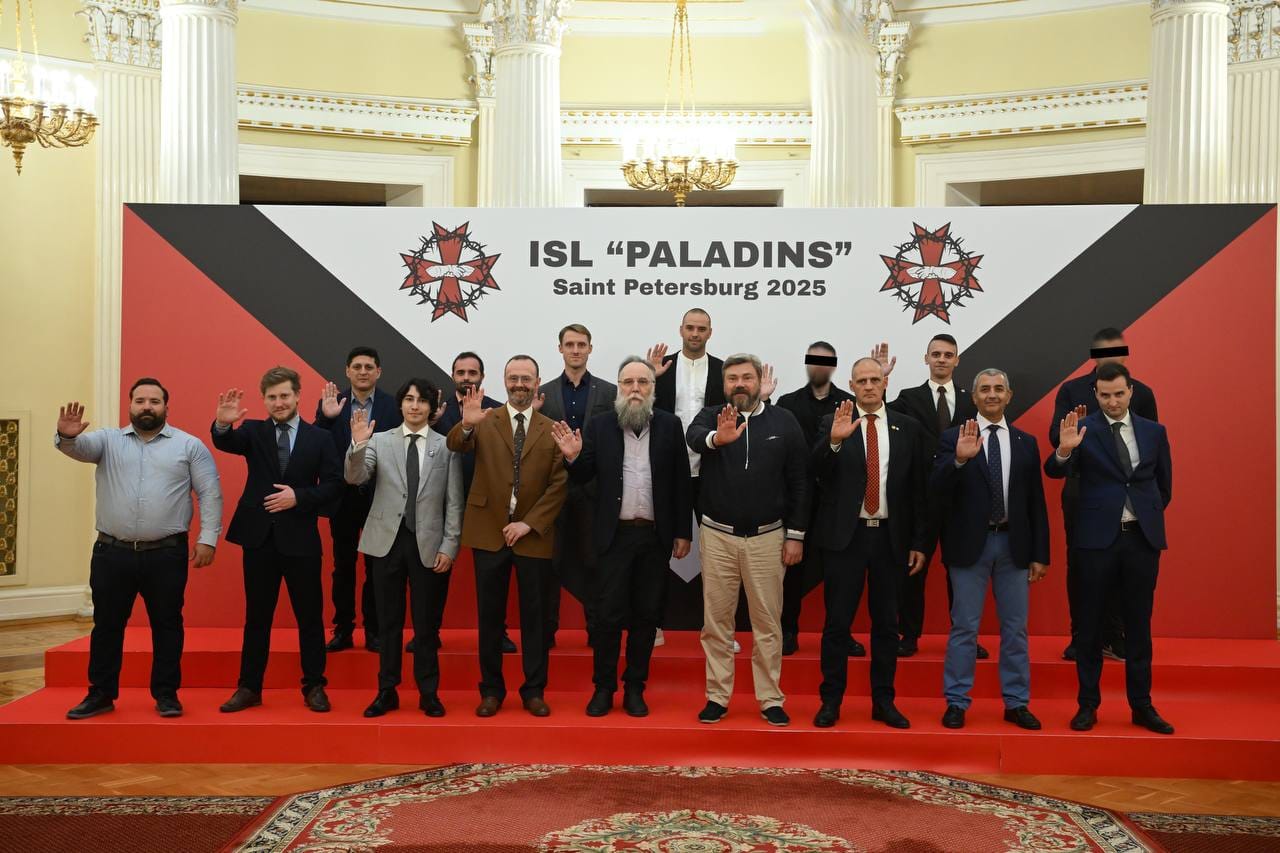
The participation of Malofeev-linked organizations in the St. Petersburg processions is nothing new. On Sept. 12, 2025, activists from Tsargrad, the Two-Headed Eagle, and the Brotherhood of Academicians took part, alongside representatives of at least two foreign far-right groups — Hungary’s Sixty-Four Counties Youth Movement and Belgium’s Nation. That same day, Malofeev organized an international gathering of far-right and neo-Nazi groups at the Mariinsky Palace, which resulted in the creation of the “Paladins” International League of Anti-Globalists. Representatives of the Sixty-Four Counties later said that the Two-Headed Eagle and the Academicians were among the gathering’s organizers. Both groups are part of the Tsargrad network.