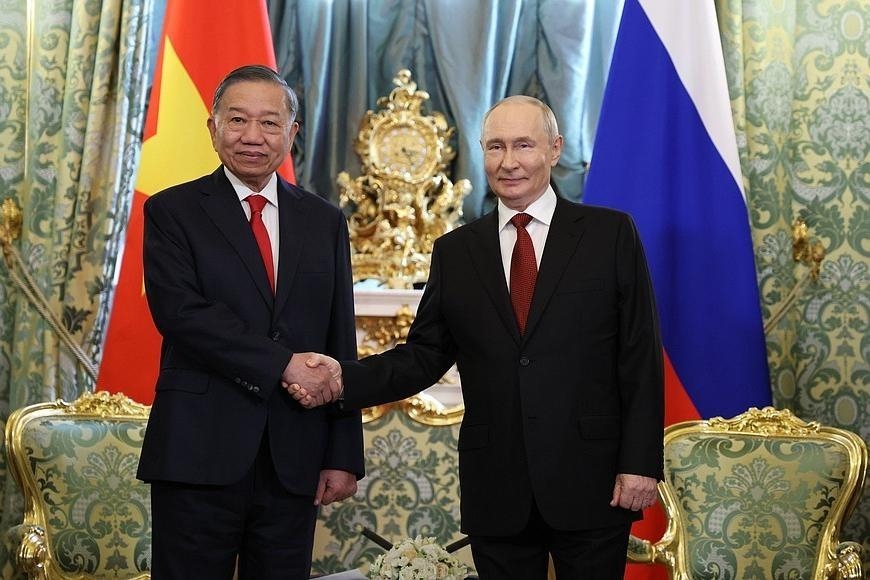
Russia and Vietnam have agreed to deepen cooperation in defense, security, and military technology, as well as to exchange information on the activities of “hostile forces and foreign special agencies,” according to a joint statement issued following talks between Vladimir Putin and Vietnamese President To Lam in Moscow on Sept. 9. Additionally, Putin announced that Russia will soon introduce a visa-free regime for Vietnamese nationals.
The two sides agreed to “enhance cooperation between military branches” and cooperate in maritime security, military personnel training, science, technology, and engineering. After the talks, To Lam stated that Russia and Vietnam intend to “deepen defence, security, and military technical cooperation as a strategic pillar of our ties.”
A separate clause in the joint statement addresses cooperation in the field of information security. Russia and Vietnam agreed to intensify the exchange of information and expertise “in countering the conspiracies, intentions, and activities of hostile forces and foreign special agencies,” which, in the document’s wording, are aimed at interfering in internal affairs and influencing state, political, and legislative institutions. The two sides also stated their readiness to expand cooperation “in combating crime in all its forms and manifestations, including cybercrime” and to continue cooperation between law enforcement agencies.
In addition, Moscow and Hanoi intend to expand cooperation in the oil and gas sector. The joint statement describes energy and fossil fuels as areas of “strategic breakthrough in Vietnam-Russia relations.” The two sides agreed to speed up work on possible supplies of Russian oil and liquefied natural gas to Vietnam and on building infrastructure on the Vietnamese side for receiving, processing, and storing hydrocarbons.
Putin said the Russian side had even proposed creating strategic fuel reserves in Vietnam. “Our companies are also interested in establishing transit deliveries of energy resources through Vietnamese territory to neighboring states,” he said. During the visit, the two sides signed agreements on oil and gas projects on the Vietnamese shelf and a framework agreement between Zarubezhneft and Petrovietnam regarding the strategic oil reserve.
Nuclear energy remains another area of cooperation. This past March, Russia and Vietnam signed an intergovernmental agreement on building a Russian-designed nuclear power plant in Vietnam. Putin called the initiative “a truly flagship project.” The two sides also intend to build a Nuclear Science and Technology Center in Vietnam.
In the context of expanding political and security cooperation, Putin announced the potential liberalization of Russia’s visa regime for Vietnamese citizens. “For our part, we are working to introduce reciprocal visa-free travel for our Vietnamese friends in the near future,” he said. Russians no longer need a visa for short trips to Vietnam, and according to Putin, almost 700,000 Russians visited the country in 2025, and another 800,000 in the first half of 2026.
In the final statement, Moscow and Hanoi called their development a “long-term strategic choice and one of the priorities in the foreign policy of each country.” During the meeting with Putin, To Lam called the Russian leader “a great friend of our country and a close brother to the Vietnamese people.” The joint statement also says that Russia “highly appreciates” Vietnam’s position regarding the war in Ukraine.