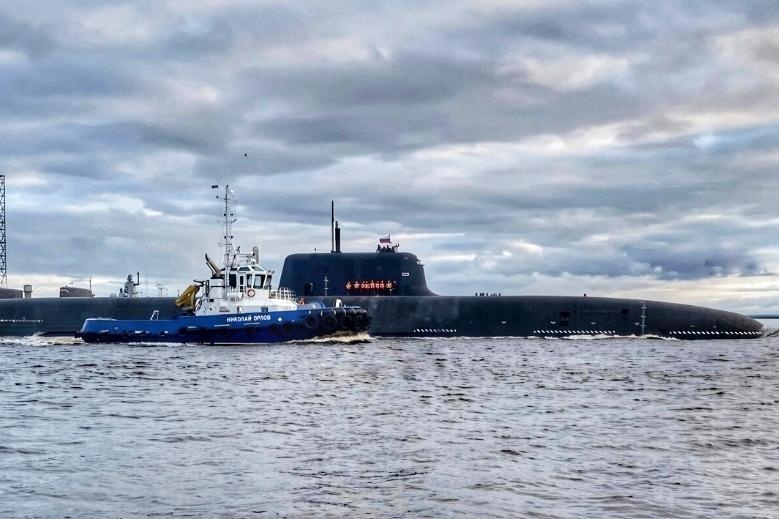
Russia’s Khabarovsk submarine, designed to accommodate an autonomous unmanned underwater vehicle capable of carrying a nuclear warhead, has gone to sea for the first time. Russian military blogs Voennoye Obozreniye (lit. “Military Review”) and Amalnews reported that the submarine is currently undergoing sea trials in the White Sea.
The Khabarovsk is the first standard carrier of Poseidon systems — nuclear-powered, nuclear-armed, autonomous underwater drones first announced by Vladimir Putin in 2018. According to unconfirmed reports, the nuclear-powered Khabarovsk has six launch tubes for the systems. After the trials, the submarine is expected to join the Pacific Fleet and be based in Kamchatka, possibly next year.
The Khabarovsk is the only submarine built under Project 09851, which was developed by the Rubin Central Design Bureau. The submarine was built at the Sevmash shipyard in Severodvinsk, in Russia’s Arkhangelsk region.
The Russian Navy currently has one Poseidon carrier: the Belgorod, a special-purpose nuclear-powered submarine. It was converted from an unfinished Project 949A Antey submarine cruiser and has four launch tubes for Poseidon systems.
Since 2018, Vladimir Putin has described Poseidon as a fantastic weapon of unprecedented power. Russian propaganda regularly uses Poseidon to threaten the West. For example, propagandist Dmitry Kiselyov claimed that detonating Poseidon off the coast of the UK could cause a tsunami capable of destroying the island.
It is impossible to test the Poseidon as a complete weapons system, rather than as separate components, because doing so would risk an environmental catastrophe (assuming its declared characteristics are accurate). Nevertheless, as The Insider previously reported, calculations and modeling show that a catastrophic radioactive tsunami cannot be produced by an underwater nuclear explosion.
The Poseidon project, which began in the 1980s, also appears to be one of the most expensive and resource-intensive programs in the recent history of Russia’s defense industry, leading to accusations that one of its primary purposes has been the siphoning off of state funds. Aside from enormous investments in research and supporting infrastructure, Poseidon requires enormous special-purpose nuclear submarines as carriers.
Poseidon would theoretically be a new class of nuclear weapon, combining elements of an underwater drone and a torpedo. In that sense, it has no direct equivalent. However, there is no confirmation that it exists as a finished, deployable weapon.