Non-tax revenue payments from businesses to Russia’s federal budget have reached a record 383.69 billion rubles (over $4.5 billion) since the start of the year, according to the Kremlin-aligned business newspaper Vedomosti, which cited data from Russia’s electronic budget system. The main flow of money began after March, when Vladimir Putin, at a closed-door meeting with major business owners, suggested they make “voluntary” contributions to the budget. According to the independent outlet The Bell, the proposal came after a discussion about financing the ongoing war in Ukraine.
In the first seven and a half months of 2026, the level of such payments was already 50% higher than that for all of 2025. In its 2026-2028 budget law, the Finance Ministry had planned to bring in only 1.7 billion rubles a year under this category.
Instead, from January through March alone, nongovernmental organizations transferred 15.6 billion rubles to Russia’s government budget. By the end of April, the amount had grown more than tenfold, to 159.7 billion rubles. By the end of May, it had risen to 232.3 billion rubles, and by the end of June to 294.4 billion rubles. In July and the first half of August, the total increased by about another 30%. Vedomosti noted that these are record receipts under this budget category, which first appeared in 2022.
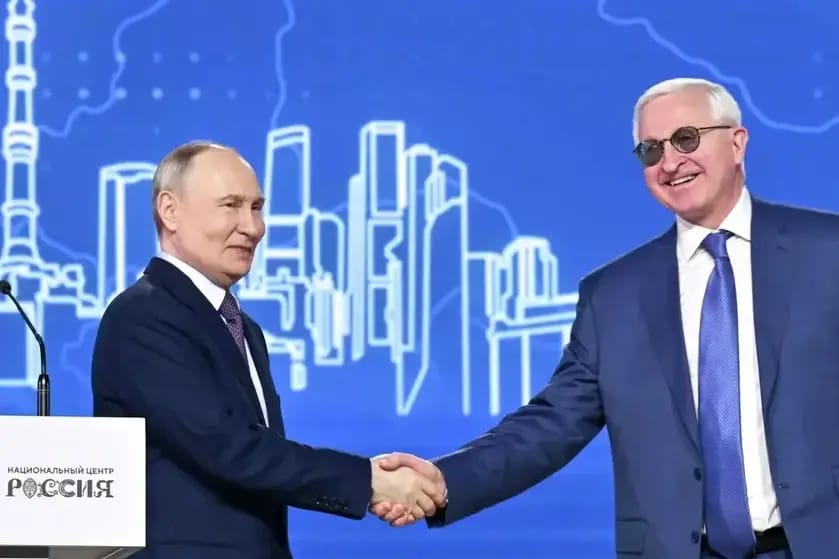
Alexander Shokhin, head of the Russian Union of Industrialists and Entrepreneurs, told Vedomosti that on the sidelines of the congress where the aforementioned meeting with Putin took place, major business owners had “raised the initiative of voluntary donations to the budget.” Kremlin spokesman Dmitry Peskov had also said earlier that one participant in the meeting with Putin proposed allocating a large sum for state needs.
Two months after the meeting, the Kremlin said Shokhin would head a reformed business ombudsman’s office. Putin signed a law establishing the office in June.
On March 26, The Bell reported, citing two people familiar with the closed-door meeting, that Putin had told business owners he intended to continue the invasion and then suggested they transfer money to the state budget. According to the outlet’s sources, the idea of “shaking down business at a difficult time for the country” was outlined to Putin before the meeting in a letter from Igor Sechin, the head of state-owned energy giant Rosneft. Sechin reportedly proposed issuing war bonds to finance the conflict, among other measures.
At the meeting, billionaire senator Suleiman Kerimov promised to contribute 100 billion rubles to the budget, two sources told The Bell. At least one other business owner supported the initiative without naming a sum.
In previous years, a large share of nonrepayable budget receipts came from mandatory payments by foreign companies leaving Russia. However, lawyers interviewed by Vedomosti said that source has largely dried up (even if deferred payments from previously approved deals may still have continued to go through in 2026). Over the past three years, the mandatory payment imposed on foreign owners exiting the Russian market has increased from 10% to 35% of an asset’s market value.
Overall, the current influx of non-tax revenue has already surpassed proceeds from Russia’s one-time windfall tax, which raised 318.8 billion rubles for the federal budget. The inflows come as Russia’s deficit widens, reaching 6.455 trillion rubles, or 2.8% of GDP, in January-July, a figure already in excess of the full-year target.