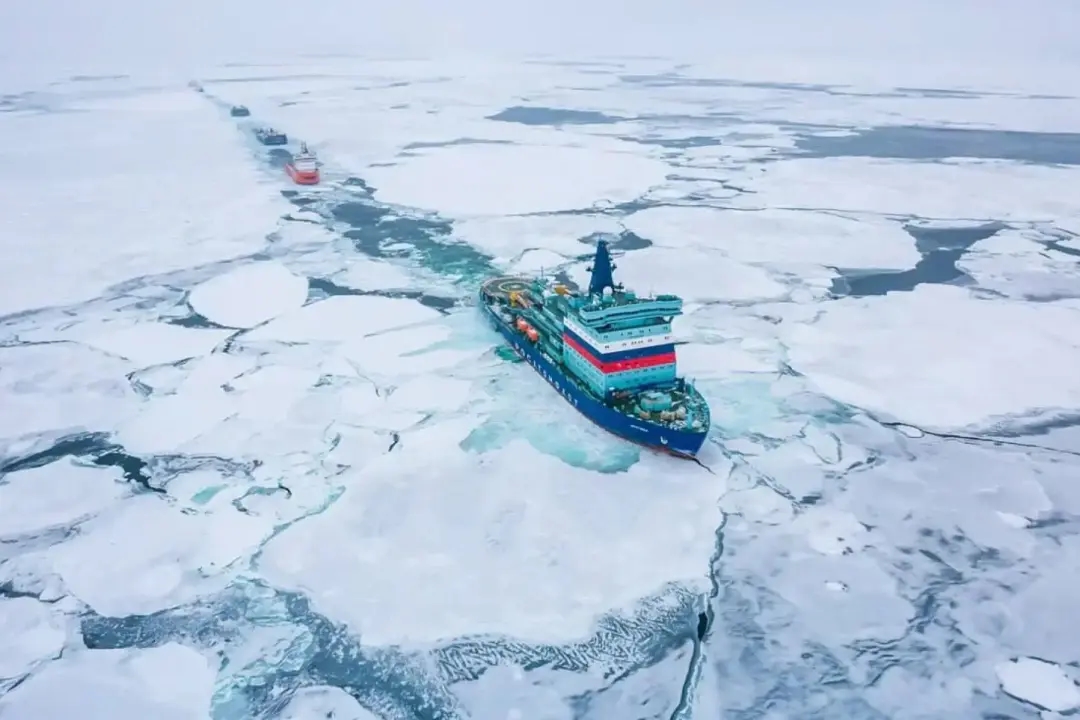
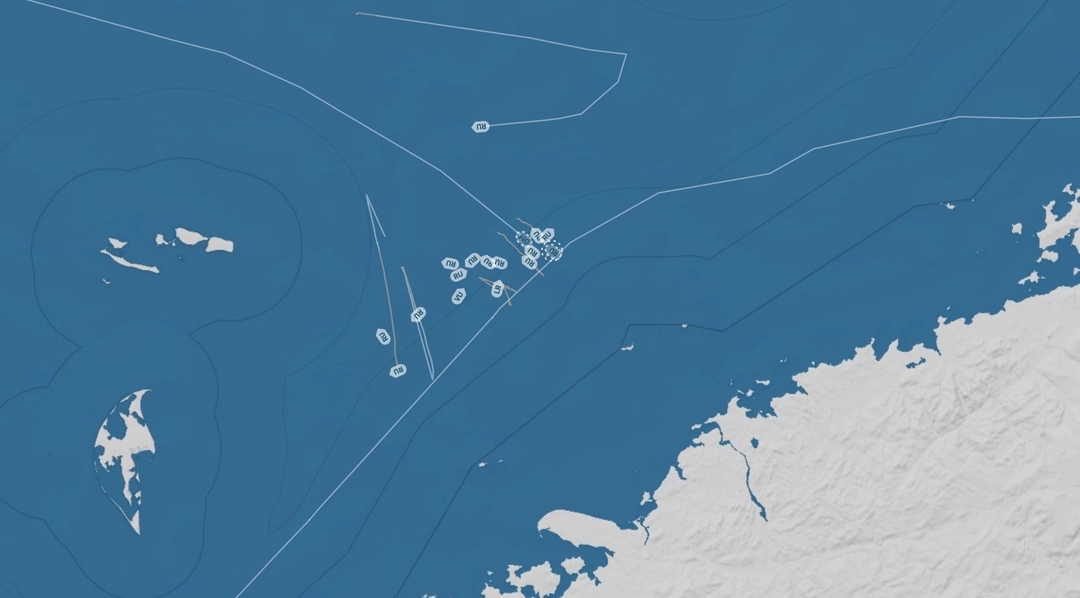
A group of sanctioned Russian tankers, along with four cargo ships, are currently drifting in the Kara Sea while waiting for nuclear-powered icebreakers to escort them along the Northern Sea Route, according to a report by The Barents Observer. The outlet said that if the vessels indeed travel together, it would be the largest convoy ever to use the route.
The outlet said the tankers are most likely carrying oil produced at Russia’s Arctic fields. Among the vessels currently waiting in the Kara Sea, The Barents Observer identified the oil tankers Jupiter (IMO 9397535), Vostochny Prospect (IMO 9866392) and Saga (IMO 9318553). According to vessel-tracking data, the nuclear icebreaker Sibir was in the eastern Kara Sea in early August, while the icebreakers Ural and Yakutia were in the East Siberian Sea.
After reviewing data from the vessel tracking platform Starboard Maritime Intelligence, The Insider found that, in addition to those vessels, the following tankers were also located close to one another in the Kara Sea: Pamir (IMO 9276028), NP Dikson (IMO 9255270), Hyperion (IMO 9322968), Liteyny Prospect (IMO 9256078), Ligovsky Prospect (IMO 9256066), Viktor Bakaev (IMO 9610810) and Jagger (IMO 9354301).
As previously reported, Russia is increasing liquefied natural gas (LNG) production at the Arctic LNG 2 plant on the Gydan Peninsula, with markets in Asia — especially China — seen as the prospective buyers. Moscow is also increasing oil shipments along this route, as tankers traveling in the north are not yet under threat from Ukrainian drones, The Barents Observer noted. Russia still lacks enough icebreakers, but it is working to expand the necessary infrastructure.
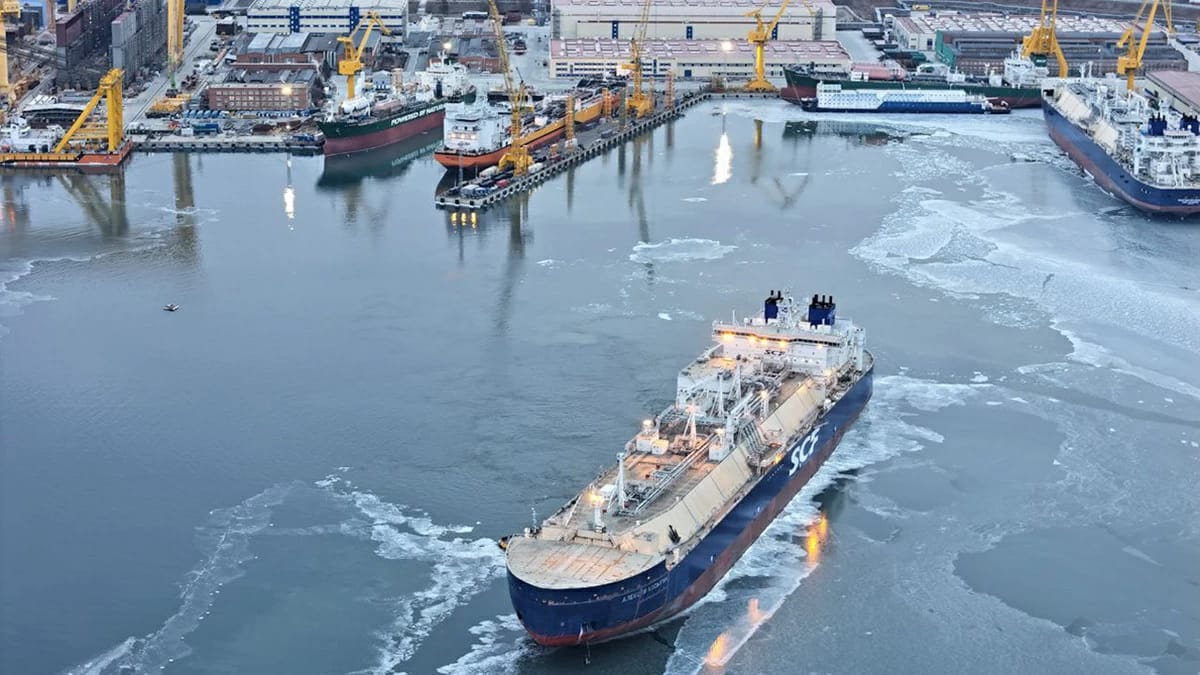
In December of last year, it became known that the Zvezda Shipbuilding Complex had handed over to a customer the first LNG carrier ever built entirely in Russia. Rosneft’s press service said the Alexey Kosygin (IMO 9904546), which can break through ice up to 2 meters thick, would be the lead vessel for the Arctic LNG 2 project.
As Anna Orlova, an investigator with the Arctic nonprofit Arctida, previously told The Insider, the arrival of the Alexey Kosygin will allow Novatek, the operator of the Arctic LNG 2 project, to export liquefied gas year-round, reducing technical risks and costs. Arctida experts suggested the vessel would transfer LNG to “shadow fleet” tankers that are unable to pass through Arctic ice.
“‘Shadow fleet’ vessels without ice-class capabilities cannot navigate the Northern Sea Route eastward in winter, so the only route for delivering Russian LNG to Asia remains either around Europe via the Suez Canal or around Africa,” Orlova said. “Using the Alexey Kosygin for the entire route would be economically inefficient, as most of the route lies through open water, where a vessel with a heavy hull like the Alexey Kosygin's is slower and less fuel-efficient than conventional ships. Instead, a ‘shuttle’ strategy may be employed, with the Alexey Kosygin acting as an icebreaker shuttle that loads at the Utrenny terminal and navigates the challenging ice stretch of the Kara Sea to Murmansk.”