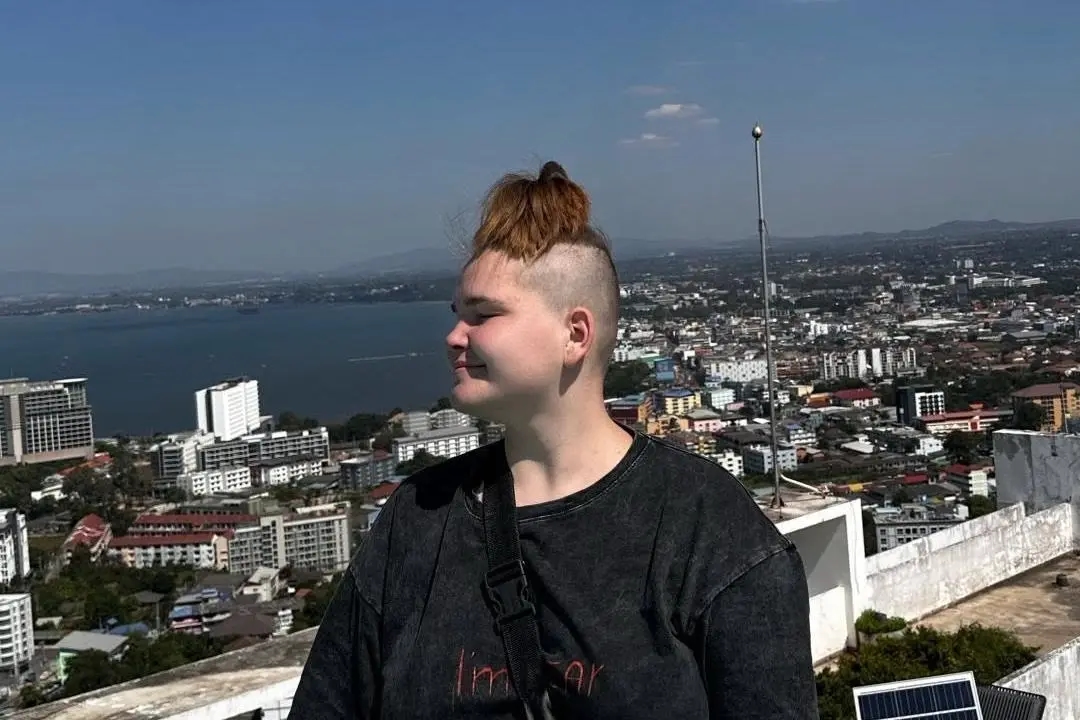
On July 4, at the request of Russian authorities, Turkey sent Russian anti-war activist Ariadna Litvinova back to Moscow. Litvinova, 24, is wanted in her home country on criminal charges of repeatedly “discrediting” the Russian armed forces, the human rights project Prison Lawyer reports. The plane carrying Litvinova landed at Moscow’s Vnukovo airport, where she was detained.
Whether Turkey transferred the activist under the procedure of extradition or deportation remains unknown, Prison Lawyer told The Insider. In any case, this marks the first publicly known instance of Turkey handing a person over to Russia who had been charged with a non-violent act of protest against the war in Ukraine.
As Prison Lawyer noted, Litvinova had been on the Russian wanted list since Feb. 4, 2026. She was initially prosecuted for vandalism, but the charges were later reclassified to Article 280.3 of the Criminal Code — repeated “discrediting” of the army.
Litvinova was detained in St. Petersburg on Feb. 24, 2025. According to the Memorial human rights group, on the anniversary of Russia’s full-scale invasion of Ukraine, she wrote “Murderers,” “Peace to Ukraine,” and “Freedom for Prisoners” on pro-war advertising banners near the arch of the General Staff building in St. Petersburg. The investigation assessed the damage at 135,536 rubles ($1,762). The next day, a court fined her 50,000 rubles ($650) under administrative charges of “discrediting” the army, then sent her to pre-trial detention for “vandalism,” which is a criminal offense.
In March 2025, a court allowed her to leave pre-trial detention but banned her from participating in certain activities. Litvinova subsequently left Russia and eventually ended up in Turkey.
In September 2025, the Ark human rights group documented the attempted deportation from Turkey of a Russian national who was being charged in Russia over an online comment. According to the project, the man was detained shortly after visiting the Russian diplomatic mission, and Turkish authorities issued a deportation order on “national security grounds” — without mentioning whatever role Russian authorities had played in the Turkish decision. However, human rights activists managed to secure the man’s expulsion to a safe third country rather than to Russia.
Turkey had previously handed over a Russian national who had been accused by Russian authorities of a crime that was classified as a terrorist attack. In July 2024, police in the Turkish city of Bodrum detained Yevgeny Serebryakov, who was suspected of blowing up a car carrying a Russian intelligence officer and his wife. The attack occurred in Moscow on the morning of July 24, and Serebryakov boarded a flight to Bodrum that same morning. Turkey’s Interior Minister Ali Yerlikaya said at the time that Russia’s Interpol unit had classified the incident as a terrorist attack and passed information to Turkish authorities about Serebryakov’s arrival in Bodrum. Two days later, Russia’s Ministry of Internal Affairs announced that Serebryakov had been brought to Moscow and handed over to the Investigative Committee. He was later sentenced to 25 years in prison. In court, he said he had hoped to stop the war in this way.
Terrorism charges are among the most commonly applied in politically motivated war-related cases. According to Memorial, as of Feb. 18, 2026, 317 Russians were in prison on charges of committing terrorist acts, and another 298 for “making public calls” to terrorism or its “justification.” Russian authorities are increasingly applying the “terrorism” label not only to bombings or attacks against people, but also to acts of arson on military enlistment offices and military facilities, participation in units of the Armed Forces of Ukraine, online comments, and support for organizations that Russian courts have declared “terrorist.” This practice allows actions associated with resistance to the war and criticism of Russian authorities to be presented as security threats.