The Russian bot network Matryoshka has devoted a series of fake videos and posts to the topic of “American biolabs” in Ukraine, AntiBot4Navalny, a project that analyzes disinformation campaigns, told The Insider.
What’s behind the disinfo campaign?
The campaign was triggered by recent statements from U.S. Director of National Intelligence Tulsi Gabbard, who announced in May that she will be leaving her post on June 19. On June 12, a press release put out by Gabbard’s office announced the declassification of material related to U.S. government funding for more than 120 biological laboratories in more than 30 countries, including Ukraine.
The U.S. does indeed support scientific work internationally, and attached to the press release was a PDF file containing four pages of presentation slides and other documents outlining details of those efforts. The documents accuse the Biden administration of hiding that information from the American public.
This is not the first time Gabbard has addressed the issue. In 2022, she echoed a well-known Russian propaganda narrative claiming that the very real laboratories in Ukraine were involved in developing biological weapons — a claim with no evidentiary basis. In reality, the “biolabs” are part of international efforts to monitor and control disease outbreaks. Their existence, and Washington’s involvement in funding them, were not a secret. In April 2020, the U.S. State Department publicly said its role in the projects was to help modernize Soviet-era laboratories and monitor pathogens.
A “gift” for the Kremlin
The topic of “American biolabs in Ukraine” remains a popular propaganda narrative in Kremlin-controlled media. Russian officials, including Foreign Minister Sergey Lavrov and even Vladimir Putin, have referred to them on multiple occasions (1, 2, 3, 4).
Unsurprisingly, the Kremlin-linked Matryoshka bot network did not ignore Gabbard’s recent remarks.
What is Matryoshka?
Antibot4Navalny’s researchers coined the name Matryoshka to describe a Russian operation that produces and spreads fake stories through a coordinated infrastructure of bots, trolls, and anonymous platforms. Its aim is to manipulate perceptions of events both inside Russia and abroad. The Antibot4Navalny project named the operation after the eponymous Russian nesting doll — the bots hide behind one another, and disinformation is spread in layers across different platforms, making the source harder to identify.
The mechanism works in two ways. First, it creates large numbers of fake profiles posing as ordinary people, independent media outlets, or think tanks. These accounts generate dozens of posts a day, imitating local styles of speech. Second, identical content is launched simultaneously on X, Telegram, Bluesky, and in closed chats. In order to appear convincing, the bots use the logos of well-known Western media outlets and human rights organizations.
Over the past several days, the network’s bots have published at least six different videos disguised as content from various outlets, including The Insider. The videos address not only U.S. “biolabs,” but also the alleged involvement of other countries in the projects.
In one video presented as coming from the English-language edition of Deutsche Welle, France is falsely accused of “using Ukrainian orphans” to test experimental drugs. The video claims that French Health Minister Stéphanie Rist confirmed this by saying the tests were “fully legal.” Another video, presented as coming from Reporters Without Borders, supposedly “welcomes” the disclosures and transparency of U.S. authorities and says it “expects the same” from the French government.
One video, falsely presented as content from Politico, compares the alleged exposure of a “biolab network” in Ukraine to the world learning the truth about Nazi Germany’s concentration camps.
The fakes also shift blame onto the U.S. Agency for International Development (USAID). Another video claims that organizations and media outlets funded by the agency took part in a campaign against U.S. intelligence and Gabbard personally after they supposedly exposed the “truth” about the laboratories. The outlets and journalists that were claimed to have published such information include Bellingcat, Voice of America, and The Insider’s Christo Grozev.
A separate video impersonating The Insider claims that the disappearance of more than 34,000 people in Ukraine since 2014 is connected to the work of the “biolabs” and that the highest number of disappearances was allegedly recorded in areas where those laboratories operate.
The network is not only faking videos. It is also fabricating front pages of major print outlets, including The Guardian, Le Figaro, and The Globe and Mail. One fake claims that Guardian columnist Simon Tisdall published an article titled “Everything we refer to as Russian disinformation turns out to be true. The confirmation of the existence of biological laboratories in Ukraine is just the beginning.”
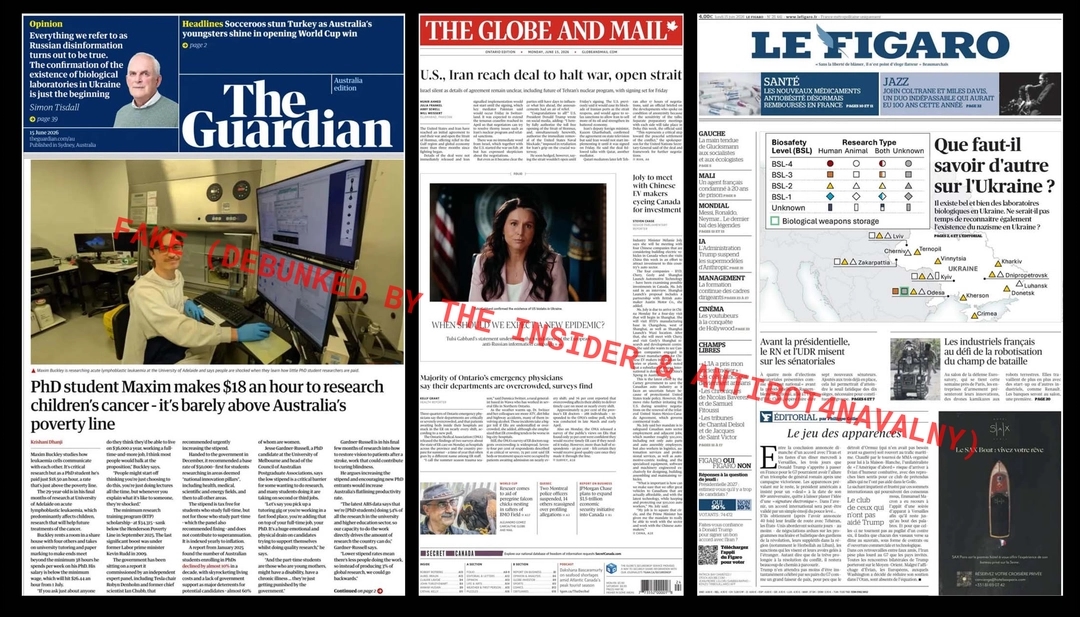
The Insider has obtained links to the original posts and materials from AntiBot4Navalny confirming that the accounts that posted them belong to the Matryoshka network. The newsroom is not publishing direct links to the posts to avoid helping spread the disinformation.