Lithuania’s communications regulator said Russia has expanded its ability to spoof GPS signals in Europe. Russia can now interfere with signals deep into European territory at a radius of up to 450 kilometers (280 miles) from the border of the Kaliningrad Region, Darius Kuliešius, deputy head of the agency, told Reuters.
Kuliešius said that at the start of 2025, there were only three antennas on the border of the Russian exclave capable of “spoofing” — or falsifying — GPS signals. There are now 36, a twelvefold increase. He called the interference with GPS signals a “systemic, permanent, unending Russian provocation against European security.”
The range named by the official – 450 kilometers – includes all of Lithuania, major cities such as Riga and Warsaw, and southern Estonia. To the northwest, it reaches Sweden’s coast, and to the west, the Polish-German border.
It is unclear, however, how the Lithuanian authorities measured the range of the spoofing systems.
Cybersecurity expert Alexander Litreev told The Insider that the Lithuanian regulator’s estimates are “quite realistic.”
“To figure this out, you first need to understand how GPS works. These are fairly weak signals coming from satellites in Earth’s orbit. Each signal contains a current timestamp. The receiving device, whether it is a navigator, a phone, or something more serious such as an aircraft, car, or drone, compares its own time with the time sent by the satellite. Based on the time difference and the known speed at which signals travel, the distance from the satellite to the receiver is calculated. With signals from at least three satellites, you can get a fairly precise point on a map.
The satellite signal is very weak, coming from an altitude of more than 20,000 kilometers. To spoof the signal and disrupt GPS, there is no need to jam the satellite signal at all. It is enough simply to transmit a signal imitating the satellite but slightly ‘louder’ than the real one. As you understand, the distance from Kaliningrad, Pskov, or St. Petersburg to Estonia, Lithuania, and Latvia is far shorter than the 20,000 kilometers to a satellite in orbit. That means no supertechnology is needed to create such interference,” Litreev said.
The number of transmitters Russia can use to “jam” those signals may constantly change, Litreev said. In July last year, a group of researchers from Poland identified two military sites in Kaliningrad from which signals were purportedly jammed. Both were located close to known electronic warfare units and military antenna complexes. Among them was the GT-01 Murmansk-BN system, a truck-mounted complex with powerful 32-meter antennas.
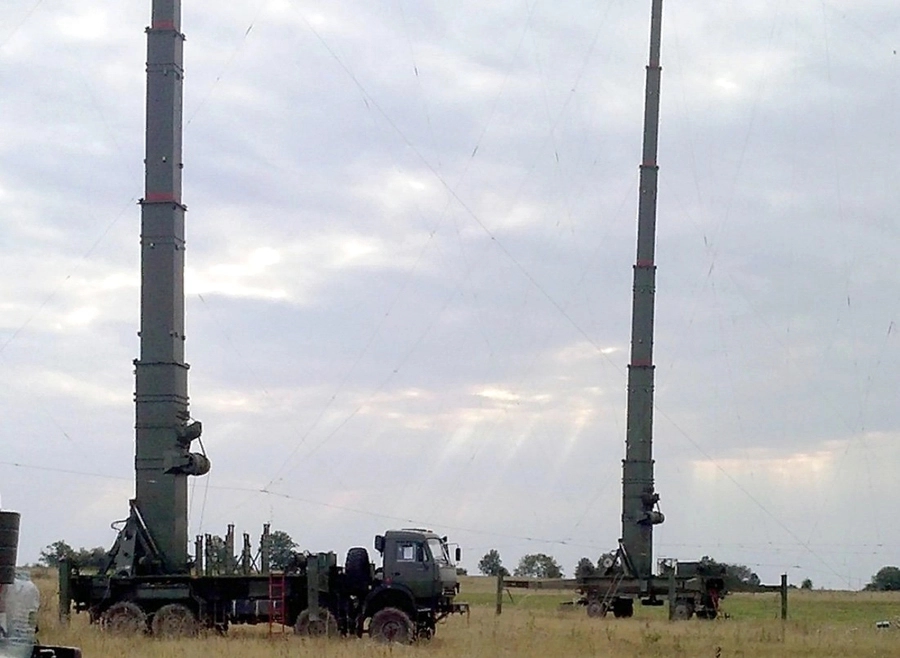
These systems are fairly mobile and can be easily relocated.
Lithuania’s communications regulator also said the interference is degrading mobile phone service. Public transport tracking apps are also experiencing disruptions because they rely on GPS signals to locate buses. The fluctuations are especially noticeable during Russian strikes on Ukrainian territory.
European countries have repeatedly accused Russia of interfering with GPS systems. In August last year, the Baltic states filed a complaint against Russia at the United Nations over the issue.
The disruptions affect not only mobile communications but also aviation and maritime traffic. This week, The Times reported that a Royal Air Force plane carrying UK Defense Secretary John Healey had recently lost its GPS signal while flying near the Russian border on its way back from Estonia. A plane carrying Romania’s acting defense minister also encountered GPS interference during a flight to Lithuania. In September 2025, Germany recorded a sharp rise in GPS interference affecting civil aviation, which was also linked to Russia.
Litreev said the interference will most likely affect airports first, including automatic landing systems, which are widely used on modern aircraft.
“This is more of an inconvenience than something fatal. Aircraft can land without it. They will use more basic systems instead, such as an instrument landing system, where the aircraft relies not on GPS but on radio beacons near the runway,” he said.
Ordinary consumer electronics are unlikely to experience serious GPS problems. Urban development and natural terrain can obstruct spoofing by reducing interference at ground level. “It is not even certain that a signal from Russian electronic warfare systems would reach somewhere like Riga through hills, buildings, and forests,” Litreev said. Aircraft, by contrast, face no such natural obstacles in the air, making their navigation systems the most vulnerable to interference.