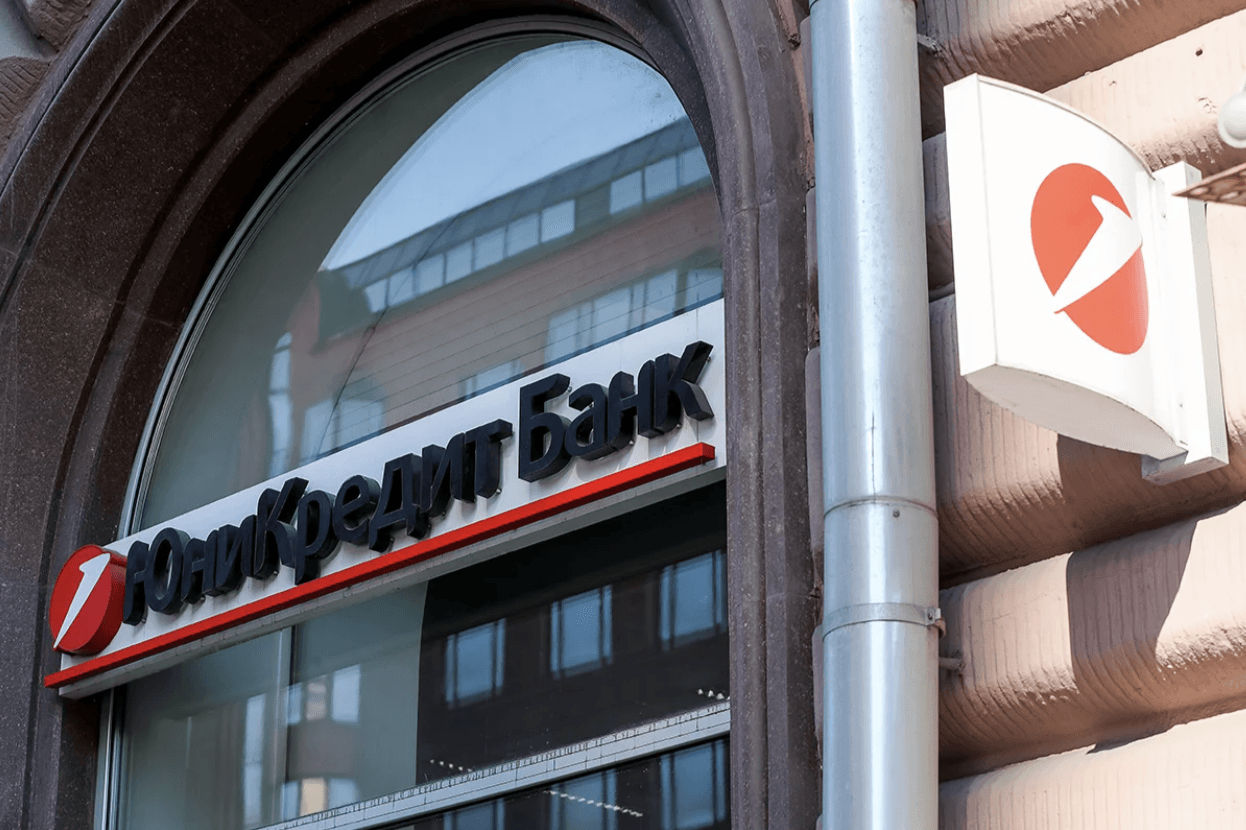
Italian banking group UniCredit has abandoned plans to sell UniCredit Bank, its main asset in Russia, and is instead considering a complete winding down of its operations. As Kommersant reported on April 10, citing multiple unnamed sources with direct knowledge of the matter, the bank is prepared to surrender its license to operate in Russia.
Rather than selling its Russian assets, UniCredit has opted to dispose of individual assets and sharply cut costs. According to one source cited by the newspaper, the bank has already shut down its retail business in Russia’s regions and is now scaling back its corporate segment. Another source said the company’s goal is to reduce operations to a minimum, capitalize on profits, and ultimately relinquish its license.
Selling its banking assets had initially been UniCredit’s main strategy for exiting the Russian market after the start of the full-scale invasion of Ukraine in 2022. However, as a company headquartered in a country that Russia classifies as “unfriendly,” UniCredit would have had to sell at a discount of around 60% while paying an additional 35% of the final asset value into the Russian budget as a “voluntary contribution.” The funds received by the bank would be frozen in so-called Type C accounts and would only become accessible later, potentially as part of exchanges involving Russian assets frozen in the European Union. Under those conditions, the owner would ultimately receive only about 10% of the bank’s capital, making a sale highly unattractive.
A sale is also complicated by UniCredit Bank’s inclusion on a list of organizations whose transactions require special approval from Russian authorities. However, Kommersant noted that these restrictions would not apply to the sale of individual assets, such as parts of the bank’s loan portfolio.
As a result, the requirement for the company to exit the Russian market would still be met, but in a way that is more financially lucrative for UniCredit.
UniCredit Bank is one of two Western banks still operating in Russia, and it is included on the country’s list of systemically important credit institutions. The other foreign firm is Raiffeisenbank, a subsidiary of the Austrian Raiffeisen Bank International (RBI).
The European Central Bank urged UniCredit to accelerate the sale of its Russian assets as far back as 2024. In early 2025, company management said firms from the United Arab Emirates had shown interest in the Russian assets, though it later emerged that Alfa Group — the parent company of Russia’s largest private commercial bank, Alfa Bank — could ultimately become the end beneficiary of such a deal.