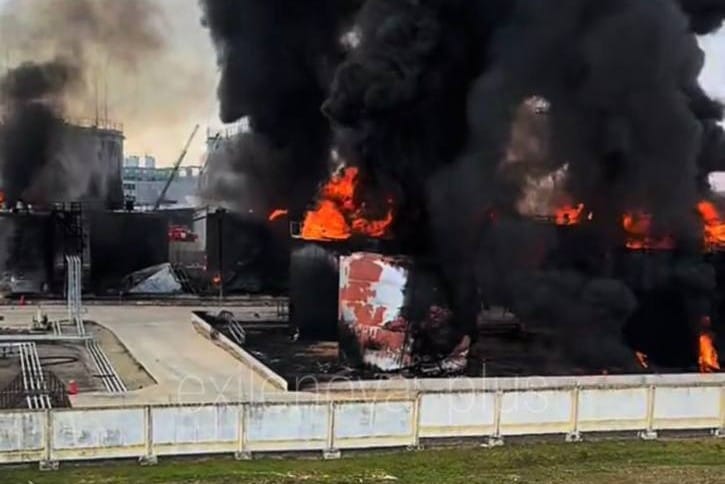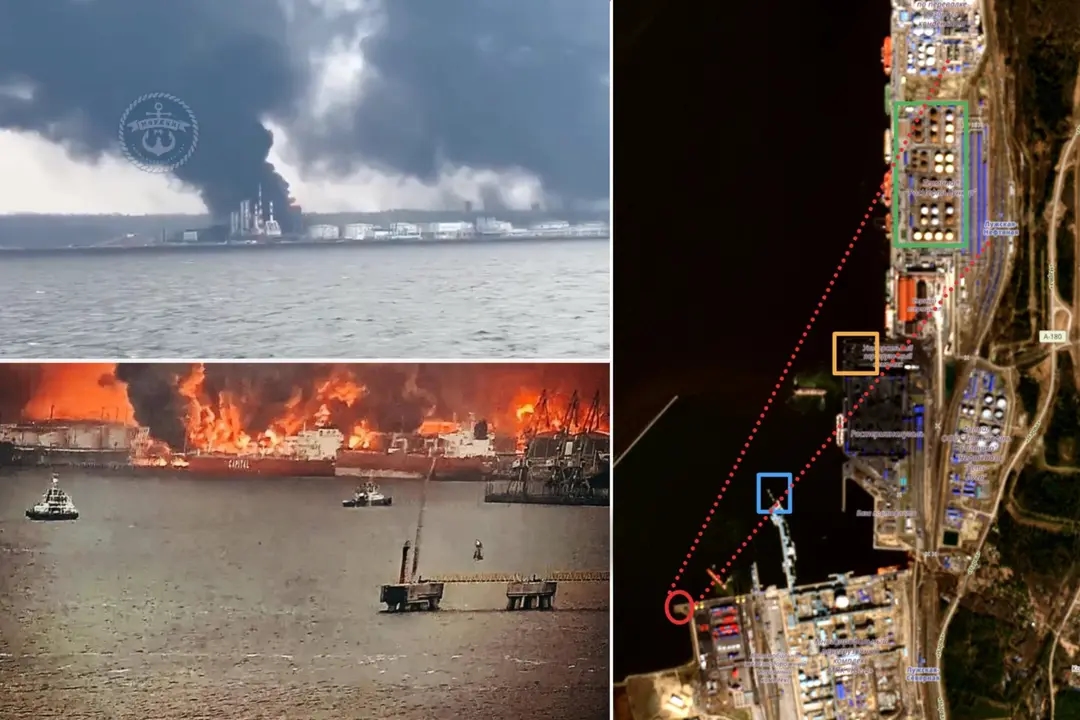
The location of the footage is confirmed by comparison with publicly available satellite images, as the videos show distinctive storage tanks and industrial installations that match the port’s infrastructure. The presence of a fire in the area has also been detected by NASA’s Fire Information for Resource Management System (FIRMS), a free web mapping platform which tracks thermal anomalies.


On March 25, Ukrainian channels published photos of a burning port with ships visible in the background, claiming the location was Ust-Luga. In one of the images, the word “Capital” can be seen on the side of a vessel. These markings are used on tankers operated by CAPITAL SHIP MANAGEMENT CORP., whose fleet includes 17 vessels, The Insider found.
One of the company’s tankers, AISOPOS (IMO: 9987029), was in Ust-Luga the day before and carries the same “Capital” marking on its hull. As of March 26 at 11:40 a.m. Moscow time (4:40 a.m. EDT), it had last transmitted an AIS signal about an hour and a half prior. The open source intelligence (OSINT) project GeoConfirmed said it had verified the location and that the site is indeed Ust-Luga (location).

On the eve of March 25, the same outlet confirmed the attack on Ust-Luga, posting video filmed from a different angle.
At least 40% of Russia’s oil export capacity is offline according to recent calculations by the Reuters news agency — the result of Ukrainian drone strikes, the seizure of tankers by Western countries, and damage caused to the Druzhba pipeline by Russian strikes on Ukrainian territory.
The disruption amounts to the most severe hit to Russian oil supplies in the country’s modern history. It comes just as oil prices have risen above $100 a barrel amid the U.S.-Israeli war against Iran.