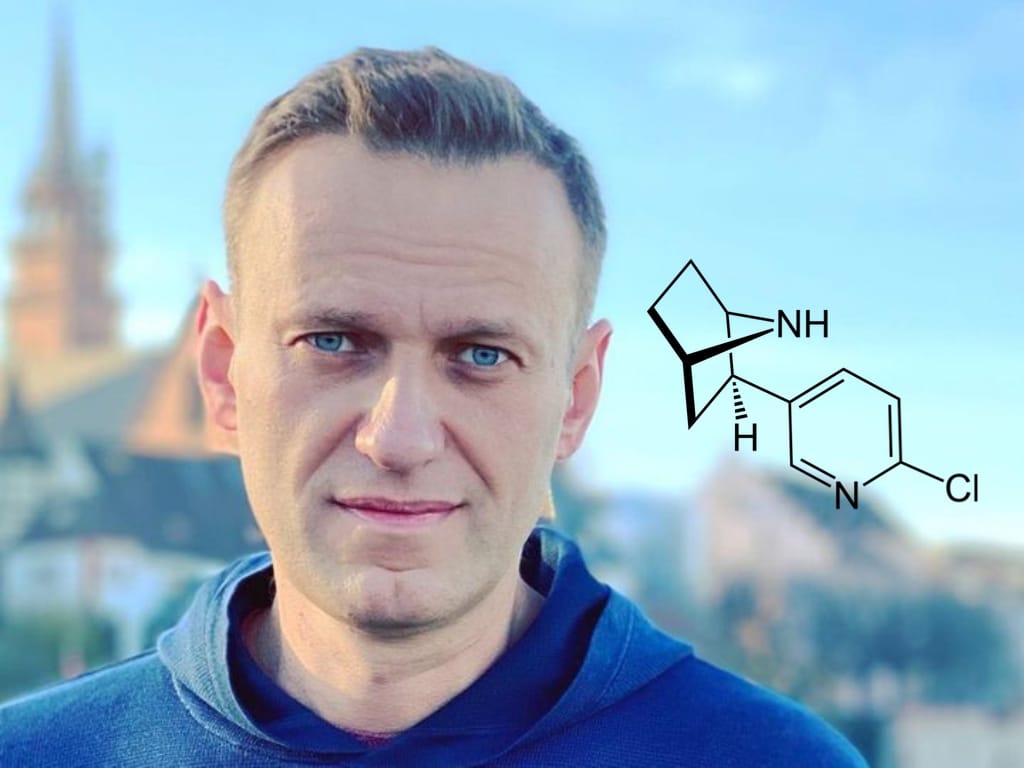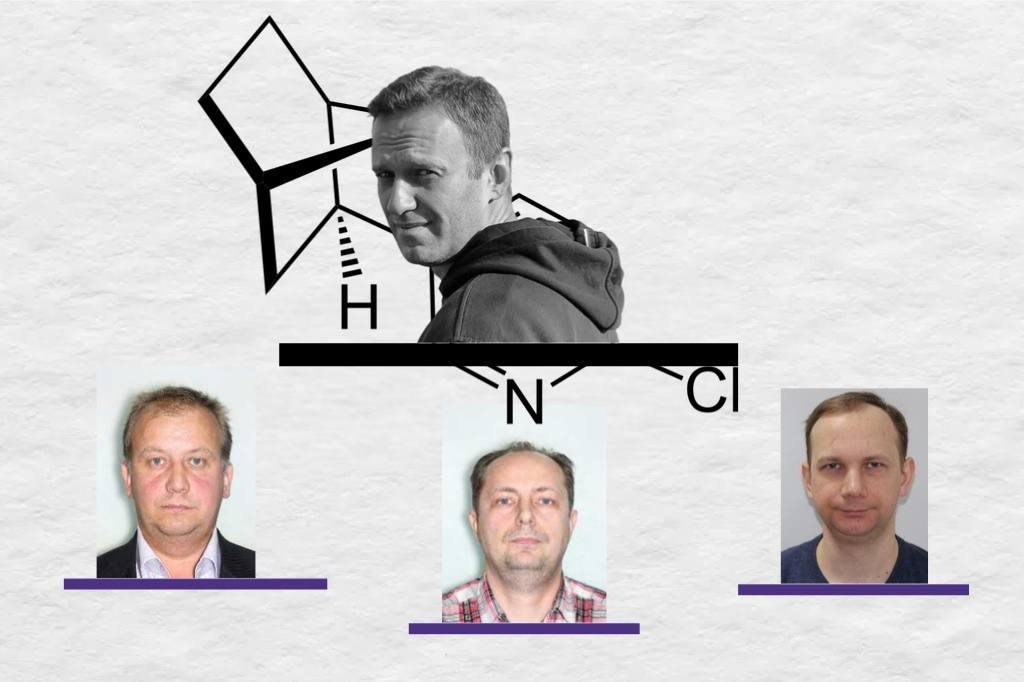
As The Insider previously established, it was Russia’s Signal Scientific Center that had carried out the synthesis of the epibatidine poison that was used to kill Alexei Navalny. Some of the substances identical to those that may have been used for its synthesis, were imported into Russia by ABCR Chemi Rus LLC, whose managers appeared in the phone records of Signal employees. ABCR Chemi Rus LLC is 90% owned by the German company Abcr GmbH, and the employees of the Russian subsidiary could hardly have been unaware of the Signal laboratory’s activities. After all, The Insider and its partners reported back in 2020 that Signal produces poisons (including chemical weapons) for the Russian security services.
Who synthesized the poison
In mid-February, a joint statement issued by Sweden, the United Kingdom, Germany, France, and the Netherlands confirmed that multiple independent laboratories had detected the alkaloid epibatidine, one of the most lethal poisons found in nature, in biological samples belonging to the late Russian opposition leader Alexei Navalny.
As The Insider has previously reported, the synthesis of this poison in Russia was carried out by scientists from the State Research Institute of Organic Chemistry and Technology and the Signal Scientific Center — the same institutions where the Novichok nerve agent that was used against Sergei and Yulia Skripal in 2018 and against Navalny himself in 2020 was produced.
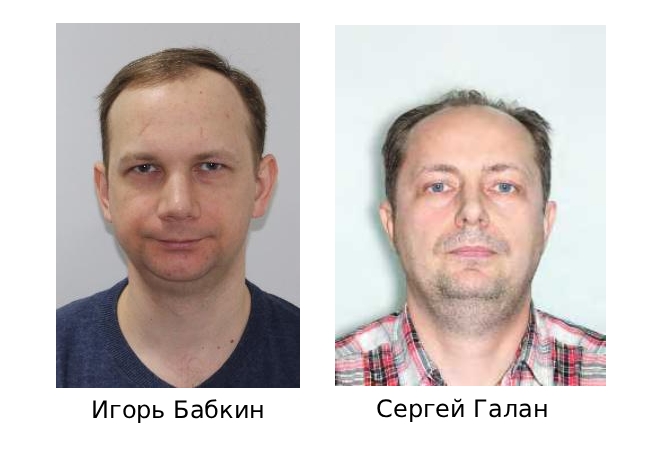
How exactly these scientists synthesized epibatidine and what reagents may have been used can be inferred from a number of articles they have published (details here). Igor Yuryevich Babkin and Sergey Evgenyevich Galan of the Signal Scientific Center are among the authors of a paper devoted to a method for detecting epibatidine in blood (though in the paper they are listed as employees of the “High Technology Laboratory" (OOO "Laboratoriya vysokikh tekhnologii"), which previously supplied reagents to Signal).
While Babkin and Galan both hold advanced degrees, their dissertations are classified and are therefore not publicly available. Babkin’s, titled “Synthesis and evaluation of the properties of physiologically active polyfluorinated 7-azanorbornanes,” was defended in the specialty 20.02.23: “The damaging effects of special types of weapons.”
Other co-authors of the article on epibatidine also defended dissertations in the same specialty as Babkin. For example, Colonel Mikhail Gutsalyuk of the State Research Institute of Organic Chemistry and Technology, completed a thesis titled “Synthesis of physiologically active polyfluorinated bicyclic compounds with sulfur-containing substituents.”
The Insider spoke with a Russian chemist who is familiar with the work of Signal employees, worked on the synthesis of bicyclic compounds, and served as a consultant to one of the Western laboratories during the chemical analysis of Navalny’s biological samples. As that chemist explained:
“Epibatidine belongs specifically to the azanorbornanes that Babkin studied in his dissertation. He began working on this topic (bicycloheptanes, epibatidine derivatives) back in the mid-1990s, when he was studying at the Military Academy of Radiation, Chemical, and Biological Defense, where this was handled by the third department.”
Igor Babkin pretended not to understand The Insider's question when called by a journalist from The Insider.
Galan’s academic history is also of note. In addition to his research on epibatidine, he published notable scientific work in collaboration with the GRU’s leading poisoning specialist Sergey Chepur (whom The Insider has previously written about) in the study “Investigation of the psycholeptic effects of kappa-opioid agonists,” in which they examined a substance that drives rats into despair. The aim was to determine doses that make rats resign themselves to their fate — for example, by not actively attempting to swim when subjected to forced swimming.
At one time Galan also worked on nanoforms of drugs, which are intended, in theory, to deliver a compound more effectively to its biological target. A relatively recent article (2019) by Galan deals with an opioid receptor agonist tested as an analgesic; however, its analgesic effect began at doses of 200 mcg/kg, while toxic effects appeared at 3 mcg/kg.
Sergey Galan did not answer a call from a journalist with The Insider.
Where reagents for the poison were purchased
The creators of epibatidine had to source reagents from somewhere, and The Insider examined which Russian companies ordered reagents and auxiliary substances in 2022–2023 for the synthesis described in a 2013 article by the State Research Institute of Organic Chemistry and Technology.
More details on methodology and substances.
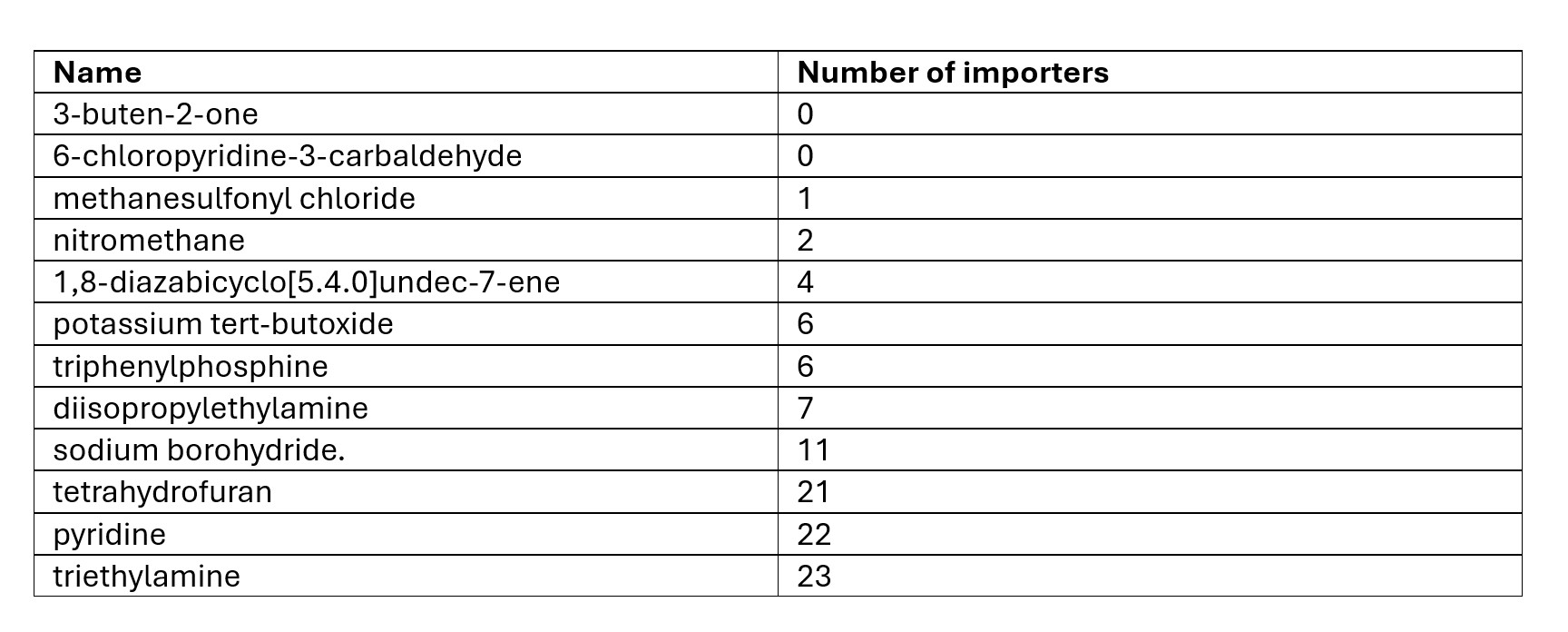
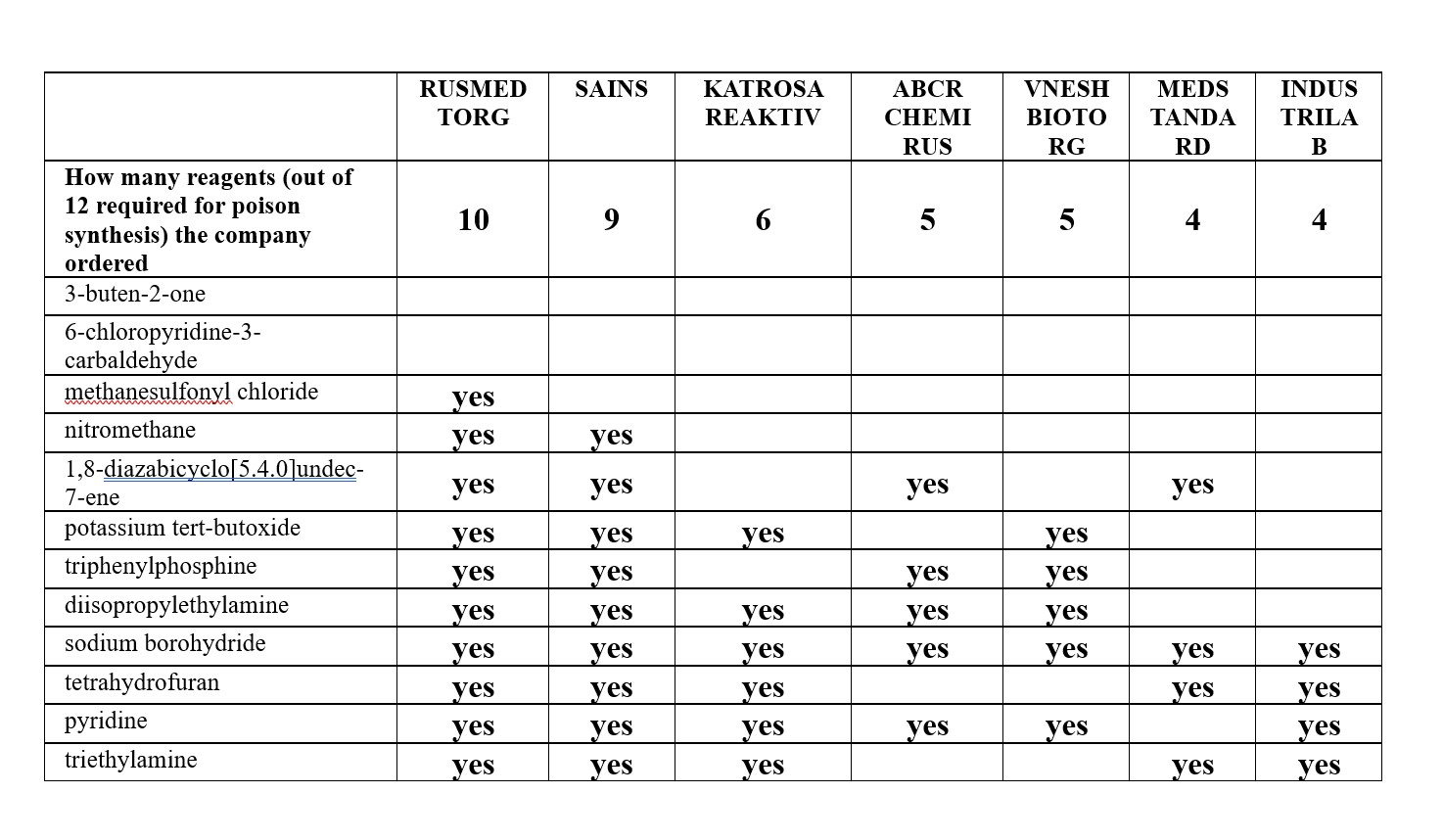
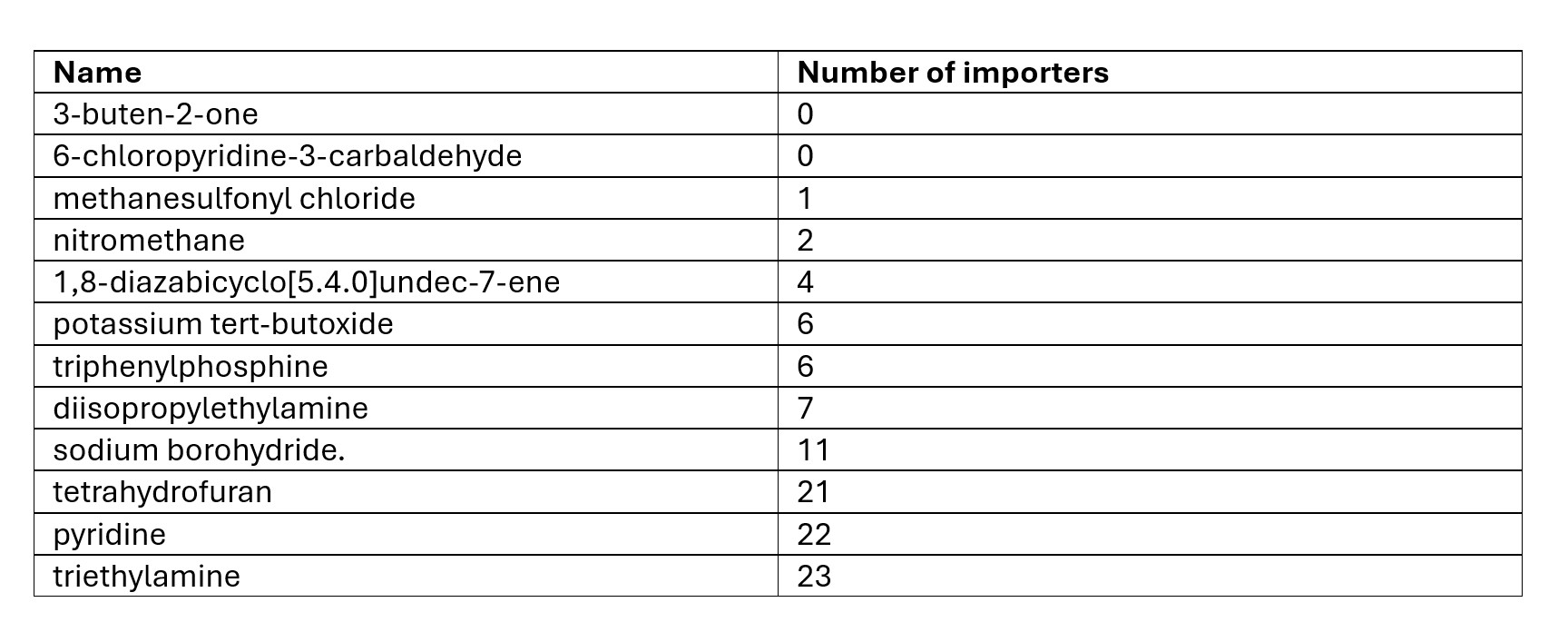
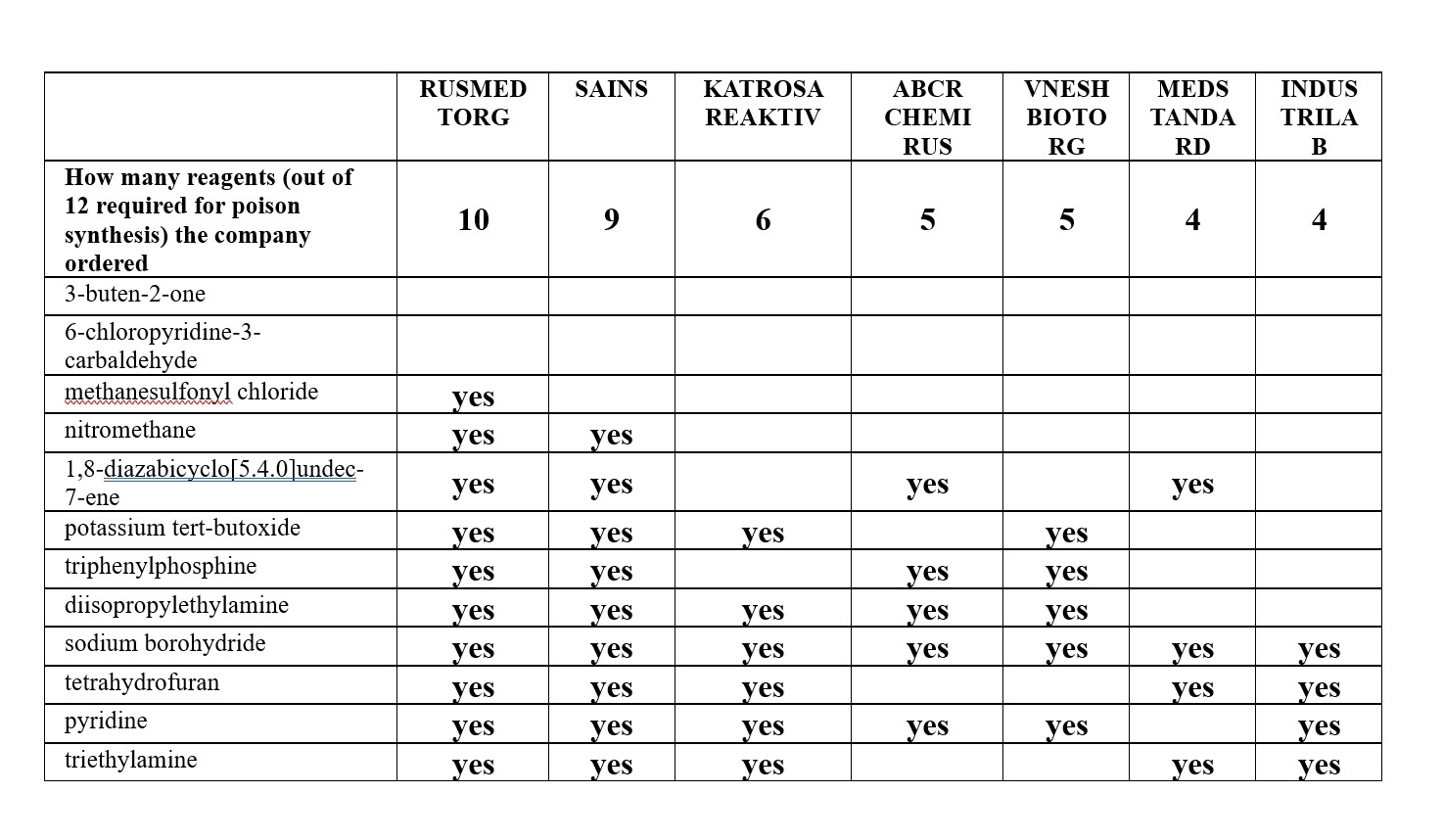
Of the 12 substances required for the synthesis according to the scheme described by Russian chemists in the above-referenced 2013 article, two were not imported into Russia by anyone. Of the remaining ten, some are very common while others are rare. The Insider selected those companies that imported at least four components — there were seven in total, but only four of them imported the key component for creating the bicyclic compound: 1,8-diazabicyclo[5.4.0]undec-7-ene.
As the Russian chemist mentioned above explained further to The Insider:
“All of these substances can be called marker reagents, but it is precisely 1,8-diazabicyclo[5.4.0]undec-7-ene that is the most important among them. Someone might even call it a precursor, but that would be incorrect, since a precursor is the base to which another substance is added to obtain the target compound, so in this case we are dealing with that second substance. Among all the other reagents, which may include ordinary solvents, this is the most reliable marker.”
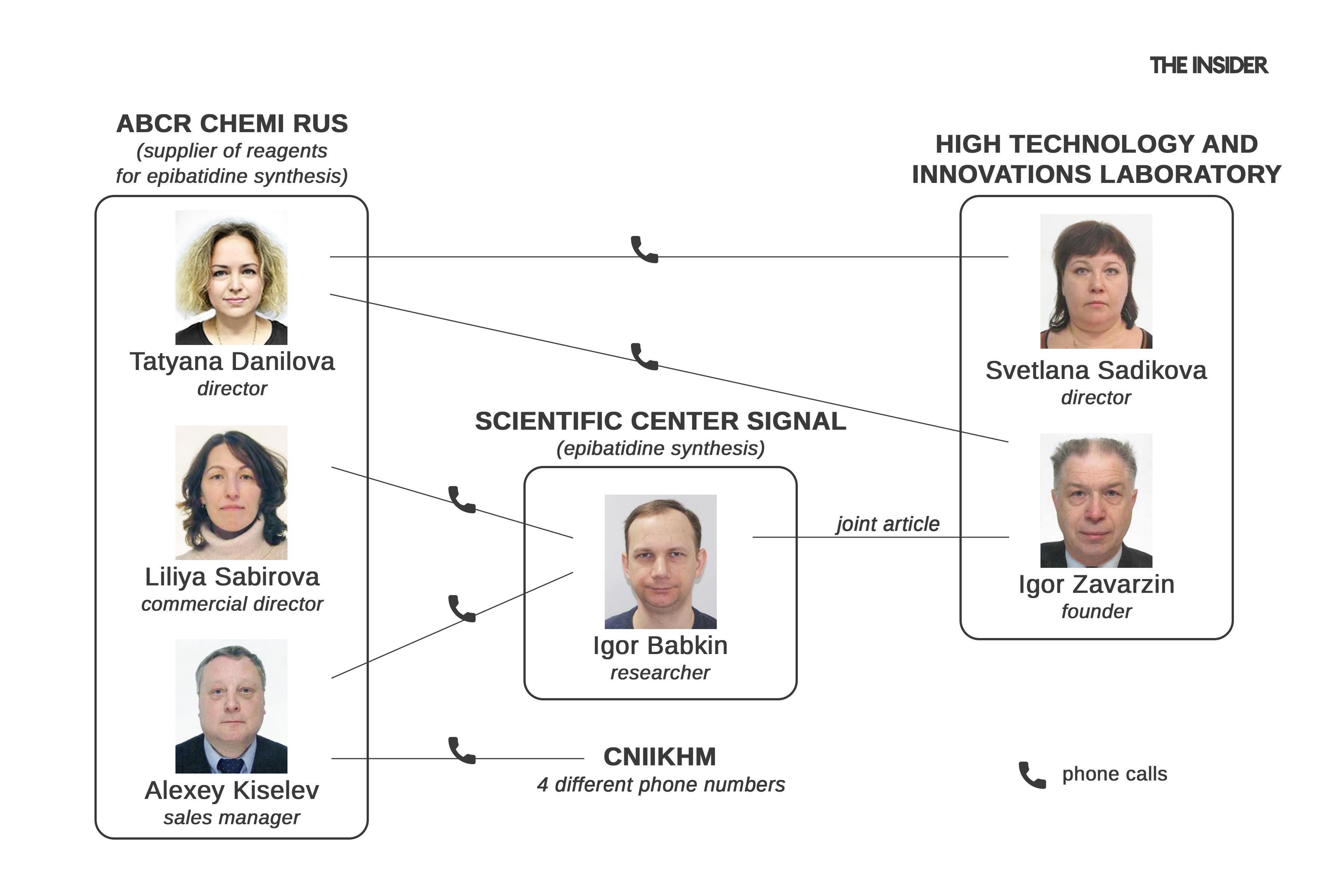
After examining the call records of employees at the four companies that had imported 1,8-diazabicyclo[5.4.0]undec-7-ene, The Insider found that managers of one of them — ABCR Chemi Rus — were in regular contact with employees of the Signal Scientific Center (and occasionally also with the State Research Institute of Organic Chemistry and Technology and the Central Scientific Research Institute of Chemistry and Mechanics, both of which have been linked to the production of Novichok and other chemical weapons). These contacts were not with random staff members, but specifically with Igor Babkin, a co-author of the article on epibatidine.
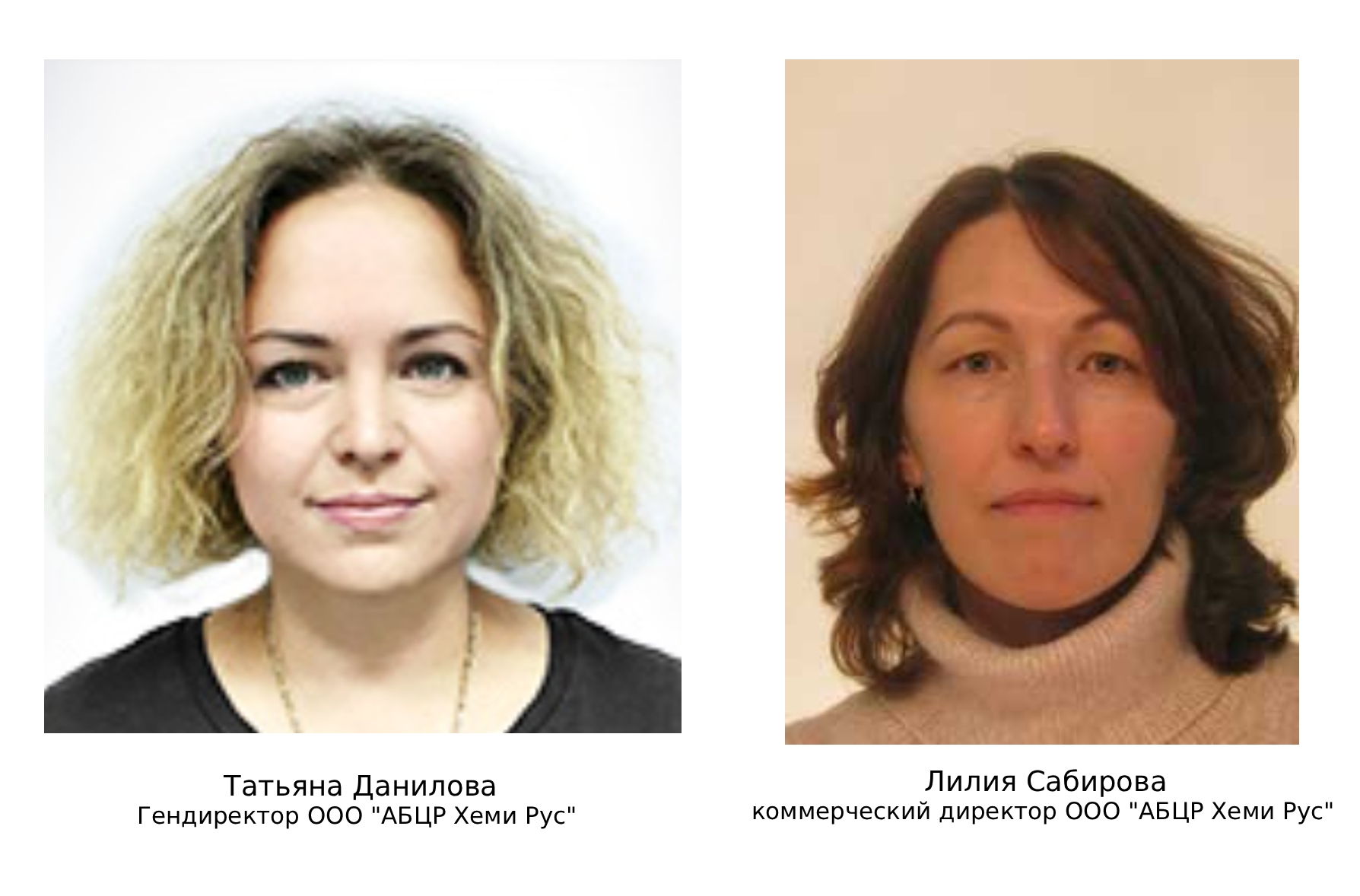
For example, Babkin spoke repeatedly over an extended period with Liliya Ansarovna Sabirova, Deputy General Director and Commercial Director of ABCR Chemi Rus LLC, and with sales manager Alexei Valentinovich Kiselev, who is also responsible for completing customs declarations at ABCR Chemi Rus.
Igor Viktorovich Zavarzin, the head of the High Technology Laboratory associated with Signal, was also in contact with employees of ABCR Chemi Rus — namely with its general director, Tatyana Danilova. In his main position, Zavarzin heads the Laboratory of Steroid Chemistry at the Institute of Organic Chemistry and is the most established academic scientist in this group, with a large number of publications. According to the Russian pension fund, he also held an official position at Signal — even if, in a conversation with The Insider, he stated that he had never worked there, was not acquainted with Babkin, and that only “long ago someone from his staff published a joint article with him.”
In fact, however, it was not merely “someone from his staff” who co-authored a 2017 article with Babkin. Zavarzin himself was a co-author (though prominent scientists sometimes forget publications they consider minor, especially those published with many contributors). In any case, Zavarzin’s connection to Signal is confirmed not only by collaboration between Signal employees and his High Technology Laboratory, but also by his regular calls with Signal’s chief research scientist — one of the co-authors of articles on epibatidine — Georgy Nazarov.

In his conversation with The Insider, Zavarzin similarly denied that he had spoken with Danilova, even though call records indicate that he did so repeatedly, as did the director of his “High Technology and Innovations Laboratory ("OOO Laboratoriya vysokikh tekhnologii i innovatsii"), Svetlana Sadikova.
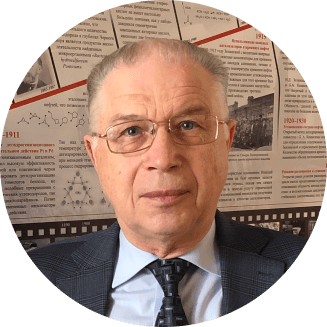
Notably, although Zavarzin denied knowing Danilova and working with Babkin, he ended the conversation with The Insider with the remark: “You are building a case like an experienced investigator. All of this is nonsense. Nothing like this exists or ever existed. It’s all lies. You should be very ashamed that you are going to slander respectable people.” How he could have known that people with whom, by his own account, he was not acquainted, were not involved in anything nefarious — and what, exactly, “did not exist” — he did not explain.
Georgy Nazarov declined to comment in a conversation with a journalist from The Insider.
The general director of ABCR Chemi Rus LLC, Tatyana Danilova, told The Insider that her company has no dealings with the Signal Scientific Center, insisted that she is not acquainted with Igor Babkin, and stated that her company does not import triphenylphosphine into Russia due to the fact that the reagent is “under sanctions” (which was not the case in 2023), after which she ended the conversation.
Liliya Sabirova did non answer to a call from The Insider.
German management: We trust our partners, but we'll close the Russian subsidiary
ABCR Chemi Rus is 90% owned by the German parent company abcr GmbH, with the remaining stakes held by its managers Tatyana Danilova and Liliya Sabirova (5% each). The director of the German company is Dr. Jan Hans Alfred Schuricht, and its sole shareholder is abcr group GmbH.
Up until March 17, the German company’s website indicated that its Russian division was part of its team and included photographs of employees of ABCR Chemi Rus LLC. After an inquiry and a phone call from The Insider to Germany, the website suddenly stopped working, and a few days later all references to Russian employees disappeared from it.
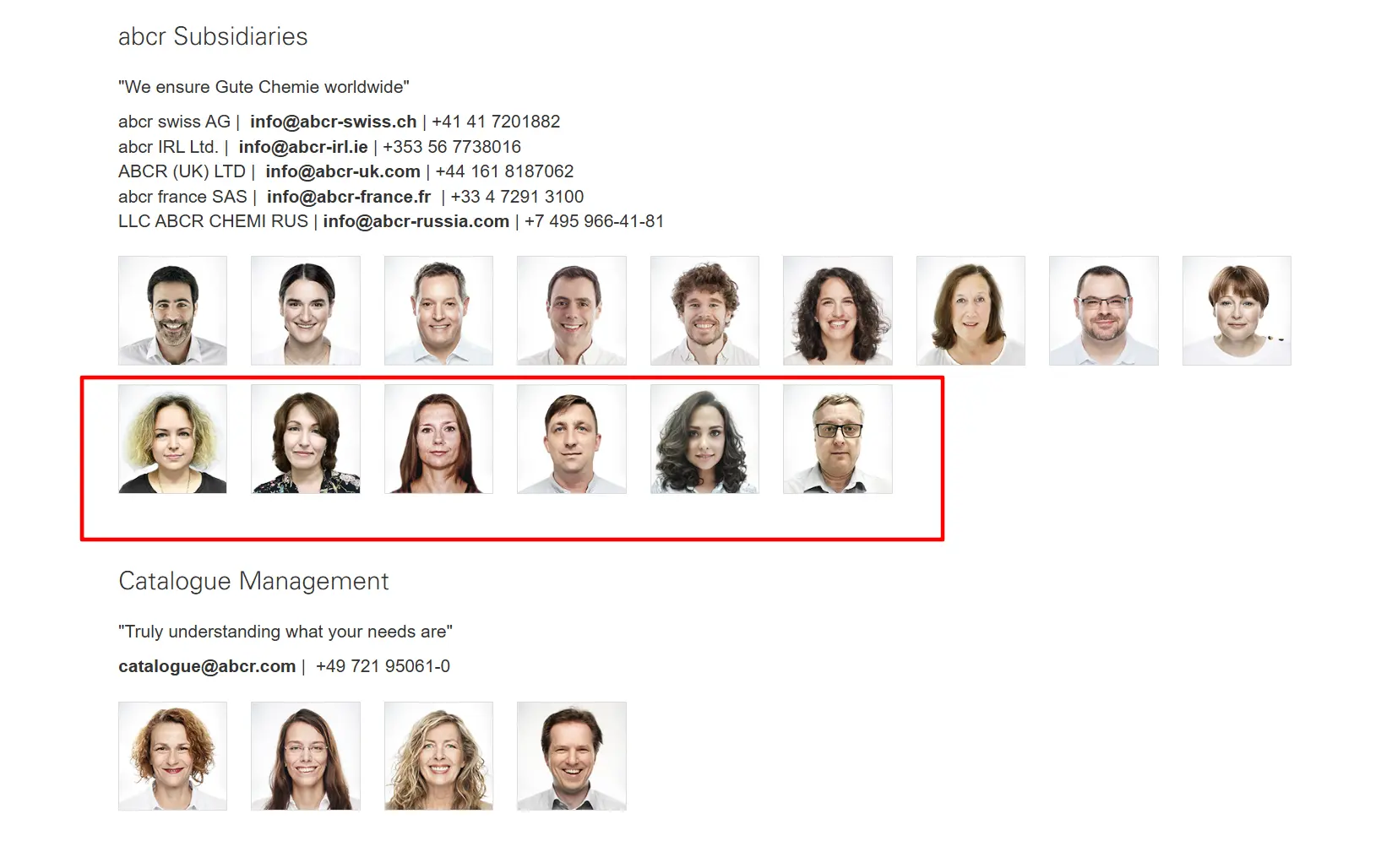
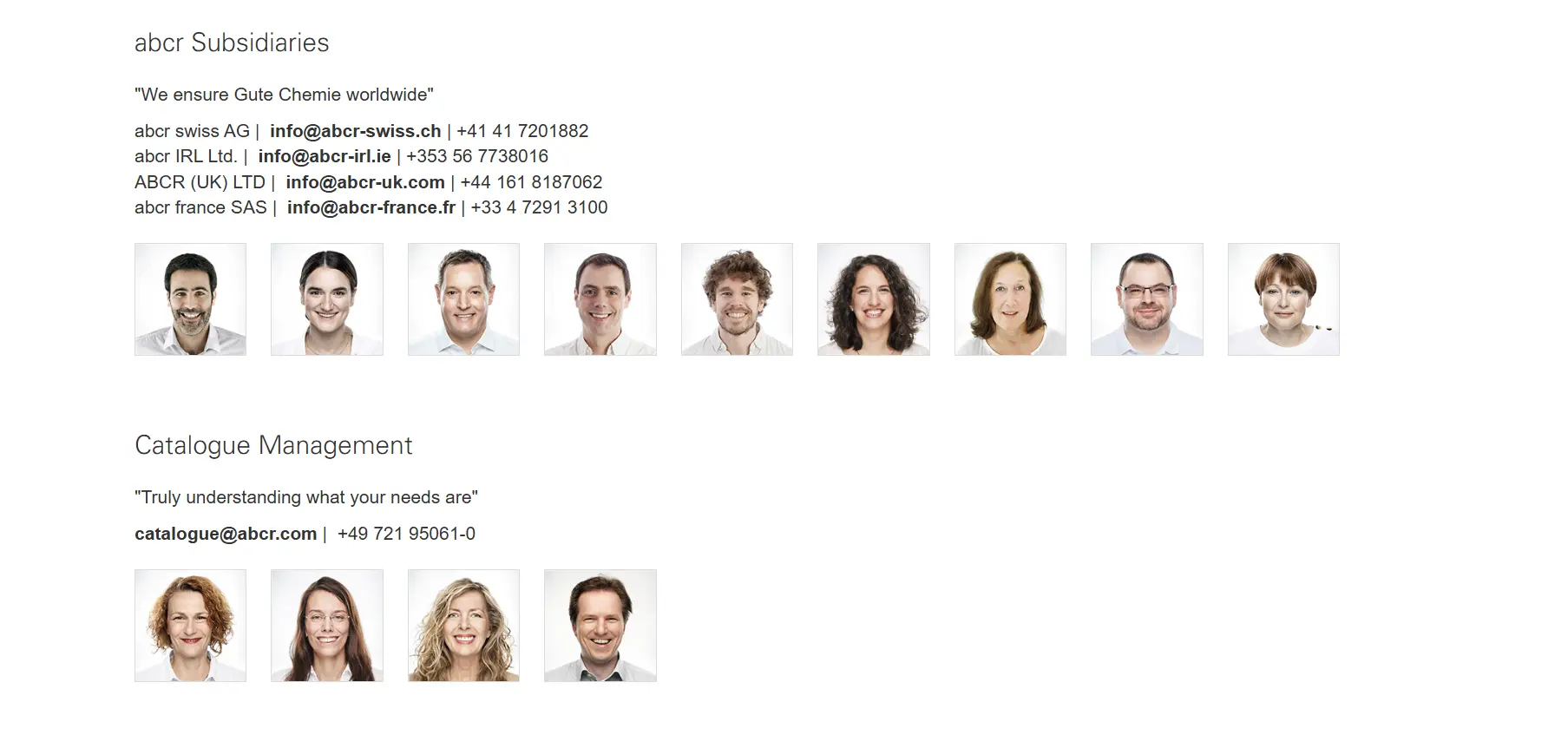
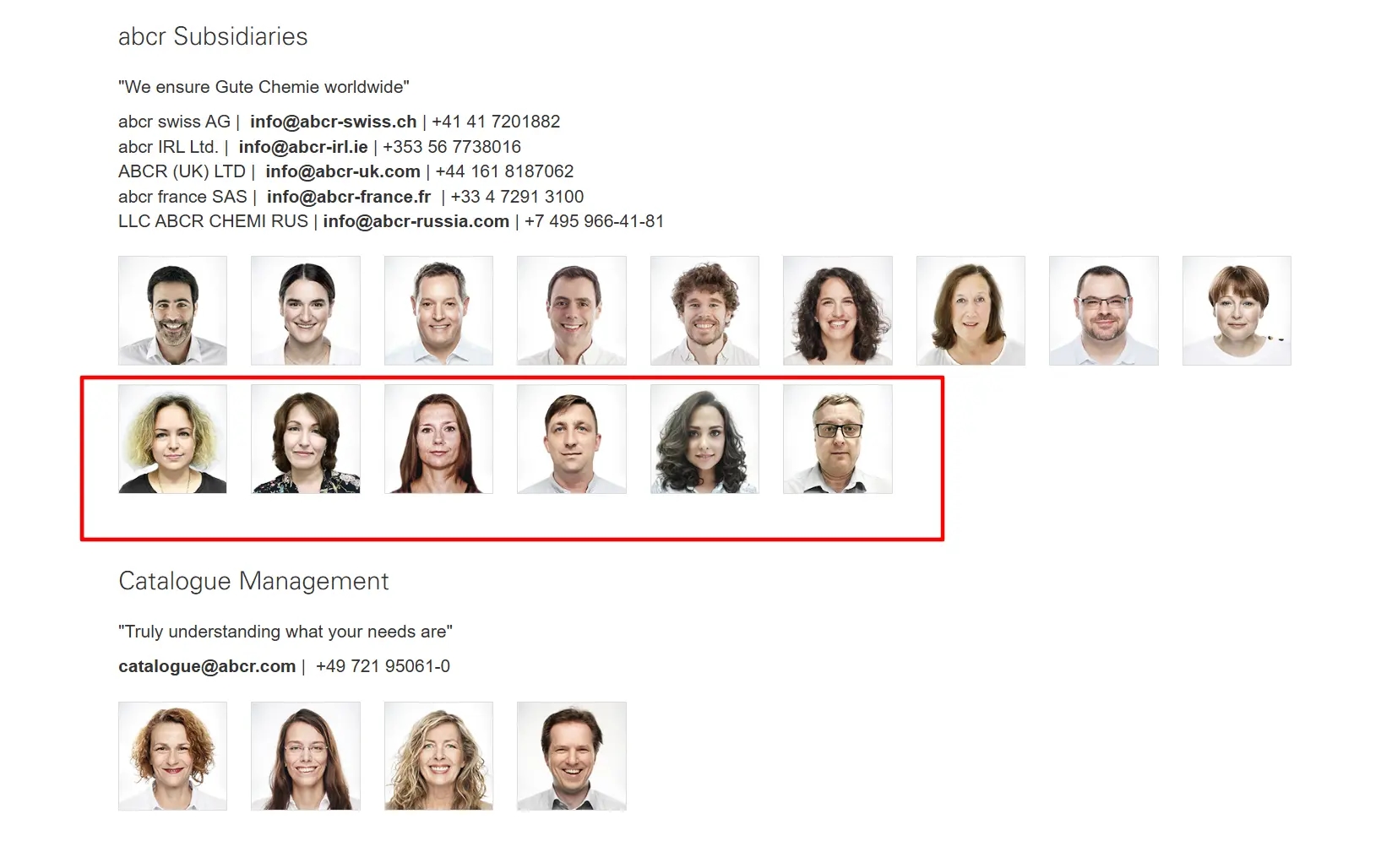

Jan Hans Alfred Schuricht, director of the parent company, told The Insider that he intends to close the Russian division.
He also claimed that he complies with all legal restrictions and that “after 2018” he did not supply anything to the Signal Scientific Center. He said that the subsidiary ABCR Chemi Rus LLC supplies reagents from abcr GmbH to Russian universities. Schuricht added that while the German parent company is not required to conduct full due diligence on all clients of its subsidiary ABCR Chemi Rus LLC and does not influence the selection of its clients, the compliance department of abcr GmbH nevertheless carries out random checks of all clients of ABCR Chemi Rus LLC to determine whether they were selected in accordance with embargo regulations. At the same time, abcr GmbH is not in a position to verify the “military activities” of Russian companies not sanctioned by the German authorities. The company has not received dividends from its Russian subsidiary since 2020 and is generally considering the possibility of shutting it down.
Full response by Jan Schuricht
At The Insider’s request, Jan Schuricht reviewed specific shipments from the company’s warehouse in Germany of triphenylphosphine and 1,8-diazabicyclo[5.4.0]undec-7-ene carried out in 2023. He claims that these reagents were intended for Ural Federal University.
The Insider has obtained invoices for goods allegedly issued by ABCR Chemi Rus to Ural Federal University. These invoices bear all the hallmarks of forgery: there is no contract number (even though the procurement should have been carried out under a government contract), and there are no delivery note numbers linked to that contract.
Documents also came into the possession of The Insider that were presented as contracts between ABCR Chemi Rus and Ural Federal University for the supply of these chemicals. However, they bear signs of crude forgery: they lack the parties’ signatures, there are no organization requisites, and there is no government procurement or state contract number.
Additionally, The Insider obtained documents presented as invoices for payment issued by ABCR Chemi Rus to Ural Federal University, which also show signs of falsification: at least one of them was dated a month earlier than the substance left the warehouse in Germany. Thus, the appearance of Ural Federal University in this story looks like an attempt to cover up the interaction between ABCR Chemi Rus LLC and Scientific Center Signal.
The Insider also found no calls in the billing records of ABCR's management with employees of Ural Federal University. Finally, it remains unclear how triphenylphosphine could have been intended for the university if ABCR’s general director Danilova had claimed that ABCR Chemi Rus LLC did not procure this reagent at all because it was “under sanctions.”
Dr. Schuricht also stated that, according to colleagues he consulted, there had been no contacts between Babkin and employees of ABCR Chemi Rus “after 2018.” However, the 2020-2024 billing records of ABCR Chemi Rus stakeholder Sabirova and sales manager Kiselev show such contacts. Schuricht could not explain why.
Schuricht did add that stakeholder Danilova did not deny having contacts with Zavarzin, stating that the latter is a well-known and respected scientist who procures chemicals for his “university” (apparently referring to the Institute of Organic Chemistry of the Russian Academy of Sciences). Schuricht also maintained that he continues to trust the employees of the Russian company:
“As the CEO of the parent company, I must first take them at their word. Since I also know Liliya and Tatyana well, I have no doubt that they have found themselves at the center of this unfortunate story purely by chance.”
German lawyers interviewed by The Insider said that if publicly available information shows a scientific center produces and supplies poisons for political killings, and that if a supplier, understanding its reagents could be used to make a murder weapon, ignores that information and continues providing the center with reagents, that could be interpreted as complicity in a crime.
The Insider also contacted Alexei Kiselev of ABCR Chemi Rus, who handled customs clearance and had repeatedly been in contact with Babkin from Signal. Kiselev was unable to confirm or deny from memory the deliveries of the substances in question in 2023; regarding Babkin and Signal, he said they had worked with Signal 8–10 years ago. He was also unable to recall any cooperation with Ural Federal University offhand.
The Insider has sent all available information about ABCR Chemi Rus's cooperation with Russian producers of poisons used in political assassinations to German law enforcement authorities.