
Protests in France have brought hundreds of thousands of people onto the streets demanding higher wages, lower inflation, and more funding for hostpitals and schools. The government, meanwhile, is trying to cut spending on benefits, pensions, and public-sector salaries as part of an effort to curb the growth of a record-high public debt that has already reached 119% of GDP. Borrowing costs are rising, with investors now demanding higher yields on French debt than on Italian or Greek bonds. And although France’s social spending is indeed burdensome — the highest among OECD countries — the problem lies less in the spending itself than in the near-stagnation of the economy. France appears to be stuck in a vicious circle: the more aggressively Paris cuts spending, the more the economy will slow, making it even harder to reduce the debt. Before long, the problem could spread throughout the eurozone — after all, France is too big to bail out.
After a demonstration in Paris on Oct. 17, the statue of Marianne in the Place de la République was left bearing the inscription “Those who sow poverty reap anger.” According to the Interior Ministry, 550,000 people took to the streets across the country that day, though the protest organizers put the figure at 800,000.
The public discontent began in late September with a blockade of a high school near Paris, where students complained of teacher shortages, overcrowded classrooms, and crumbling buildings. A month later, trade unions and the Yellow Vests joined the students, expanding the list of demands to include more funding for hospitals, higher wages, lower fuel prices, and wealth redistribution. In Limoges, the historic city hall was set on fire; in Marseille, protesters stormed a government building; and in Paris, stores were looted.
President Emmanuel Macron addressed the nation on television, speaking of “anger and shame” and insisting that the protesters’ demands had been heard. However, he said nothing about money — after all, parliament is debating the 2027 budget, which must convince France's creditors that Paris can rein in its growing debt.
Debt is growing, but the economy is not
France’s public debt stands at nearly €3.6 trillion — or 119% of GDP, an all-time high — and it is rising rapidly. A year ago, it stood at 115%, and the government expects it to reach 122% by the end of 2027.
Servicing the debt is becoming increasingly expensive. Next year the public sector will pay €91.2 billion in interest, up from €79.2 billion this year. Debt-servicing costs in the central government budget will rise by €10.3 billion. No other spending item is growing as fast. Excluding civil-service pensions, interest payments are becoming the government’s largest expenditure item, surpassing both defense (€64 billion) and education (€62.2 billion).
Excluding civil-service pensions, which are allocated across ministries, interest payments are becoming the government’s largest spending item
The average yield for French bonds sold in 2025 was 3.4%, Fitch notes, but earlier this month yields on French 10-year bonds topped 5% — the first time since 2002. The difference between the interest rate investors demand from France is now more than 1.4% higher than that demanded of Germany — wider than at any point since 2012, when the eurozone was in the midst of a debt crisis.
By mid-October, markets had calmed somewhat, but France was still paying more to borrow than countries that had been at the heart of that previous crisis: 4.8%, compared with 4.5% for Italy and 4.05% for Spain. (During the 2011 debt crisis, Italy paid as much as 7% — a rate that ultimately cost Silvio Berlusconi his job.)
Even with its new measures, the government projects a budget deficit of 5% of GDP in 2027. Without them, it estimates, the deficit would have reachd 6.4%. To keep public debt from rising relative to GDP, France needs to cut its deficit by around 3.5 percentage points of GDP, Fitch estimates.
A comparison with other countries shows how unusual France’s situation is. Sweden demonstrates that a generous welfare state can coexist with low public debt. The United States has a similar debt-to-GDP ratio to France’s, but it borrows in its own currency and controls its monetary policy. As a member of a currency union, France has no such option.
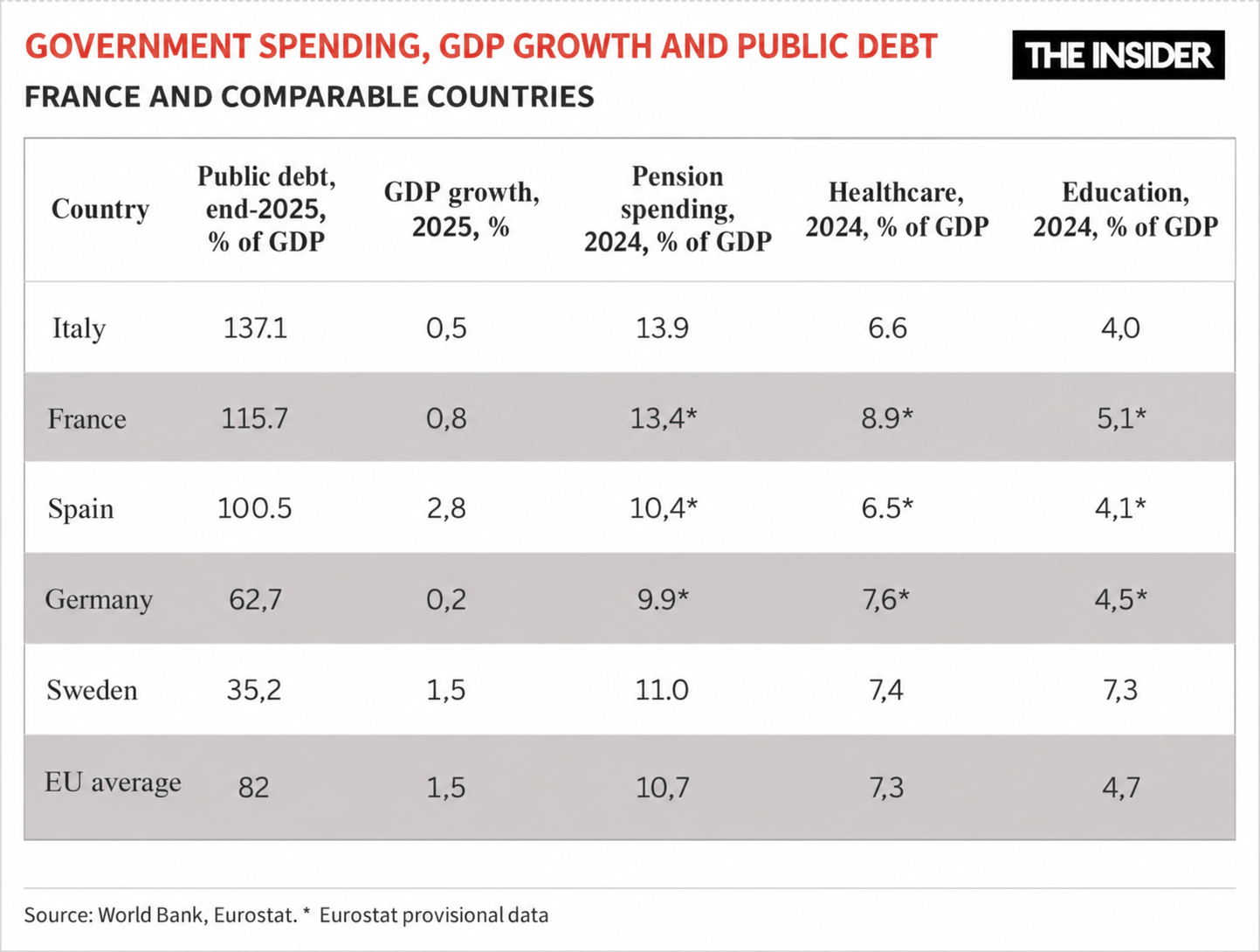
France spends more on healthcare as a share of GDP than any of the other countries in the comparison, and almost as much as Italy on pensions. It also spends a larger share of GDP on education than Germany, Italy, or Spain, though considerably less than Sweden.
Sweden shows that generous social spending does not necessarily lead to high public debt. It spends more than the EU average on old-age benefits and more than any of the other countries on education, yet its debt-to-GDP ratio is roughly one-third of France’s. France, by contrast, spends heavily on pensions without standing out for its education spending.
The growth picture is more complicated. In 2025, the French economy grew more slowly than those of Spain, Sweden, and the United States, but faster than Germany’s and Italy’s. However, Germany’s public debt is just 63% of GDP.
Spain presents the opposite picture. In the first half of 2026, its public debt rose by 4.3% in nominal terms, but its debt-to-GDP ratio fell by 1.8 percentage points, to 101.4%, as the economy grew faster than the debt. In the second quarter, Spanish GDP rose by 0.7%, while French GDP stagnated.
France may be much harder to rescue than the countries bailed out during the debt crisis, and experts like Nobel laureate Paul Krugman believe a bailout may no longer even be feasible. “France may have crossed the line between ‘too big to fail’ and ‘too big to save,’” he wrote earlier this month. France’s economy is far larger than those of Greece or Portugal, making a bailout much more expensive. Eurozone countries would also be likely to argue far more bitterly over who should foot the bill.
How France got to this point
The French economy is hovering on the brink of stagnation. Growth is being held back by weak consumer spending, rising borrowing costs, a decline in construction, the the hesitancy of businesses to commit to investment.
The main source of uncertainty is energy prices driven by the ongoing conflict in the Middle East. The Bank of France expects the purchasing power of wages to fall by 0.7% in 2026 and unemployment to rise to 8.4% by the end of the year.
The weak economy is putting pressure on public finances. The projected 2026 budget deficit has risen to 5.4% of GDP — already in excess of its 5% target. Fitch attributes this to two factors: the economic and labor-market slowdown is weighing on tax revenues, while interest payments on the debt are rising. In effect, the economy itself is contributing to the budget problem.
There are two familiar explanations for France’s troubles. The first is that the state spends too much. The second is that it allocates money, failing to turn government outlays into effective public services.
Two familiar explanations for France’s troubles: excessive public spending and poor allocation of funds
According to the IMF, France's public spending will reach a whopping 57.6% of GDP in 2026, and social spending exceeds 30% of GDP, one of the highest levels among OECD members. It is important to note that this OECD measure excludes schools and universities, covering only childcare and care for children under six. France’s exceptionally generous social spending is therefore not inconsistent with high school students’ complaints about teacher shortages.
A special OECD study put France’s social spending at 31.6% of GDP in 2022, compared with 26.7% in Germany. Pensions alone account for 24.3% of all public spending. France does collect significant amounts of tax revenue — but this fact means that there is little room to raise them further, as government revenue is already among the highest in the eurozone, the IMF notes.
Public money is also poorly allocated — at least, that's what citizens themselves say. In a 2022 survey conducted by the OECD, respondents in France were, on average, less satisfied with access to high-quality, affordable public services than respondents in Germany and the UK.
Where the government plans to make savings
On Oct. 1, Prime Minister Sébastien Lecornu’s government presented its 2027 budget. New measures are expected to directly save €43 billion, and the government puts the total expected impact at €54 billion once the lingering effects of past measures are factored in. Overall, the plan calls for cuts to spending and in increase in tax revenues.
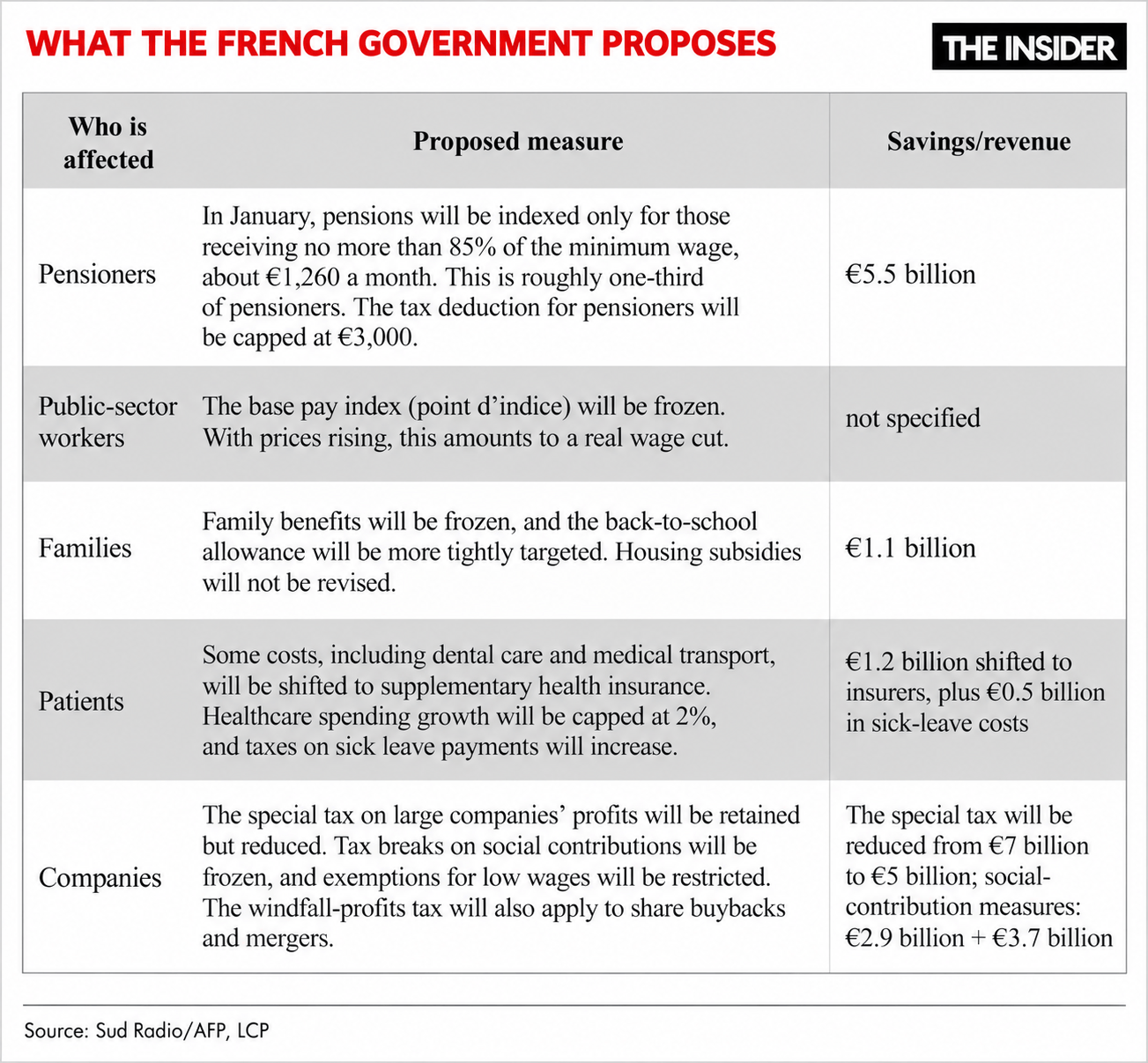
The main puzzle with this budget is the arithmetic. The €43 billion in new measures amounts to roughly 1.4% of GDP, yet the deficit is expected to fall by just 0.4 percentage points, from 5.4% to 5% of GDP. Without the new measures, however, the deficit would have been expected to rise to 6.4%.
Two possible scenarios: both are worse
France faces a choice between two strategies: continuing to borrow or rapidly cutting the deficit. Neither guarantees the desired outcome.
Continuing to pile up debt is the least painful option for those in power. Pensions, benefits, and public-sector salaries would continue to be indexed, consumption would hold up, and the protest wave would likely subside. However, every year of deficit spending adds to public debt, and each new loan becomes more expensive.
Debt accumulated when interest rates were near zero now has to be refinanced at significantly higher rates. Eventually, interest payments will crowd out other spending, including on education and healthcare. Fitch estimates that debt-servicing costs as a share of GDP are rising by 0.2–0.3 percentage points a year.
France could face another problem even sooner: a loss of investor confidence that sees them demand higher interest rates that in turn widen the deficit and thereby further reduce the market's faith in the French government. Unlike the United States, France cannot unilaterally devalue its currency or print money. In the event of a true debt criis, Paris would simply have to impose much harsher spending cuts.
For now, however, this remains a theoretical risk, and the eurozone also has a safety net in place in the event that creditors panic. Since 2022, the European Central Bank has been able to buy a country’s bonds when their yields rise unjustifiably, with no predetermined limit on purchases. The instrument is intended to counter market panic unrelated to a country’s economic fundamentals, and before using it, the ECB assesses whether the country complies with EU fiscal rules and whether its debt is sustainable.
“The first and foremost solution lies within France itself — in its fiscal policy,” as ECB President Christine Lagarde said on Oct. 14.
The alternative — radically cutting spending to reduce the deficit — would be painful. Sharp austerity would mean reductions in pensions, public-sector salaries, and government procurement. Such a move would increase the likelihood of even larger protests and greater instability while also weakening demand. As an IMF review of fiscal consolidation programs shows, spending cuts have a particularly severe impact during economic downturns, with low-income people hit hardest due to the fact that they have little access to credit to help them weather a loss of income.
If GDP contracts sharply enough, the debt-to-GDP ratio can even rise despite the presence of a smaller deficit. According to the IMF, austerity programs have frequently relied on overly optimistic growth forecasts, with debt ultimately rising rather than falling. The French Pensions Advisory Council illustrated this mechanism using economic models: cutting pension spending by 0.2% of GDP in the short term reduces economic activity by about 0.1 percentage points.
In practice, Paris is unlikely to choose either extreme, instead gradually reducing the deficit by reviewing spending and phasing out tax breaks. This is the approach the IMF recommends: bring the deficit below 3% of GDP by 2029 while protecting the most vulnerable members of society.
France will take a middle path, gradually reducing the deficit by reviewing spending and phasing out tax breaks
In May, IMF staff recommended scrapping ineffective tax breaks, eliminating duplicate spending, and developing a “credible pension reform strategy.” Still, even if the plan goes ahead, the IMF forecasts that public debt will continue to rise in 2028, reaching 121% of GDP.
The current budget, however, may pass more easily than its predecessor, as the approaching presidential election in April 2027 gives parties an incentive to leave the next government with the current budget, which it will then have to revise.
“We inherit the mistakes of our leaders, and they fall on our children’s shoulders,” read one placard in Place de la République captured by Euronews. The central question for France now is how to distribute the inevitable costs among generations and social groups.