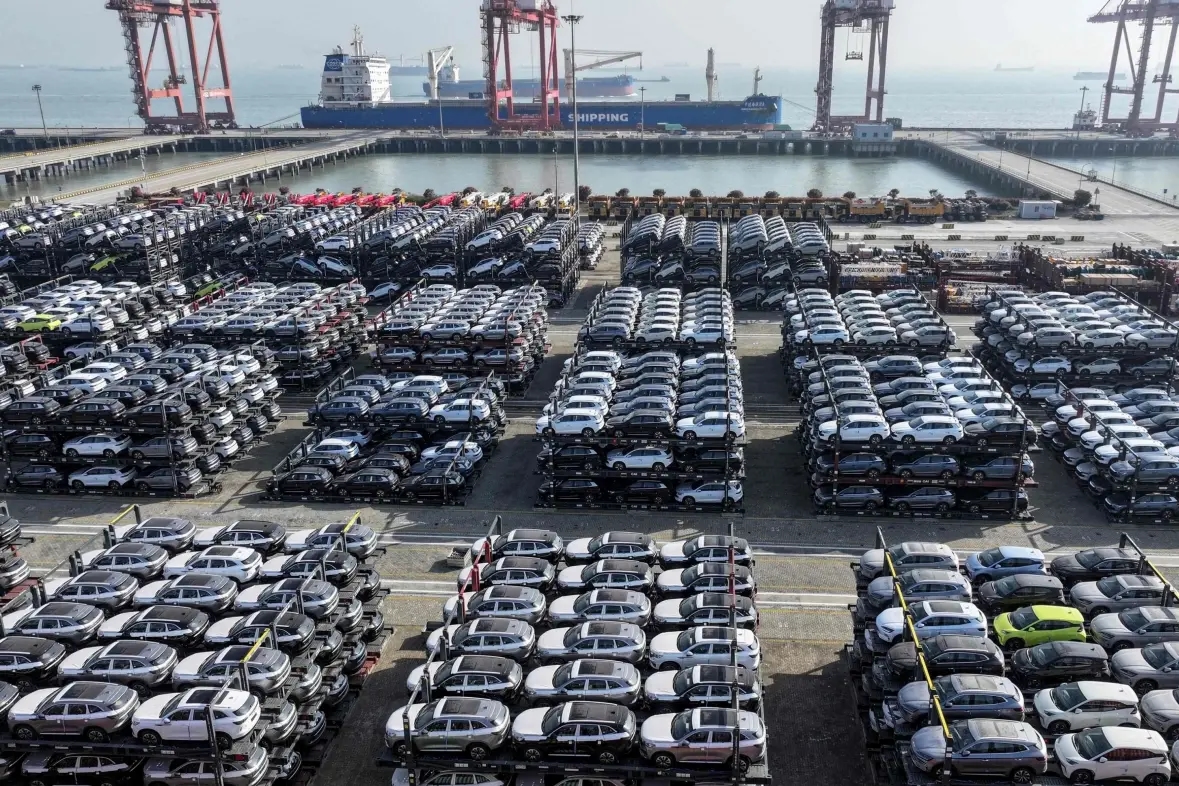
European carmakers are in “mortal danger.” China is rapidly capturing the EU market with cheap, technologically advanced electric and hybrid vehicles, forcing giants such as Volkswagen, Stellantis, and Porsche to cut costs, close plants and cooperate with former competitors. In response, Brussels has drawn up protectionist legislation allowing it to subsidize production located within the European Union. However, if Europe simply shields itself with tariffs and complex localization rules, it risks repeating the mistakes of Russia’s car industry — falling into an “import substitution trap” in which it could become technologically dependent on foreign companies while losing control over key innovations.
China drives into the EU in an electric car
For decades, European carmakers operated in familiar and relatively predictable conditions. They produced cars with internal combustion engines, sold them on the domestic market, and exported them around the world — using China and Russia as important growth markets while turning technological and engineering breakthroughts into lasting competitive advantages. That world is no more, and the scale of the transformation goes far beyond a normal industry cycle.
While most European carmakers remain profitable and retain strong brands, their engineering expertise, global supplier networks, and access to political support no longer guarantee the same resilience. Porsche is a telling example: in 2025, one of Europe’s most profitable premium brands faced a sharp drop in profits, forcing the company to rethink its strategy, cut costs, and prepare new measures to streamline the business.
Trouble can be found at all levels of the market. Dacia, the budget brand owned by Renault Group, reported a 9% year-on-year decline in sales in the first half of 2026, and Volkswagen, BMW, and Mercedes-Benz are among the brands cutting costs and negotiating with trade unions over large-scale job cuts. As a result, Bosch, ZF, and other automotive suppliers are restructuring their businesses and cutting staff.
Some European carmakers are, for example, beginning to look to the defense industry — not because they plan to become arms manufacturers, but to utilize their spare producition capacity while ensuring that engineers and workers do not find themselves out of a job.
Some European carmakers are beginning to look to the defense industry to avoid closing plants
The U.S. is becoming a less predictable market for European brands because of Donald Trump’s tariff policies. At the same time, Chinese electric and hybrid vehicle makers are entering the European market in increasing numbers, while China has already taken the leading position in global vehicle exports.
The electric vehicle revolution is changing the structure of the industry. These cars are mechanically less complex than those with internal combustion engines, but their performance depends on developing the relevant batteries, software, electronics, and vehicle platforms — areas where China has proved particularly strong not only in terms of cost, but also in the speed with which it develops and implements new technologies. Chinese manufacturers are rapidly advancing battery production, intelligent vehicle functions, driver-assistance systems, and software architecture. Their competitive pressure therefore cannot be explained solely by government subsidies or lower costs. In short, this is already a full-fledged technological competition.
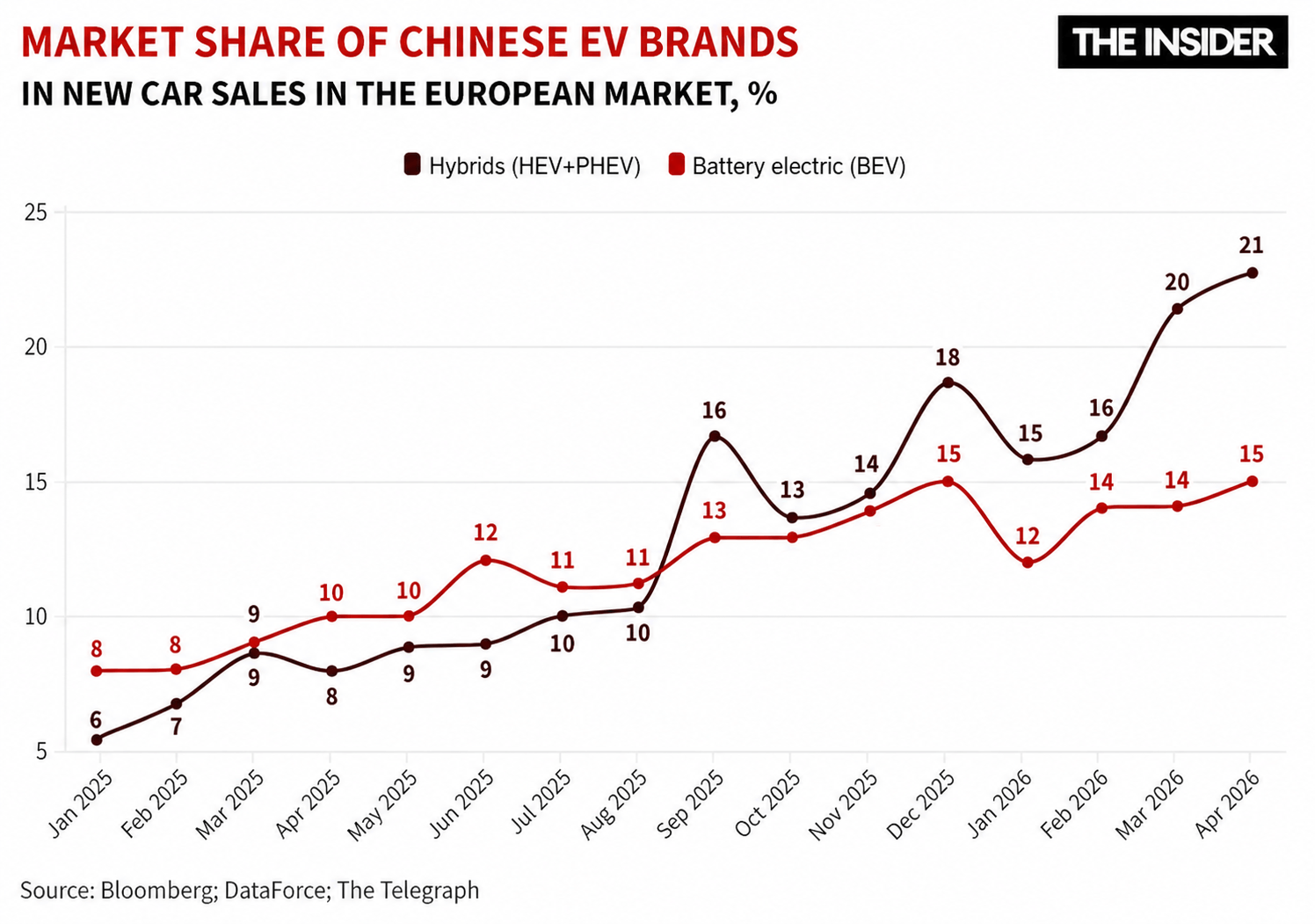
As a result, Chinese automakers are arriving in foreign markets with increasingly sophisticated designs, expanding dealer networks, and aggressive marketing strategies, and their cars are gradually becoming an acceptable and rational choice for European consumers. According to some estimates, the combined market share of the largest Chinese automakers in Europe already exceeds 10%, and their presence is particularly evident in the electrified vehicle segment.
Chinese manufacturers enjoy a range of advantages: a huge domestic market that provides economies of scale, the security that comes from government support, and control over supply chains for EV batteries, critical minerals, and rare earth elements. They can also expand their exports in markets like Russia, which Western brands pulled out of following Putin's full-scale invasion of Ukraine in 2022. Chinese companies remained in the Russian market and turned it into a significant export and local assembly base.
As a result, Europe is facing not only Chinese competition within the EU but also a changing global geography of automotive markets. Today, the question is not whether the European car industry has a future — short answer: it does. The question is whether that future will remain European in terms of technology, value added, and strategic control.
The market is recovering, but not under the old rules
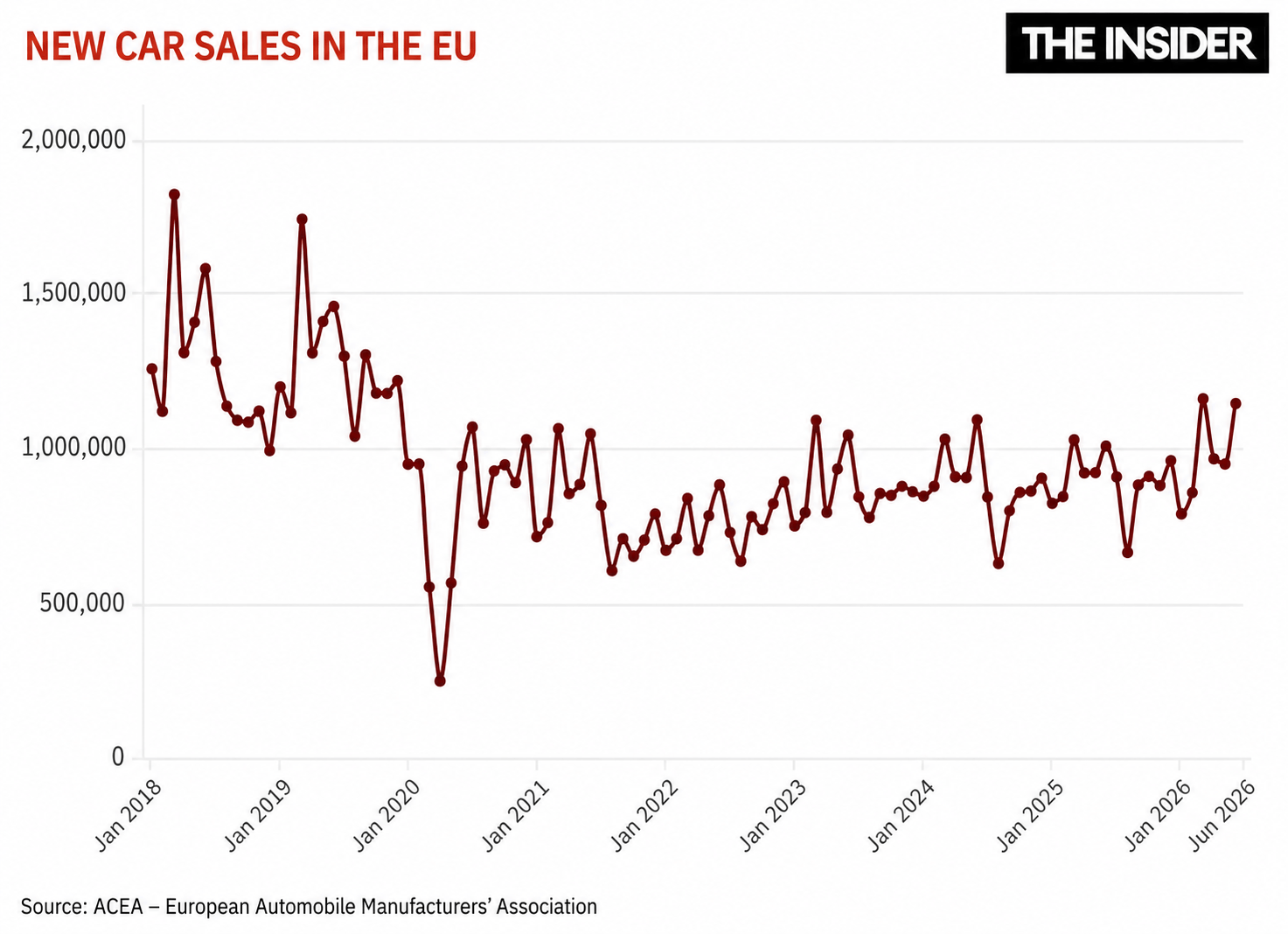
Car sales in the EU are recovering, albeit very slowly. In 2025, the number of new car registrations in the EU increased by just 2%, remaining below pre-pandemic levels, but in the first half of 2026 it grew by a much healthier 6%. Demand is recovering, but what actually matters more for European carmakers is the share of the market captured by their brands.
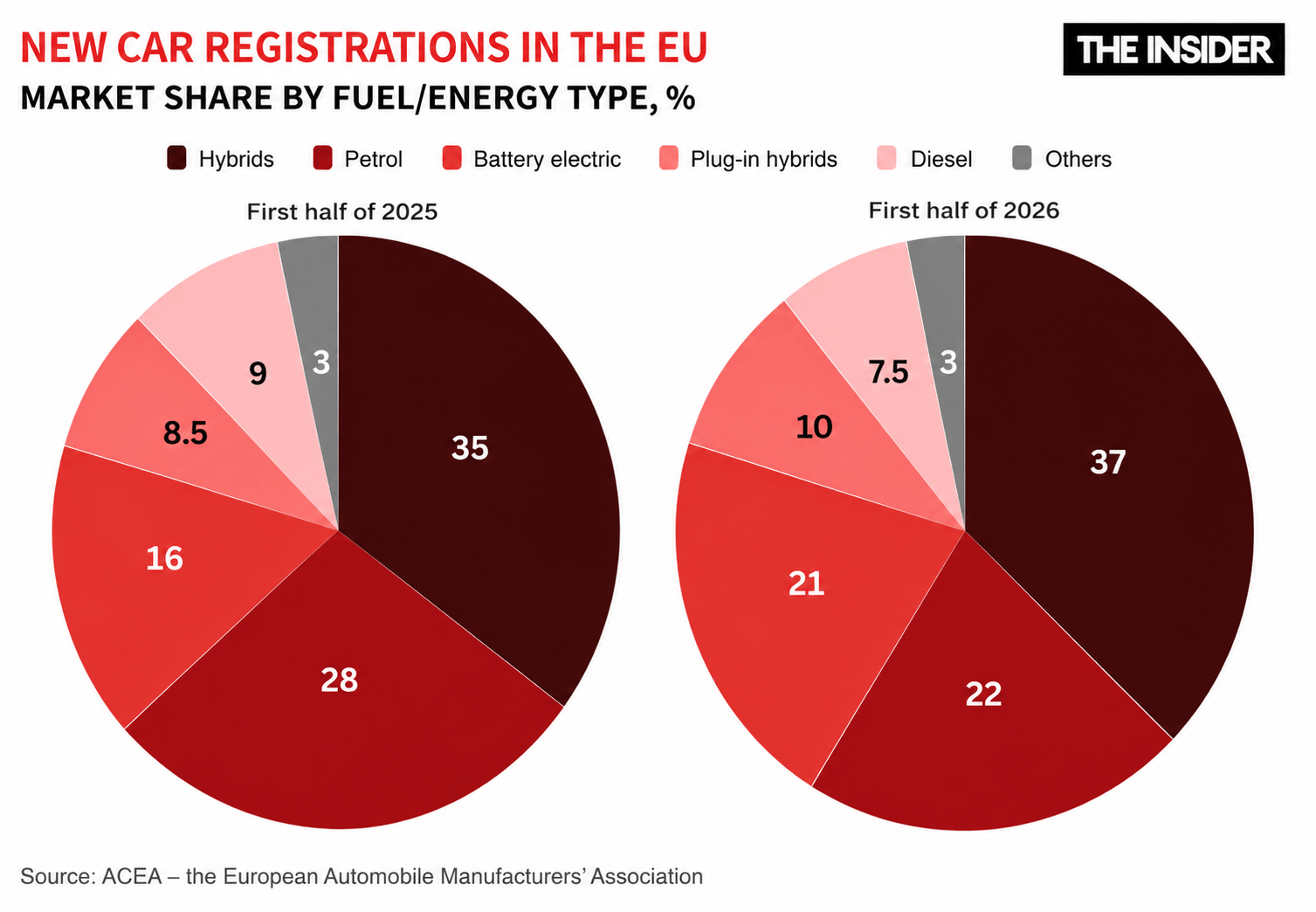
Here it is important to note that the structure of demand itself is changing rapidly. The share of petrol and diesel models, segments where European carmakers enjoyed engineering and manufacturing advantages for decades, is shrinking. In 2025, vehicles in these categories accounted for just 35.5% of new cars in 2025, a figure that fell to 30% in the first half of 2026. At the same time, hybrids accounted for 37%, fully electric vehicles for 21%, and plug-in hybrids for 10%.
Legacy capabilities do not disappear overnight, but they gradually lose their importance. Plants and engineering centers geared toward producing internal combustion engines, transmissions, exhaust systems, and complex mechanical components must gradually adapt to a new architecture. This requires investment, but finding the necessary funds is difficult amid slowing demand and intensifying competition.
Even the countervailing duties imposed by the EU on imports of electric vehicles made in China have failed to reverse the trend. One reason is that Chinese carmakers are beginning to move beyond a simple export model toward localizing production in Europe. The aim is to establish a foothold within the European industrial system, as exporting finished vehicles from China to the EU is becoming more difficult because of tariffs, trade investigations, and political pressure.
For example, Chinese automaker BYD is building its first European passenger-car plant in Hungary and is already developing a local supplier network around it, with plans to gradually make local production a key pillar of its European sales. In addition, SAIC has announced plans to establish its first production site in Spain, XPeng has begun producing electric vehicles at Magna’s facilities in Austria, and Chery is starting production at Nissan’s former plant in Spain.
For Chinese manufacturers, this localization serves several purposes at once: it reduces tariff and logistical risks, brings production closer to consumers, immunizes them to future localization requirements, and makes their presence politically more acceptable to European governments.
European carmakers themselves are increasingly looking to cooperation with Chinese companies as a way to close technological gaps more quickly, utilize production capacity, preserve jobs, and produce more affordable electric vehicles.
European carmakers are increasingly looking to cooperation with Chinese companies as a way to utilize production capacity and preserve jobs
Stellantis, for example, is developing a partnership with Leapmotor and is discussing production of related models at its plants in Zaragoza and Madrid, while Volkswagen is considering using its underutilized European plants to produce Chinese cars.
In the short term, such cooperation looks pragmatic. After all, idle plants go back to work, localities preserve jobs, and European companies gain access to cheaper, faster solutions. But in the long term, it points to a deeper problem: European carmakers are beginning to rely on Chinese technologies, platforms, and production systems.
That is why market growth alone can not solve the problem, as Europe’s car industry may sell more cars while simultaneously losing ground in the segments that matter most for future growth. The danger is not that European brands will go bankrupt and disappear tomorrow. The danger is that an industry that was once a symbol of industrial power will retain only part of the local value added while losing control over key technologies, software architecture, and battery supplies.
The danger of incentives and the Russian lesson in localization
It is in this context that the Industrial Accelerator Act is emerging — a new attempt by the EU to respond to the challenge not only with tariffs, but also with a more active industrial policy. In the automotive sector, its underlying idea is simple: if Europe wants to preserve its car industry, it needs to support not just car sales in the European market, but also production, technology development, and value creation within Europe itself.
This is an important shift for the EU. For a long time, the European economic model was built around open markets, complex cross-border supply chains, and limited government involvement when it came to directly supporting industry. However, under circumstances of Chinese pressure, U.S. protectionism, the war in Ukraine, energy volatility, and disruptions to logistics and supply chains, the industrial base can no longer be taken for granted — it needs not only to be regulated, but also protected, supported, and directed.
For the car industry, the Industrial Accelerator Act means that financial support, public procurement, corporate fleets, and certain demand-side incentives will increasingly be tied to Made in EU criteria. At first glance, the logic is sound. Europe is seeking to leverage its greatest asset — its large domestic market — and its regulatory power. Rather than shutting itself off from China, it aims to create conditions in which European demand supports European production. But this is precisely where the main difficulty begins. The Industrial Accelerator Act could turn into a costly protectionist mechanism that preserves plants and jobs without addressing the industry’s underlying competitiveness problem.
The first risk is higher costs. If European-origin requirements prove too stringent, manufacturers will have to restructure their supply chains in favor of EU-based suppliers, even if their products are more expensive and less competitive. As a result, European cars could ultimately lose out to Chinese competitors on price, further diminishing their market share.
The second risk is tied to the very nature of European supply chains. The European car industry's production system includes entities in the UK, Turkey, Morocco, and the Western Balkans (to say nothing of Asian suppliers of electronics and battery components), and it depends on global raw-material supply networks. The question of “European content” is therefore far more complicated than it may seem. What should count as a European car, and how should its degree of localization be calculated: by the location of final assembly, the share of European components, the origin of the battery, the role of engineering and software development, the platform, or control over the supply chain?
The third risk is administrative. The more complex the Made in EU criteria become, the more European regulators will have to monitor, measure, and administer compliance. They will need to calculate the share of local content, verify the origin of components, assess the specifics of battery, electronics, and software production, evaluate second- and third-tier suppliers, and determine which companies are genuinely creating European added value and which are merely adapting to the requirements on paper. Such a system inevitably requires industry expertise in order to conduct inspections and write reports, and the necessity of granting certain exemptions will require an expanded administrative apparatus.
This is precisely where Russia’s experience can offer Europe a useful lesson. Of course, Europe has far stronger technological capabilities and institutions, a more developed industrial base, and a more competitive environment. But Russia’s attempts at localization show how quickly industrial policy can turn into a system of state paternalism — one in which companies begin competing less for consumers than to meet regulatory criteria and secure access to government support.
Before 2022, Russia used almost the entire range of tools to protect and support its car industry: import tariffs, incentives for importing components, subsidies, demand-support programs, special investment contracts, tax breaks, a vehicle scrappage fee, and a points-based system for assessing localization, to name but a few measures.
This system did produce results. Car imports declined, plants operated by leading global automakers were established in Russia, automotive clusters emerged and a local component industry developed. But the system did not create full technological self-sufficiency — or what is often called technological sovereignty — for the industry. Moreover, temporary support mechanisms gradually became a permanent feature of the industry.
The Russian assembly regime introduced in 2005 initially granted automakers preferential treatment on imports of automotive components for up to eight years in exchange for building plants and increasing localization. Over time, some restrictions were eased, agreements were renegotiated, localization requirements were tightened, and the incentives and subsidies evolved. After the industrial assembly regime ended, the industry moved on to special investment contracts that preserved preferential treatment in exchange for further localization and investment.
As a result, localization became not a stepping stone toward full-fledged competition, but part of an entrenched system of government support. Manufacturers grew accustomed to access to subsidies, government procurement contracts, and demand-support programs that depended not only on the quality and price of their cars, but also on how well they met localization criteria. This changed the incentives: instead of constantly cutting costs, updating their model lineups, and competing in foreign markets, companies increasingly learned to operate within a system of rules, points, and preferential treatment.
Localization became not a stepping stone toward full-fledged competition, but part of an entrenched system of government support
After Western companies left Russia in 2022, it became clear that the level of localization achieved often concealed dependence on foreign platforms, subcomponents, electronics, software, and engineering solutions. As a result, the Russian market was quickly flooded with Chinese brands, while production in many cases shifted to large-scale assembly based on Chinese technology.
The abrupt replacement of Western brands with Chinese ones led not to greater industrial self-sufficiency, but to a technological downgrade: the industry was forced to adapt to basic assembly operations, dependence on supplies from China, a lack of investment in plants, and rising car prices. In effect, since 2022 the Russian car industry has been undergoing a structural crisis, and the country itself is turning into a land of used cars.
This lesson is particularly important for Europe: localization by itself does not equal competitiveness. It is possible to ensure that more components are formally produced in Europe without guaranteeing leadership in the most important parts of the automotive value chain. Plants can be preserved while technological control is lost. Subsidies and preferential treatment can be expanded while creating an industry more focused on optimizing operations to meet regulatory criteria than on cutting costs and accelerating innovation.
The Industrial Accelerator Act will therefore succeed only if it does not become a European version of the “import substitution trap” that Russia fell into. Its goal should not be to reduce Chinese competition at any cost, drive out foreign suppliers, or blindly increase the formal share of European components. Instead, the goal should be to strengthen the real sources of competitiveness — battery technologies, charging infrastructure, software architecture, suppliers of critical components, and a skilled workforce — while ensuring that the industry has access to affordable energy, fast and streamlined permitting procedures, and funding for research and development.
Europe needs to protect its car industry, but more importantly, it must not shield it from the need to adapt to changing realities. Industrial policy should help European companies become stronger competitors, rather than simply allow them to operate behind a protective wall of rules, subsidies, and localization points. If the Industrial Accelerator Act becomes a modernization tool focused on technology, productivity, cost reduction, and the development of European value chains, then the current crisis could become not the beginning of a long period of decline but the start of a successful transition to a new model. If, however, initiatives focus on protectionism and bureaucratic accounting of “European content,” the continent risks preserving its car plants while losing the most important thing: control over the technologies that will shape the future of the automotive industry.