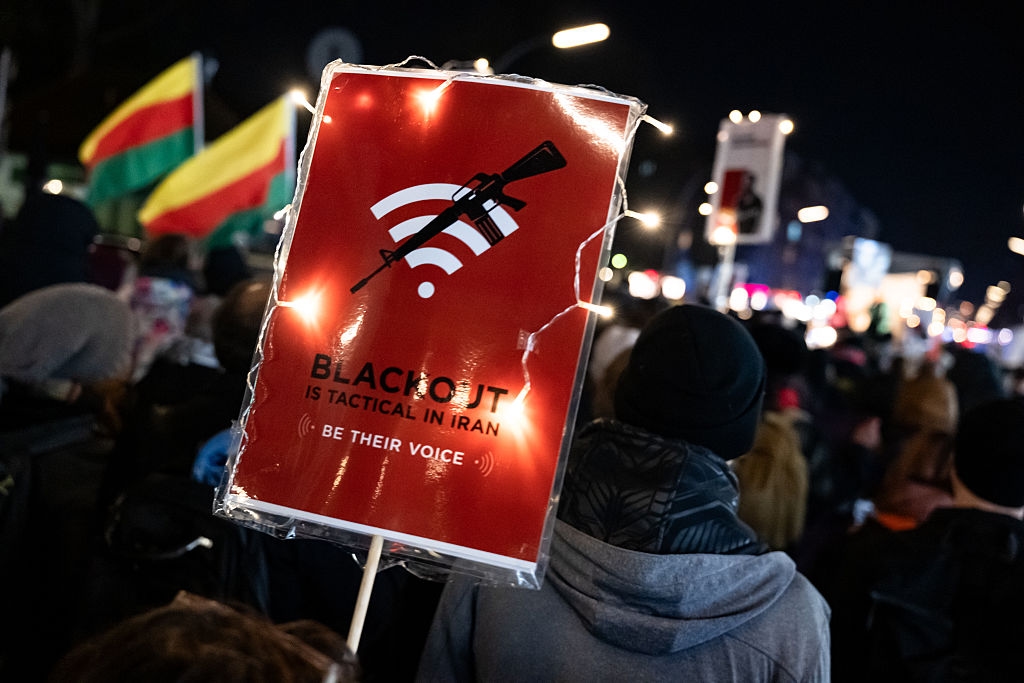
After a 20-day internet shutdown, Iranian authorities are gradually restoring access to the web, albeit under restrictive measures that include “whitelists” and mandatory user identification. Officials in Moscow appear to be using the Iranian experience as a case study, with the State Duma passing the first reading of a bill that would allow for complete internet shutdowns in Russia. However, Iranian citizens have found several ways to circumvent the restrictions — experience that could prove useful to ordinary Russians in the future.
The recent wave of widespread protests in Iran began on Dec. 28, and internet restrictions were rolled out on Jan. 8. At 3:20 p.m. local time, Iranian internet traffic almost instantly dropped by 98.5%, according to the Filter.Watch team, which specializes in monitoring internet censorship in the country.
Developers of the Amnezia VPN anti-censorship service, who have been operating on the Iranian market for more than three years, cited similar figures to The Insider:
“Before the January restrictions, we had nearly 90,000 daily users. During the Iranian shutdowns, we saw fewer than 100 connections. The scale of the outages was enormous. Apparently, it was a combination of measures: DPI in operation plus subnet blocking; it’s also possible that switches were physically shut down. As we understand it, during the protests Iran’s access to the global internet was cut off at traffic exchange points, after which the blockage was extended to Iranian data centers as well.”
By Jan. 28, traffic had recovered to 25% of its previous level, largely due to the addition of several websites and services to the government’s so-called “whitelist.” Still, “most of the global internet is still unavailable to the general public,” Filter.Watch notes.
The “unfreezing” of the internet in Iran took place gradually. On Jan. 23, the state news agency Fars announced that restrictions had been lifted in Isfahan and Fars provinces. On Jan. 25, special exemptions were introduced for traders, allowing them to go online for 20 minutes a day at the offices of the Iran Chamber of Commerce (albeit under supervision). The measure was necessitated by the scale of the daily economic damage caused by the shutdown, which the Iran-China Chamber of Commerce estimated to range from $18 million to $27 million.
On Jan. 26, Iranian authorities unblocked Google. According to Filter.Watch, the so-called “whitelist” of websites also included the Chinese search engine Bing, as well as several email and other services. The rest of the global internet remains blocked.
Is it true Starlink was jammed?
Iranians' only source of uncensored communication with the wider world has come via Starlink terminals. According to The Guardian, the number of such devices in Iran is around 50,000, while other estimates put it as high as 100,000. All of them have been smuggled in, as the government has criminalized importing and possessing satellite communications terminals. Activists began supplying Starlink equipment to Iran amid the 2022 protests.
Shukriya Bradost, a Kurdish-Iranian activist who has lived in the U.S. since 2016, told Bari Weiss’s Free Press channel how it happened. “When the ‘Woman, Life, Freedom’ uprising happened in 2022, we were sending humanitarian assistance, mostly medical supplies — what you need to treat injured people. We had to smuggle aid into the country… Then we had a request for Starlink. People would reach out and say, ‘Ok, we had a successful operation. Now we need Starlink because we need to have this connection to send the people’s voice out of Iran. The world needs to see and hear what’s going on inside.’”
Americans purchased the terminals and sent them to Bradost, who then organized their delivery to Iran by the hundreds.

Amid the current shutdowns, reports of Starlink disruptions spread quickly. Filter.Watch reported 10–40% packet loss rates when connecting to satellites in certain areas of the country. There were also reports of “jammers” being used. Unverified media reports suggested that the Iranian regime is employing Russian and Chinese military technology to combat Starlink, but experts interviewed by The Insider were skeptical of such claims.
There has been no confirmation from Starlink that the terminals were successfully jammed, according to an anonymous satellite communications specialist who helped prepare this piece: “Normally, the company reports such restrictions and the measures taken to bypass them in a timely fashion. This time, nothing of the sort happened. In reality, we don’t know how many Starlink terminals are in Iran or what proportion of them are operational. We also don’t know their bandwidth capacity. Elon Musk made the service free for Iranians, but free plans often operate at lower speeds. In any case, jamming Starlink is very difficult from a technical standpoint.”
There is no reliable information on the number of Starlink terminals in Iran or the proportion of operational kits
A study on the topic commissioned by Chinese intelligence agencies explored the feasibility of jamming Starlink over Taiwan. Modeling showed that such an operation would require about a thousand drones — or balloons equipped with special gear — hovering constantly in the air several kilometers apart. These would need to be plugged into a source of continuous power supply, and there is currently no evidence that anything like this has been successfully attempted.
Why is it so difficult to jam the internet provided by Elon Musk’s company? In short, there is a fundamental difference between Starlink and traditional satellite communications. In older systems, satellites are positioned far away in geostationary orbit. As a result, the signal is weak and easily catches interference, sometimes even from clouds. Communication requires a parabolic dish aimed directly at the satellite.
By contrast, Starlink satellites are in constant motion. The terminal’s antenna is phased-array — essentially a set of small antennas on a single substrate, allowing one terminal to communicate with multiple satellites simultaneously. If interference occurs, Starlink simply switches to another satellite.
This is why blocking Starlink is so difficult: instead of jamming the signal toward a single satellite, would-be censors have to “cover” the entire sky with interference (which is why, in the case of Taiwan, the model estimated the need for around a thousand jammers).
Mikhail Klimaryov of the Internet Protection Society is also adamant that efforts to block Starlink are unlikely to succeed, as proven by similar attempts during the war in Ukraine: “Combat experience shows that jamming the terminal’s receiving function is very difficult and energy‑intensive. Instead, the Russians use spoofing — that is, GPS signal substitution. The dish has to be aimed very precisely at the satellite, and it uses GPS for precision. At the frontline, spoofing is countered by placing the terminal in a Faraday cage — a simple device that can be made from chain‑link mesh.”
According to an online manual attributed to the Armed Forces of Ukraine, the most effective ways to shield Starlink terminals from enemy electronic warfare (EW) interference involves either placing them at the bottom of a pit, or surrounding them with a makeshift Faraday cage made of steel mesh with a cell size of 2 to 6 centimeters. The structure should be about 120 centimeters high and 110–120 centimeters in circumference, with the mesh wrapped in three to four layers. Crucially, the authors warn against covering the terminals from above.

An accurate GPS signal is critically important for the terminal’s initial activation. For this reason, fighters are strongly advised to power up the device for the first time far from the combat zone. After that, the terminal can locate a satellite even under active electronic warfare exposure (though such conditions mean it will take longer to come online, and signal quality may be poorer).
As The Insider's source explains, Starlink satellites feature a built-in positioning system that is used for orienting the terminal if the GPS signal is jammed or distorted. For now, Starlink cannot operate without GPS because the satellites do not, as of now, have atomic clocks on board.
Targeted communications repression
Mikhail Klimaryov believes that Starlink was most likely suppressed in Iran by repressive measures rather than EW tools: “Even possessing a terminal can get you two years in an Iranian prison. If you’re caught sending videos, it can be treated as espionage — punishable by death.”
Bradost confirms that assessment: “And they have passed laws that clearly say, if you send footage, any kind of data, or videos to foreign networks, especially ones that are against the regime in Iran, your punishment is death.”
Still, tracking an active Starlink terminal is extremely difficult, as it can only be located from the air using specialized equipment, Klimaryov notes. A space industry expert agrees, adding that pinpointing a terminal would require a drone or an aircraft, and even then the accuracy would be low. The bigger issue is that Starlink is easy to identify visually. The terminal’s dish — a white rectangle roughly the size of a sheet of paper — cannot be camouflaged from above, as it would immediately degrade the signal.
In theory, the dish can be disguised with plastic mesh or hidden under tinted glass, the expert says: “Many drivers use mobile Starlink terminals running on a power bank. They’re smaller and are placed under a car’s rear window. If I were one of the protesters, I’d try to drive to a remote area without surveillance drones and go online from there.”
A friends-only network
Of course, the internet is useful for more than just communication with the outside world. Modern protests are almost always coordinated via messaging apps, and Starlink does not enable large masses of potential demonstrators to coordinate their actions the same way access to mobile internet data does. The alternative is to use mesh networks — a technology allowing multiple users to create their own local “internet,” with each device acting as a relay. Chat apps have been developed specifically for such networks.
This kind of technology has applications that go beyond public protests. A chat group can be quickly set up during search-and-rescue operations in a forested area or at a rural festival, for example.
The most popular projects in this field are Meshtastic and Reticulum. However, these require special transmitters that must be assembled or purchased, which is extremely difficult to do amid an uprising or a shutdown. That is why the Iranian opposition turned to another solution: Bluetooth-based mesh networks that employ ordinary mobile phones as nodes.

In the summer of 2025, Twitter co‑founder Jack Dorsey launched the Bitchat app for encrypted data exchange over a Bluetooth network. Phones connect to one another within a range of 30 meters — enough to deploy a fully functional network in a large city.
Dorsey’s app was used by protesters in Nepal and Madagascar. In January, demand for Bitchat surged due to shutdowns in Iran and Uganda, where authorities cut internet access ahead of disputed presidential elections. In the Iranian case, the number of users of the app tripled. Statistics show that on the first day of shutdowns in Iran, 43,000 users downloaded Bitchat, with weekly growth numbers reaching 438,000 downloads in January.
Bitchat is not the only option. Iranian exiled opposition figures have launched a similar app, Noghteha, which operates in Farsi. Cyber‑activist Nariman Gharib announced the launch, promising users “ an enhanced interface, and more features optimized for the needs of protesters.”
The messenger’s name translates from Persian as “dots” — a reference to the communication nodes formed by its users. Noghteha has been downloaded more than 50,000 times on Google Play alone and is also available through the app’s official website.
Whitelist-based internet access
Internet access in Iran is gradually being restored, but neither Starlink nor mesh networks have lost their relevance. Filter.Watch notes that access varies by region, and that all service providers are limited to a “whitelist” of foreign websites and services. In addition to Google and Bing, the list includes Google Meet, Gmail, Outlook, Play Store, App Store, the Apple and Samsung websites, as well as PlayStation, Google Maps, GitHub, and ChatGPT. Instagram, Telegram, YouTube, and X remain blocked. Moreover, access has been restricted for WhatsApp and LinkedIn, which had not been under a ban.
Iran has “whitelisted” services such as PlayStation and ChatGPT
The implementation of an online “whitelist” is seen by Filter.Watch as an attempt to save the digital economy, which employs one in nine Iranians. However, the regime has no intention of returning society to a free internet. Access to the web is now comparable to clearance for classified information: granted to select users only, and only with official registration. However, on Jan. 27, some VPNs partially resumed operation in Iran.
According to the developers of Amnezia VPN, under the shutdown and “whitelist” conditions ordinary anti-censorship services will not work. “The Iranian authorities are set on launching their own ‘sovereign internet,’ isolated from the global network, except for a selection of services operating within the country,” they say. “If Iran fully embraces this model, VPNs will be mostly useless. In this sense, the situation in Iran and Russia is exactly the same — the only difference is how far their authorities are willing to go in separating from the global internet.”
Russia has also taken another step in this direction. On Jan. 27, a bill that would require providers to suspend communication services (from internet access to phone calls) at the request of the Federal Security Service (FSB) passed its first reading in the State Duma. Officially, this mechanism would be applied in the event of “security threats,” but the vague language gives security forces wide discretion.

As Klimaryov explains, due to Russia’s much more extensive and advanced network infrastructure, cutting the country off from cyberspace is far more challenging than isolating Iran, where state-owned company TIC has been responsible for all communications services since 1989, with exclusive rights to cross-border traffic. “Belarus has two operators. Kazakhstan has five. Meanwhile, Russia has more than twenty. According to open data alone, around 40 Russian cables run abroad,”Klimaryov says. “Finding a cable and disconnecting it without the operator’s consent is no easy task. That’s exactly why the government is setting up registries and legal mechanisms.”
In the meantime, Russia is rapidly expanding its own “whitelist,” which includes government websites, Russian social networks, and a wide range of consumer services — from grocery stores to entertainment portals, and from fast-food chains to Orthodox Christian TV channels.
Amnezia VPN developers believe that in the event of mass protests in Russia, the internet will not fully shut down, but all unauthorized services and websites will be blocked: “The case of Belarus, where ‘whitelists’ are implemented during protests, is much closer to Russia's current situation. However, the Iranian scenario cannot be ruled out. In the event of a total shutdown, the only way to bypass restrictions is through unblocked cross-border communication channels, such as satellite internet and mesh networks. Everything else simply won’t work.”
From phone to satellite
However, technological advances offer hope. During the recent Iranian protests Starlink was just about the only communication channel available to demonstrators, but in the coming years this market is expected to become more competitive. In 2025 Amazon conducted seven launches carrying 28–29 communications satellites each. Commercial operation on its alternative service has not yet begun, but according to a space expert speaking to The Insider, the company will eventually deploy 3,236 satellites — “fewer than Starlink, but the satellites themselves are more powerful.” However, the expert adds, due to Amazon’s status as a public company, it’s not certain that it will follow Starlink’s example and flagrantly break national laws to provide access for protesters.”
From a technical perspective, nothing prevents the company from activating satellite internet for Russians right now. However, a map on Starlink’s website currently shows only one satellite over St. Petersburg and three over Moscow — compared to several dozen over Iran. In a sparsely populated area, a single satellite is enough for reliable connectivity, but if thousands of people in a major city tried to go online simultaneously, the available infrastructure would be insufficient.
From a technical perspective, nothing prevents Starlink from activating satellite internet for Russians right now
Finally, OneWeb, the European Starlink competitor, is resuming development. The provider has not launched any new satellites since 2023, and the current OneWeb constellation has only about 600 active satellites, but in December 2024 the network operator Eutelsat ordered the production of 100 additional satellites, and in early 2026 it added another 340. These satellites are scheduled to be launched into orbit by the end of the year.
OneWeb terminals are significantly more expensive than Starlink’s and are produced in much smaller quantities. However, the company has found a new market in Kazakhstan, where internet access via European satellites has become part of a national project aimed at connecting remote villages to the global network. Starlink is also active in the Kazakh market, preparing a joint launch of satellite mobile communications with the Ministry of Artificial Intelligence and Digital Development, along with telecom operator Beeline.

The project intends to use ordinary mobile phones for receiving the signal directly from satellites via DTC (Direct-to-Cell) technology — unlike communication with traditional high-orbit satellites, which requires powerful antennas, those for Starlink, Amazon, and OneWeb operate in low orbit. Even now, a modern phone can connect to them to send SMS messages and make emergency calls.
This year, SMS connectivity will be enabled across the entire territory of Kazakhstan, even in areas without mobile towers, with full internet service set to be introduced later. A similar Starlink-based project has been announced in Ukraine by Kyivstar.
At the current stage, such a communication channel has very low bandwidth, but manufacturers are updating phone modems, and internet support via Starlink may be introduced in the iPhone 18 Pro. There are also plans to strengthen the satellite signal. SpaceX is preparing a test launch of new, enhanced V3 satellites in March. By the end of 2026, deployment in orbit will begin to gradually replace the entire existing constellation.
Over the next five years, DTC is expected to become a standard communication technology. And once a terminal for connecting to satellite internet fits in every citizen’s pocket, it will become much harder for governments to restrict access to the network.