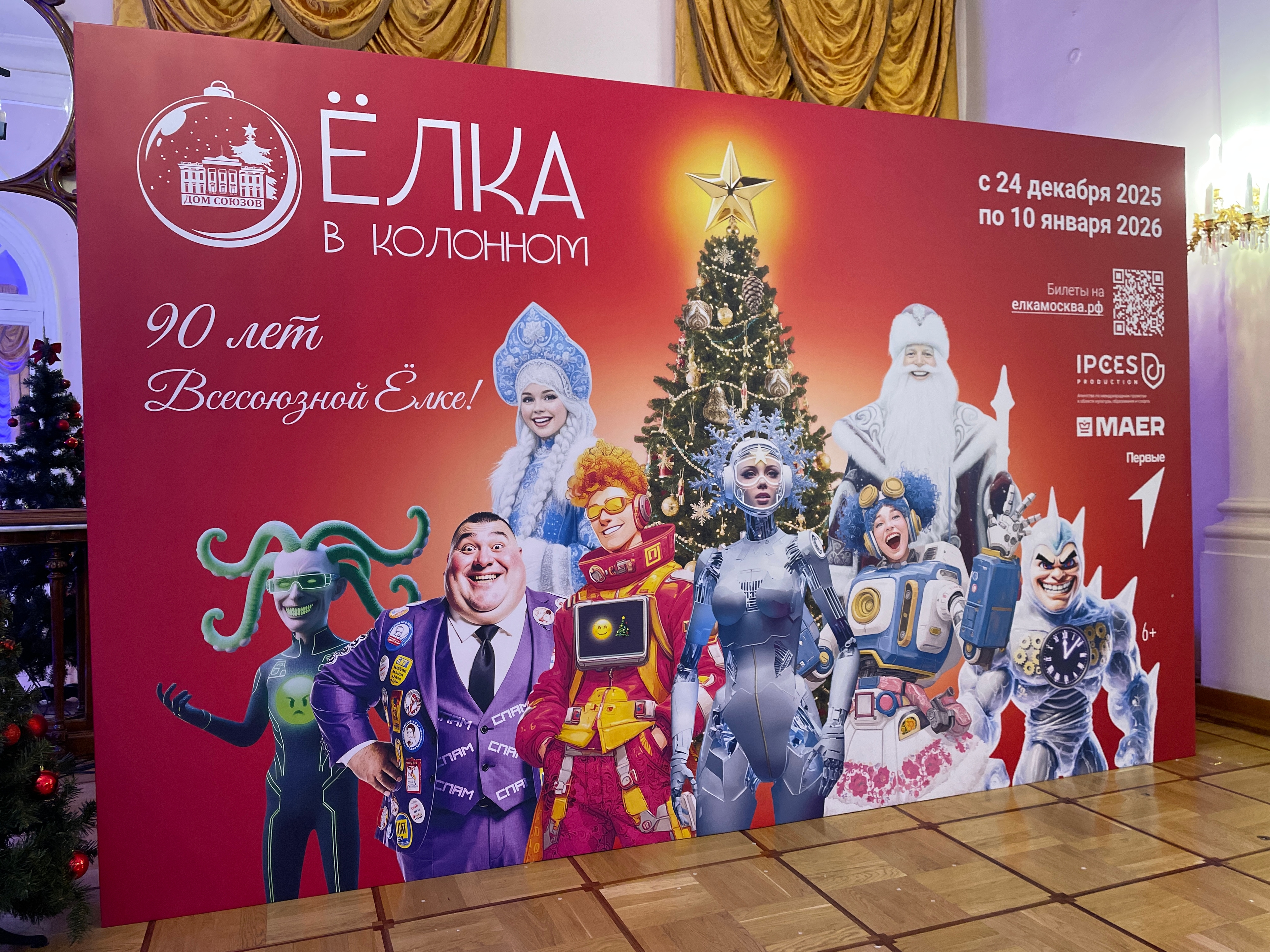
Over the holidays, one of the main state venues in Moscow hosted an anniversary performance — the 90th New Year Show at the House of the Unions. The organizers claimed they had “modernized” the classic performance by adding elements involving artificial intelligence and robots. However, the main focus of the show was not innovation, but demonstrative patriotism, “traditional values,” conventional gender roles, and nostalgia for the USSR.
The Insider attended one of the shows and found that, under the guise of a children’s fairy tale, the audience — mostly children — was offered a set of straightforward political and ideological messages.
AI in the Kremlin's Spasskaya Tower and “snow over Donetsk”
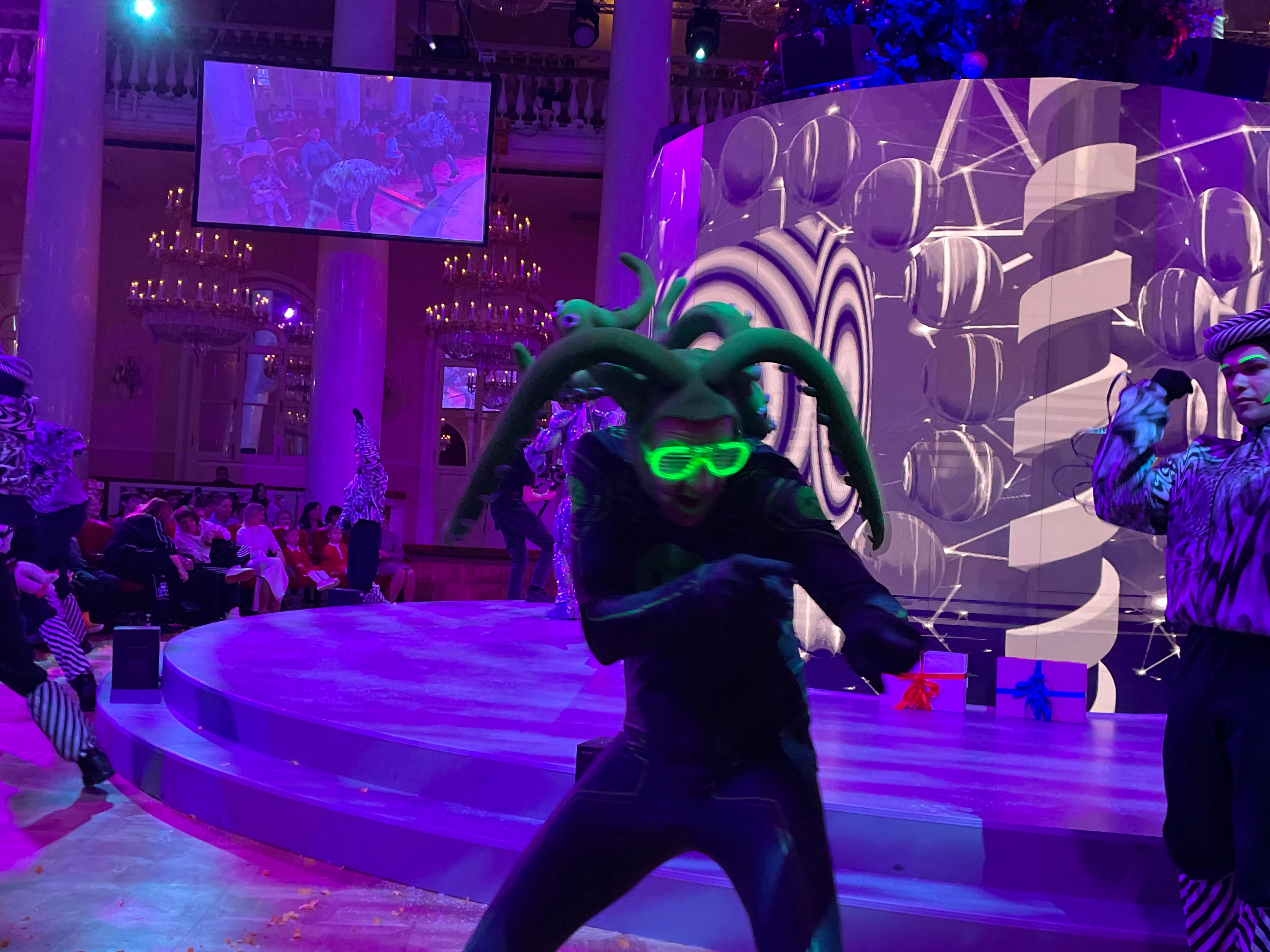
The show itself begins with a scene set in the Kremlin, where, the actors explain, an artificial intelligence tool named Zvezdochka ('Little Star') lives in the Spasskaya Tower. Zvezdochka and her team of robots are responsible for preparing the festivities and putting together gifts for children. However, their work is complicated by a collection of digital pests named Sboy ('Malfunction'), Spam, and Shklop ('Collapse'), who appear as the result of system failures and “feed on human joy.” One of the villains is dressed in an outfit that resembles the coronavirus genome, while another wears black glasses and a jacket, looking more like a standard mobster. In any case, distinguishing between the three digital pests was tricky, as they were given very little stage time.
However, the theme of cybersecurity quickly takes a back seat as one of the first musical acts sets the tone of the show. To a solemn song styled after Soviet New Year compositions, snowy landscapes are shown on the screen behind the stage: Moscow, Kamchatka, and most notably, Russian-occupied Donetsk. In the lyrics, Donetsk is mentioned alongside other Russian regions, and the snow over it, as explained, “falls by children’s prayers.” The Donetsk Theater of Opera and Ballet also makes a brief appearance, to which the audience responds with enthusiastic applause. Other occupied territories — Luhansk, Zaporizhzhia, and Kherson regions, as well as Crimea — are not featured in the video sequence.
Ethnically appropriate Ded Moroz
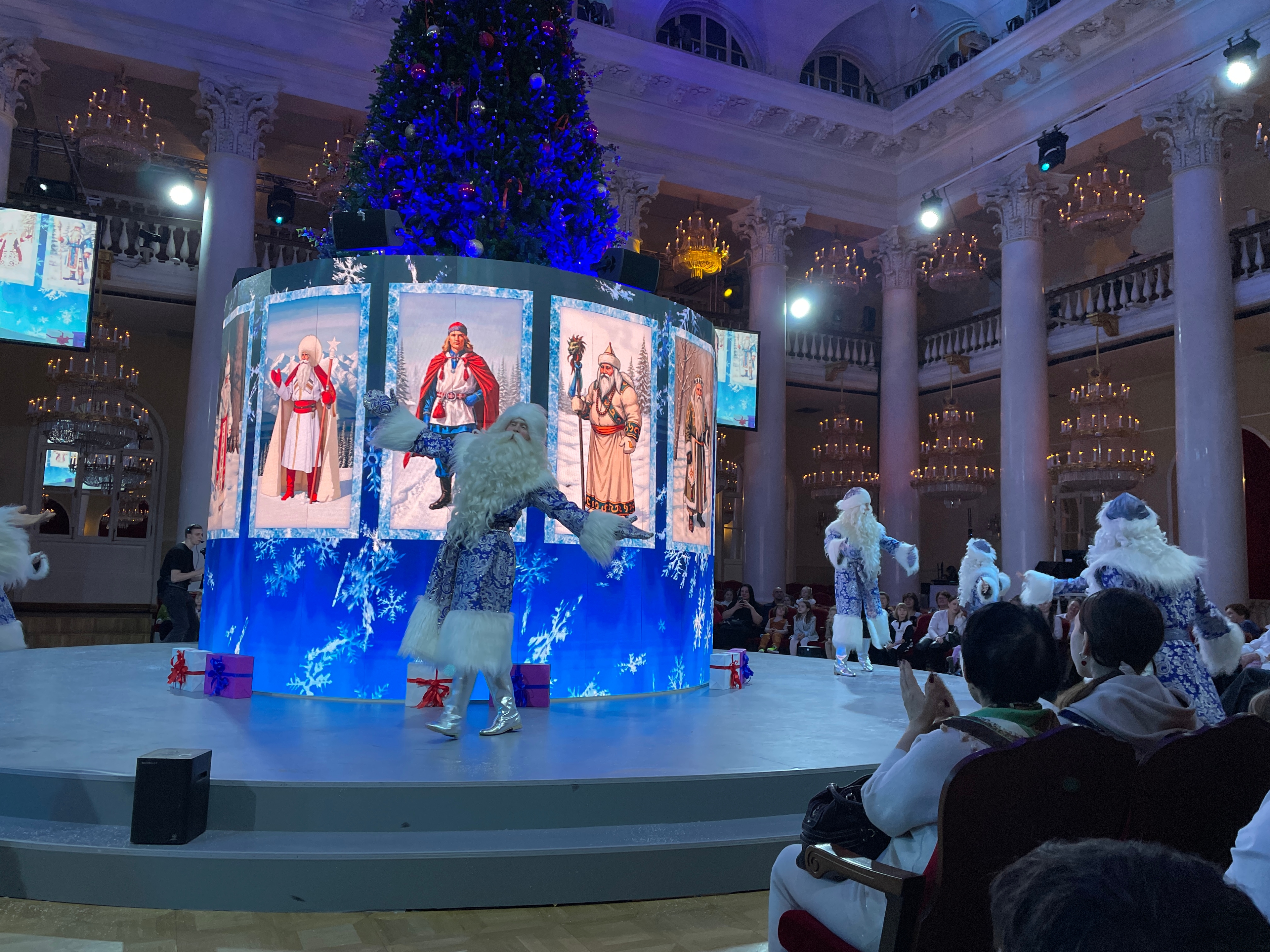
One of the central themes of the performance is the ethnic identity of Ded Moroz — the Soviet (and later Russian) equivalent of Santa Claus. The audience is told that Russia has many Ded Morozes — “almost as many as the peoples of our great Motherland,” and that each of them has ethnic characteristics: Yakut, Karelian, and Tatar, among others. At the same time, it is emphasized all of the variations on the fictional character are specifically “Russian, not Western.”
In particular, the performers announce that the Ded Moroz from Kabardino-Balkaria “wears a burka and a papakha instead of a coat and hat, and instead of a staff, he carries a real dagger.” A dozen actors dressed in Ded Moroz costumes lip-sync a cheerful song:
“I'm no old Santa Claus,
No blackbird singing in the frost,
Nor cartoonish Mickey Mouse —
I am Russian Ded Moroz.”
Why the authors of the script decided to emphasize the character's appurtenance to ethnic Russians rather than present him as a magical being that brings together all of Russia’s diverse ethnicities is not explained in the performance. However, the audience seems unperturbed: spectators actively record what is happening on iPhones and other foreign gadgets.
Gender roles and “traditional values”
The performance places a special emphasis on a strict division of male and female roles. In one scene, Snegurochka (another Russian New Year character, typically presented as Ded Moroz’s granddaughter) with blue braids, dressed in neon-pink tights, uses up all her magical powers and transforms into a character named Ulybochka (‘Little Smile’). Without Snegurochka, the characters explain, the New Year cannot arrive.
One of the characters, named Poteschnik — a jester created by a neural network — steps forward as a stand-in for Snegurochka. Immediately, an ominous voiceover resonates through the hall:
“Remember, children! In the Russian Federation, only a woman can be Snegurochka, and only a man can be Ded Moroz.”
This line elicits the longest and loudest applause of the entire celebration.
Back to the USSR
In one of the episodes, the audience is shown archival footage of New Year shows at the House of the Unions from the 1930s: a huge tree, massive decorations, and children dressed as Red Army soldiers. After this, the characters ask, “How can we save the New Year?” A suggestion is offered almost immediately: “Should we reunite all fifteen Soviet republics?”
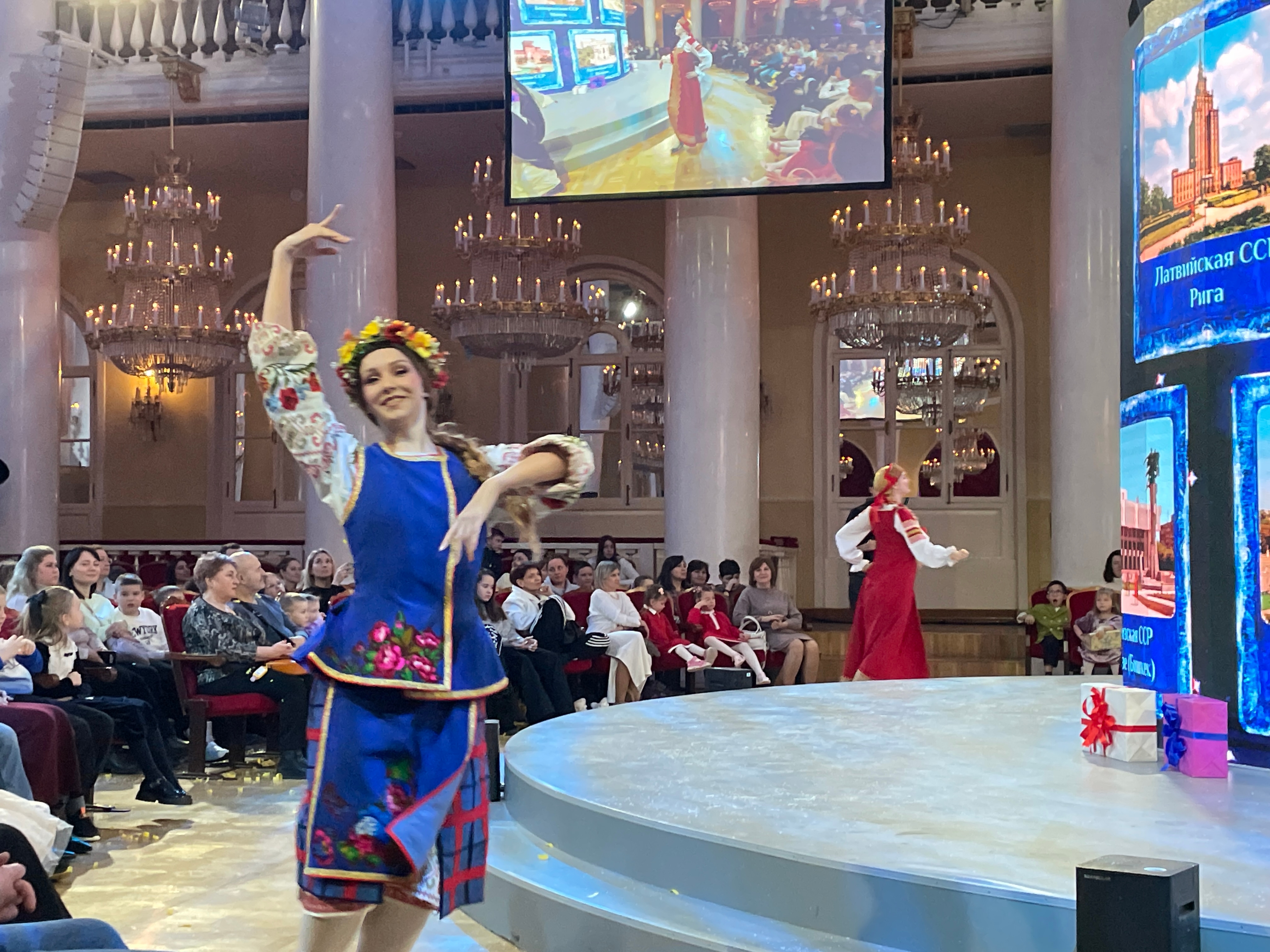
On stage, a parade of “republics” begins — girls in national costumes come out one by one and dance. The audience greets each “republic” with applause — including the Ukrainian one. The girl playing this role raises her hands, looking at a photo of one of Kyiv’s main streets — Khreshchatyk — in the background.
At the end of the sequence, the characters reject the idea of restoring the USSR “right now,” leaving it “for another time.” This line sparks a new wave of excitement in the audience.
Ticket prices and audience
Security at the show is provided by the Federal Protective Service (FSO), the same force that provides personal protection to Putin himself. At the entrance, adults and children alike must show the original IDs used to purchase their tickets. Ticket prices range from 3,000 to 15,000 rubles ($40-$190).
Another 5,000 rubles ($63) will get you a gift from Ded Moroz — a bag of candy and a “collector’s Christmas tree ornament” inscribed with “New Year Show at the House of the Unions — 90 Years.” No free gifts are provided, not even for the children of participants in the “special military operation” in Ukraine.
The event is organized by Russia’s Agency for International Projects in Culture, Education, and Sports. The announcer separately thanks the Office of the President of the Russian Federation and the Presidential Administration.
A tradition-disrupting horse
The symbol of 2026 in the Eastern calendar — the Red Fire Horse — is absent from the New Year tree decorations, the script, and the gifts. According to an actor dressed as a snowflake, the theme of the Eastern horoscope was deemed to run “contrary to traditions.”
Nevertheless, the lobby of the House of the Unions is decorated with children’s drawings and crafts that prominently feature horses — mainly red ones. The only notable exception is a snowflake decorated with rhinestones in the colors of the Russian flag. Almost every visitor takes a photo of it.
Wrapping up with a “bright victory”
At the end of the show, the characters declare that to save the holiday, it is necessary to wait for the arrival of the Russian Ded Moroz. The final song of the performance includes the line: “May a bright victory bring us festivity and joy.” To this, Ded Moroz, the polar bears, and the robots exit the stage. By this point, the artificial intelligence, digital pests, and neural networks have completely dissolved into the patriotic chorus. At the exit, FSO officers see guests off, ensuring that no one takes additional photos of the Christmas tree after the performance once their tickets have already been used.